
Committee hears proposal to create tax credit for bottle-bill distributors to offset operating costs
Get AI-powered insights, summaries, and transcripts
Subscribe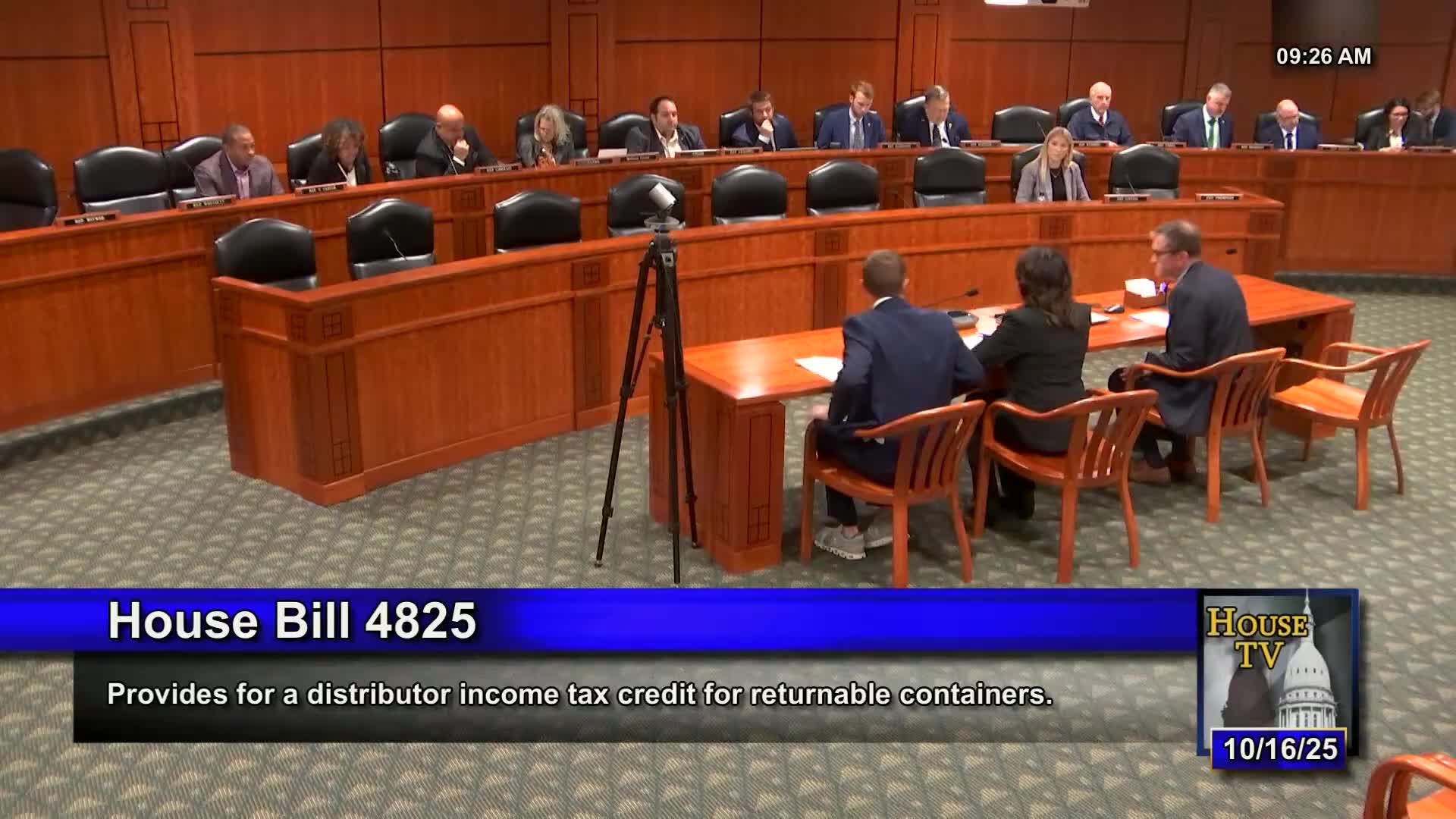
Summary
Representative Whitworth and industry witnesses urged the committee to create a half-cent-per-container income tax credit (House Bill 48 25) for distributors who manage collection, transport, and recycling of returnable beverage containers, citing rising operating and capital costs and uneven historical reimbursement.
The committee heard testimony on House Bill 48 25, a proposal to create individual and corporate income tax credits for distributors that originate deposits on beverage containers to offset the costs of operating Michigan’s bottle-deposit system.
Representative Whitworth framed the proposal as compensation for distributors who pick up, transport, clean, process and recycle returnable containers after they are returned to stores. Brett Visner of the Michigan Beer and Wine Wholesalers Association told the committee distributors handle roughly 70% of containers processed through the statewide system and that distributors collectively spend more than $60 million a year operating the program, a figure he said predates pandemic-related cost increases. Visner described capital investments—warehouse space, crushing and sorting equipment, and new facilities—that distributors fund to process returned containers.
Derek Badgemau of the Michigan Beverage Association and other witnesses said the original bottle-bill structure directed unclaimed deposits (the unreturned 10-cent deposits) to distributors until legislative changes shifted most of those funds to the Michigan Department of Environment, Great Lakes, and Energy (EGLE) and to retailers. Witnesses said the change in 1989 reduced distributor reimbursement and that prior tax credits under the Michigan business tax (pre-2011) had partially offset costs.
The bill would provide a half-cent tax credit per container, which witnesses estimated would amount to roughly $20 million annually statewide and would cover a portion (about one-third by their estimate) of present-day operating costs. Witnesses said the $60 million figure likely understates current costs because it was estimated before inflation and pandemic supply-chain impacts. Committee members asked about where unclaimed deposits currently flow, how returned containers that are not accepted by return-vending machines are handled, and how proceeds from nonreturned deposits are used by EGLE. Witnesses said that exact downstream flows and uses involve state budget decisions and EGLE allocations and that traceability outside the collection system is limited.
No committee vote was recorded on HB 48 25 in this hearing; the bill received testimony and multiple stakeholders listed their support in the hearing record.
Ending: Committee took testimony and listed supporters; no committee action was recorded at this session.