Get Full Government Meeting Transcripts, Videos, & Alerts Forever!
Get email alerts on the Municipal Budget topic
No spam. Unsubscribe anytime.
Madison council reviews draft 2026 budget, debates staffing, nonprofit cuts and infrastructure spending
Summary
Council members and staff reviewed the draft 2026 budget in a workshop, discussing unfilled positions, requests for professional services and building security, proposed increases to animal shelter and Main Street funding, and a $10,000 appropriation request from opioid settlement funds for a jail chemical-addiction pilot program.
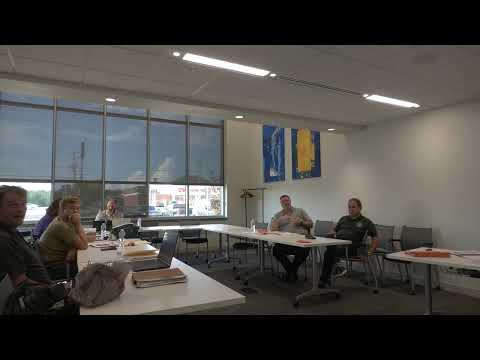
Madison City Council members and staff reviewed the draft 2026 budget in a workshop meeting, debating whether to hold spending steady amid revenue uncertainty and where to prioritize limited funds.
Council members pressed staff on personnel changes, a proposed increase in professional services, and specific line items for nonprofit support, building security and infrastructure. Staff described offsets created by shifting some costs into other budgets and said several positions shown in the draft will not be filled in 2026.
The budget narrative drew multiple questions about staffing. One councilmember (Speaker 1) said the draft “includes 8 plus positions,” and another councilmember (Speaker 3) told colleagues, “I think increasing our budget is not probably the right thing, not knowing what we're going into.” Staff clarified that some jobs — including planning positions and police vacancies — were combined or left vacant; they also said moving an operations person from NPD would free funds to hire a fire chief.
City staff (Speaker 5) described professional-services dollars as “soft costs” used to pay for engineering and outside advice on projects that do not have grant reimbursement. To build a cushion, staff proposed a modest increase in the professional-services line; one councilmember suggested trimming it from $25,000 to $20,000 if required.
On building and facility needs, staff said $8,000 is earmarked for security work at City Hall after an active‑shooter training flagged vulnerabilities. Staff declined to discuss detailed security measures on the record but confirmed the line is intended for access control and camera work.
Council members reviewed a range of nonprofit appropriations. Springdale Cemetery was singled out because its bylaws contain a reversion clause that could require the city to assume control if the nonprofit dissolves; staff noted the city already provides premises and some income support. Council members debated whether to reduce nonprofit contributions across the board or apply percentage cuts; staff said overall nonprofit funding is roughly half what it was four years ago and that the city has been more targeted in awards (youth programs, seniors, veterans, parks).
Staff outlined a $10,000 proposed increase to the city’s contribution for the animal shelter, tied to a draft interlocal agreement with Jefferson County. That increase, staff said, is contingent on finalizing a new interlocal agreement and would only occur if the council and county approve the agreement.
On opioid settlement funds, staff asked the council to appropriate $10,000 to support a three‑year jail chemical‑addiction pilot program launched with Jefferson County and Bethany Legacy Foundation. Staff said 2025 has already been funded and requested the $10,000 appropriation from unrestricted opioid settlement monies so the city would not need an additional appropriation next year; no formal vote on that appropriation was recorded in the workshop.
Councilmembers and staff also discussed technical and equipment shortcomings: remote‑meeting audio/video problems, aging cameras at riverfront and bicentennial park facilities, and a range of options from inexpensive USB webcams to more expensive 360‑degree “owl” systems. Staff proposed trying lower‑cost upgrades first and leaving larger improvements as a later step.
On economic and tourism spending, the council agreed to reallocate Main Street and tourism dollars to increase support for downtown promotion and infrastructure planning. The workshop participants agreed to move Main Street support to the food‑and‑beverage/tourism line and to increase the tourism/Main Street allocation to $75,000 while setting aside $50,000 of that amount to continue supporting the Main Street organization; councilmembers said the remaining $25,000 would be used for broader corridor planning and tourism development.
Council members asked to reserve a small amount — suggested $5,000 to $10,000 — for immediate maintenance at John Paul Park while a nonprofit fundraising effort develops a multi‑phase plan for longer‑term improvements. Staff said private fundraising and grants are expected to cover major capital work, while a small city maintenance appropriation would cover short‑term needs such as mowing and field repair.
Throughout the workshop staff advised consolidation of very small appropriation line items (many under $1,500) to reduce administrative burden when processing transfers and payments. Staff said some funds (rotary/airport, campgrounds, food & beverage) function as cash‑flow accounts and that appropriation timing and state gateway reporting rules affect how and when those dollars can be used.
The meeting produced several budget allocations and proposals that staff said would be placed in the formal budget notice and later public hearing materials; the workshop did not record final council votes on the individual appropriations. Staff said next steps are to prepare the notice to taxpayers and schedule the public hearing on the proposed 2026 budget.
End note: Councilmembers asked staff to return with more detail about proposed nonprofit cuts, the interlocal agreement terms for the animal shelter and the schedule for Main Street project funding so members could consider final appropriations at future meetings.