
Minneapolis committee approves ordinance to require council review of highest-risk rental license renewals
Get AI-powered insights, summaries, and transcripts
Subscribe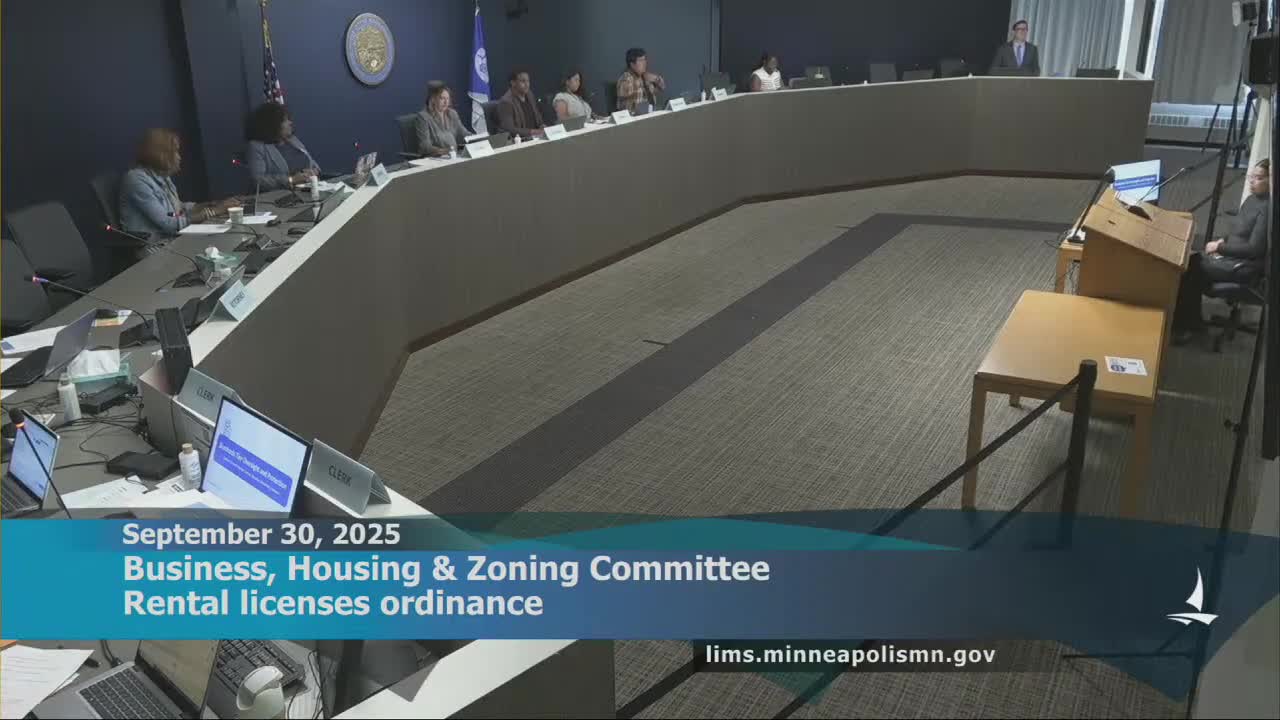
Summary
The Business, Housing and Zoning Committee voted to advance an ordinance that would require City Council review of renewals for high-risk (Tier 3) rental licenses, add oversight options including conditional renewals and provisional licenses, and set an effective date of Jan. 1, 2027.
The Business, Housing and Zoning Committee on Sept. 30 advanced an ordinance that would require the City Council to review renewal applications for rental licenses the city designates as high-risk (Tier 3), a category staff and council members said reflects repeated or serious housing-code violations. Chair Jamaal Osman and co-authors described the measure as adding oversight and new enforcement pathways while preserving appeals and options short of immediate eviction.
The ordinance matters because Minneapolis is a renter-majority city and committee members and dozens of public commenters said current enforcement has not stopped substandard housing in some properties. Committee members said the change creates a process similar to other license reviews — including options for conditional renewals, provisional licenses and appeals — and gives residents, council members and staff a public forum when persistent violations recur.
During a presentation, Osman said the change targets a small number of the city’s rental portfolio: the regulatory services director’s tiering system identifies about 160 Tier 3 licenses covering roughly 2,260 units. Co-author Council Member Charlie Cashman told the committee renewals for properties in that Tier 3 category would be brought before the council to allow oversight like that applied to liquor and gambling licenses. Co-author Council Member Chowdhury said the point system that places a property in Tier 3 uses a two-year lookback and can include life-safety violations such as condemnations.
Public commenters included tenants, tenant organizers, student-government representatives and housing advocates. Several tenants described mold, infestations, nonfunctional heat and other long-running problems despite 311 complaints and prior city citations. Twin Cities Housing Alliance Executive Director Kathy Bennett and the Minnesota Multi Housing Association’s president and CEO both testified but reached different conclusions: Bennett urged alternatives that strengthen staff capacity and anonymous resident reporting because of potential displacement risks; the housing association warned the ordinance could strain staff and complicate due process. Tenant advocates and attorneys argued the ordinance targets a small share of units and produces necessary leverage to compel repairs.
Committee members asked about implementation and fiscal impacts. Co-authors and supportive members said the ordinance was intentionally delayed for implementation until Jan. 1, 2027, to allow two budget cycles for possible staff capacity and fee adjustments. They also said tenant relocation assistance and a tenant-relocation fund exist to support renters if a license revocation leads to relocation; staff was asked to provide additional details on that program and funding. Opponents raised the potential for unintended displacement and urged investing in Regulatory Services rather than elevating casework to the council.
The committee approved the ordinance by roll call: Council Member Vitale voted no; Council Members Cashman, Jenkins, Chavez, Vice Chair Chowdhury and Chair Osman voted yes. The committee vote was recorded as five ayes and one no. The ordinance will go to the full City Council for further action and, if adopted as written, would take effect Jan. 1, 2027. The ordinance text preserves an appeals process and describes a range of staff recommendations that could include approval with conditions, provisional licensing, suspension or, as a last resort, revocation. Committee members said staff will return with follow-up budget and implementation details, and that the committee intends to coordinate with Regulatory Services and the administration on operational needs.