Get Full Government Meeting Transcripts, Videos, & Alerts Forever!
Get email alerts on the Treatment Court topic
No spam. Unsubscribe anytime.
Dunn County treatment court shifts toward behavioral-change model, adds peer support and law-enforcement mentor pilot
Summary
Treatment court coordinator Kayla Johnson described a year of changes: a peer-support liaison funded by a 2025 TAD enhancement grant, a move from compliance-focused phases toward behavioral-change milestones, a planned law-enforcement/treatment-court mentor program, and steady participant engagement with about 85% using peer support.
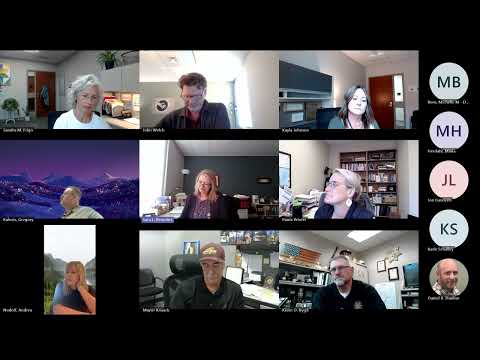
Kayla Johnson, treatment court coordinator, presented an update on Dunn County’s adult treatment court, which she said she has coordinated for about a year. Johnson described the court as a largely voluntary, intensive alternative to traditional sentencing or revocation for people with substance-use disorders; participants who agree to enroll are later required to follow program conditions.
Johnson said treatment court began in Dunn County in 2008 and that all current judges and previous judges have supported the program. Eligibility, she said, generally requires participants to be at least 18, be Dunn County residents (to allow close coordination with probation), have felony drug- or alcohol-related charges or be part of an ATR (alternative-to-revocation) process, and score high risk/high need on assessments.
Johnson listed the multidisciplinary team: branch 3 Judge Luke Wagner, herself, Sarah Benedict (criminal justice director), probation/parole agent Paul Gilbertson, DHS mental-health clinician Stacy Plummer, Arbor Place substance-use provider Tani Strong, public defender John Lundin, district attorney Brad Erickson, Menominee Police Department commander Chris King and sheriff’s office chief deputy Marshall Moltoff. Johnson said the program added a peer-support liaison, Hope Remus from Milkweed Connections, funded by a 2025 TAD enhancement grant.
Johnson said the program is changing its phase structure to emphasize behavioral change rather than simple compliance and to measure milestones of recovery instead of counting only days of sobriety. She described a planned law-enforcement/treatment-court mentor program modeled on Marquette County’s approach to build positive connections between participants and officers.
On outcomes, Johnson said the program’s graduation rate was about 51% in February 2024 (near the national average). She reported that in February 2024 the program recorded 10 graduates and 4 terminations; as of August 2025 the program had a total of 75 graduates. Johnson said recidivism data were current through 2023 and that 2024 numbers are being prepared for presentation at the November CJCC meeting.
Johnson highlighted community-engagement activities—service projects, planting flowers outside the judicial and jail entrance, and recent graduations—and said roughly 85% of participants are engaged with peer support. She reported that most 2024–2025 referrals were self-referrals and that staff are working to increase referrals from the DA’s office, defense counsel and the Department of Corrections.
Johnson concluded the presentation by noting positive daily operational effects: team members reported that program participants engaged with treatment court had not returned to jail except for sanctioned sanctions during the past year, and staff cited integrated case planning as a factor in reducing manipulation and improving outcomes.