Handbook advisory group reviews MPO work‑program administration, funding timelines and invoice rules
Summary
At the sixth Handbook Advisory Group meeting in Laredo, representatives from TxDOT, MPOs and consultant teams reviewed the draft MPO work‑program administration chapter and companion resources; discussions focused on TPF composition and distribution, UPWP timelines and amendment rules, reimbursement (RFR) deadlines and eligible costs.
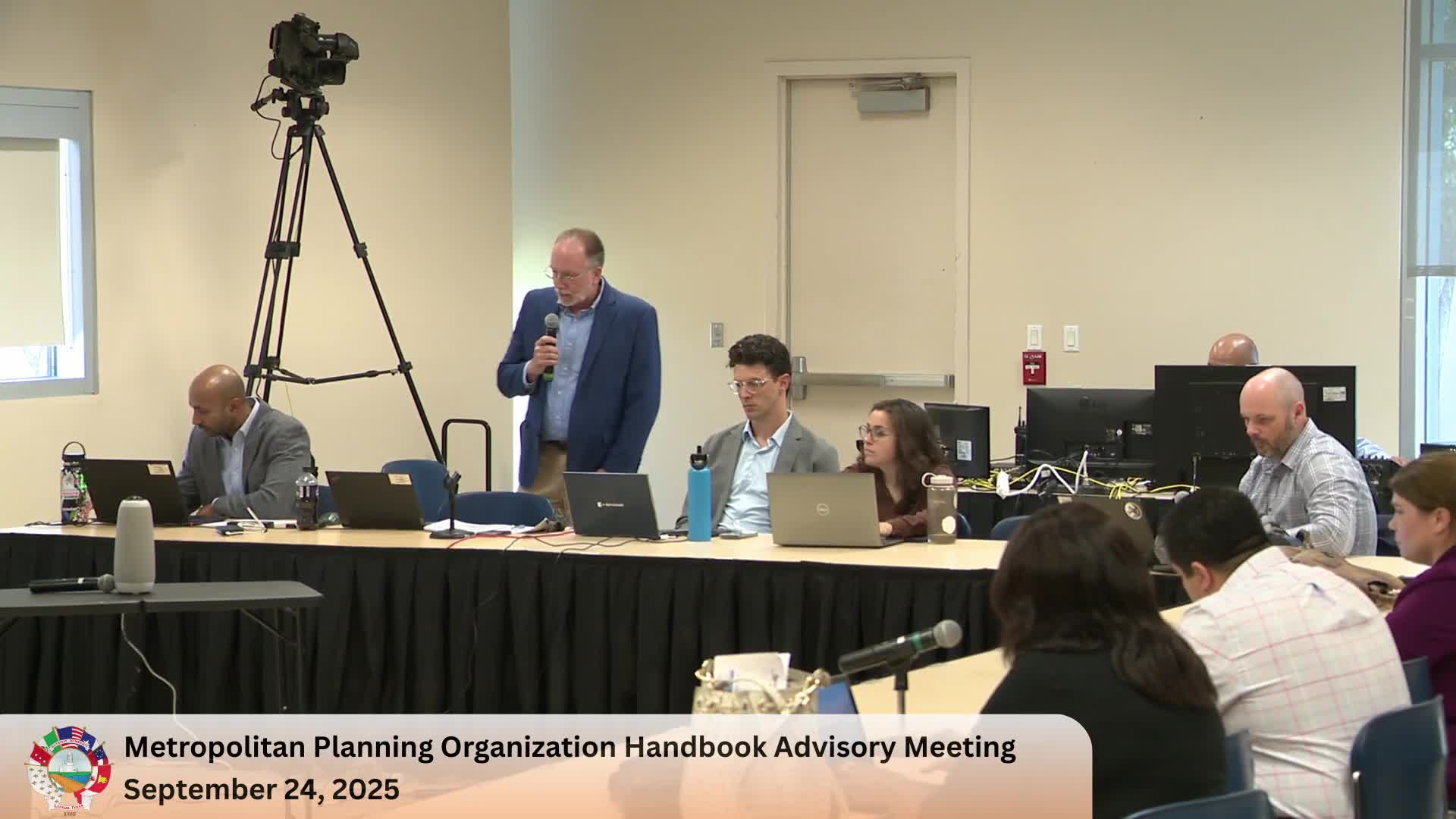
At the sixth Handbook Advisory Group meeting in Laredo, representatives from TxDOT, Metropolitan Planning Organizations (MPOs) and consultant teams reviewed the draft chapter on MPO work‑program administration and related resources. Jim Wood, with Kimley Horn, opened the meeting and thanked the host MPO; Casey Wells, TexTalk, said, “we are getting close. We're gonna have it done by the end of the year.”
Why it matters: the chapter and linked resources will guide how MPOs prepare Unified Planning Work Programs (UPWPs), request federal reimbursements, document carryover and close out federal planning funds. Those processes determine the timing of reimbursements, what expenses are eligible, and how small and mid‑sized MPOs manage consultant contracts and carryover funds.
Consultants and TxDOT staff presented the proposed chapter scope and a set of companion resources. Harrison Garrett (Kimley Horn), one of the chapter authors, summarized funding sources that commonly appear in UPWPs: FHWA Metropolitan Planning (PL) funds, FTA Section 5303 (often consolidated into PL in the Consolidated Planning Grant/CPG), CMAQ (Cat 5), STBG (Cat 7) and TA (Cat 9), plus discretionary grants and state/local match (cash or toll/transportation development credits). Garrett said the CPG conversion (FTA 5303 to PL) “streamlines the delivery of those federal funds.”
Key points discussed
- TPF distribution and work orders: TxDOT’s distribution formula includes a TEMPO takeoff ($2,500), a $75,000 set‑aside for qualifying nonattainment/TMA MPOs, a population distribution using U.S. Census estimates, and a $375,000 minimum allocation per MPO. The team described three annual work orders: work order 1 (initial authorization/confirmation), work order 2 (updated PL obligations) and work order 3 (carryover authorization). Presenters noted the month targets for each work order but characterized the dates as aspirational because federal system timing and invoice reconciliation can delay final authorization.
- UPWP preparation timeline and governance: The chapter will recommend an administrative timeline and templates. In the meeting TxDOT staff said MPOs will receive the current UPWP template by January, with TPP office hours in February. Draft UPWPs are expected to be submitted to the TxDOT MPO coordinator by May 1, governing board adoption should occur before July 15, coordinators submit adopted UPWPs to FHWA/FTA by August, and federal approval is expected by Oct. 1. Presenters emphasized that individual MPO public‑participation policies may require additional steps (for example, some MPOs place UPWP amendment thresholds in their public participation plans rather than bylaws).
- Amendments and approvals: The working draft sets a 25% threshold for “major” versus “minor” changes. Major revisions (for example, increases in total UPWP budget or task budget increases greater than 25%, adding new tasks, or changing task scope) require policy‑board approval, TxDOT review, and—for TMAs—FHWA/FTA approval. Minor revisions (task budget changes under 25%, editorial changes) typically require only local approval and a courtesy copy to TxDOT.
- Nonconstruction advanced funding agreements (NCAFAs): The group clarified that NCAFAs are used for federal funds other than TPF (for example CMAQ, STBG, TA or other nonconstruction federal categories) and are developed and managed at the TxDOT district level. Several MPOs reported that many NCAFAs fund non‑planning programs (incident management, TDM/vanpool, carpool programs) as well as planning studies.
- Indirect costs and de minimis rate: The draft explains direct versus indirect costs and notes that MPOs without a federally approved indirect cost rate may use the 15% de minimis rate (15% of modified total direct costs). Presenters noted the de minimis option cannot be used if an organization already has an approved indirect rate or if the recipient receives more than $35,000,000 in federal awards in a year; TxDOT may require a certification letter.
- Eligible and ineligible costs: Presenters reiterated standard federal guidance: eligible costs must be necessary, reasonable and documented in the approved budget; examples of eligible items include salaries tied to planning work, program evaluation, data analysis and delivery costs. Ineligible items discussed included entertainment, alcohol and costs not tied to the federal award. Professional memberships are eligible only when the MPO (not an individual employee) is the subscriber and the membership is related to performance of the federal award.
- Request for reimbursement (RFR) and APER deadlines: TxDOT serves as the pass‑through for Transportation Planning Funds. MPOs may submit up to 24 RFRs annually (twice monthly) and no fewer than 12; TxDOT aims to reimburse each RFR within 15 business days. TxDOT indicated a target of December 15 for final invoices (subject to coordination), the annual performance and expenditure report (APER/APR) must be submitted to TxDOT by Dec. 15 so FHWA/FTA can receive it by Dec. 29, and the Federal Project Authorization Agreement (FPAA) approval target is Jan. 31. Presenters warned that late invoices can delay work‑order 3 carryover authorization.
Questions and areas of operational uncertainty
MPO participants raised operational questions that the chapter or companion resources should clarify: how and when carryover will be calculated and authorized; the detail required for food/meeting refreshment approvals; whether the UPWP or separate prior‑approval requests suffice for recurring meeting food costs; examples of documentation that satisfy “necessary and reasonable”; and how fiscal agents should treat indirect charges. Participants requested concrete examples to illustrate ambiguous eligibility rulings.
Other administrative notes
Participants confirmed TxDOT’s smooth urbanized area boundary is the state’s record of the approved boundary (the census smooth boundary and FHWA approvals also factor into MPO boundary decisions and gubernatorial approval). Multiple MPOs described using their public participation plan (PIP) to document administrative thresholds (for example, whether a UPWP change requires board approval). Several MPOs said their districts routinely use NCAFAs for non‑planning programs as well as planning studies.
No formal board votes or policy adoptions occurred at this meeting; the session was a technical review and information exchange.
Next steps
The project team expects to finalize the MPO work‑program administration chapter for TxDOT review and then circulate it to the advisory group for review. Presenters asked advisory‑group members to review the chapter and the companion checklists carefully and provide examples where guidance proved ambiguous in practice. TxDOT and the consultant team flagged that several supporting resources (TPF invoice templates, UPWP checklist, APR template) will also be released and linked to the handbook chapter.
The meeting combined policy‑level timelines with practical process questions from MPOs and TxDOT staff; the project team said it will update the chapter to reflect clarifications raised in discussion and to incorporate examples where possible.