
South Texas 911 manager outlines plan to roll out next-generation 911 for four-county region
Get AI-powered insights, summaries, and transcripts
Subscribe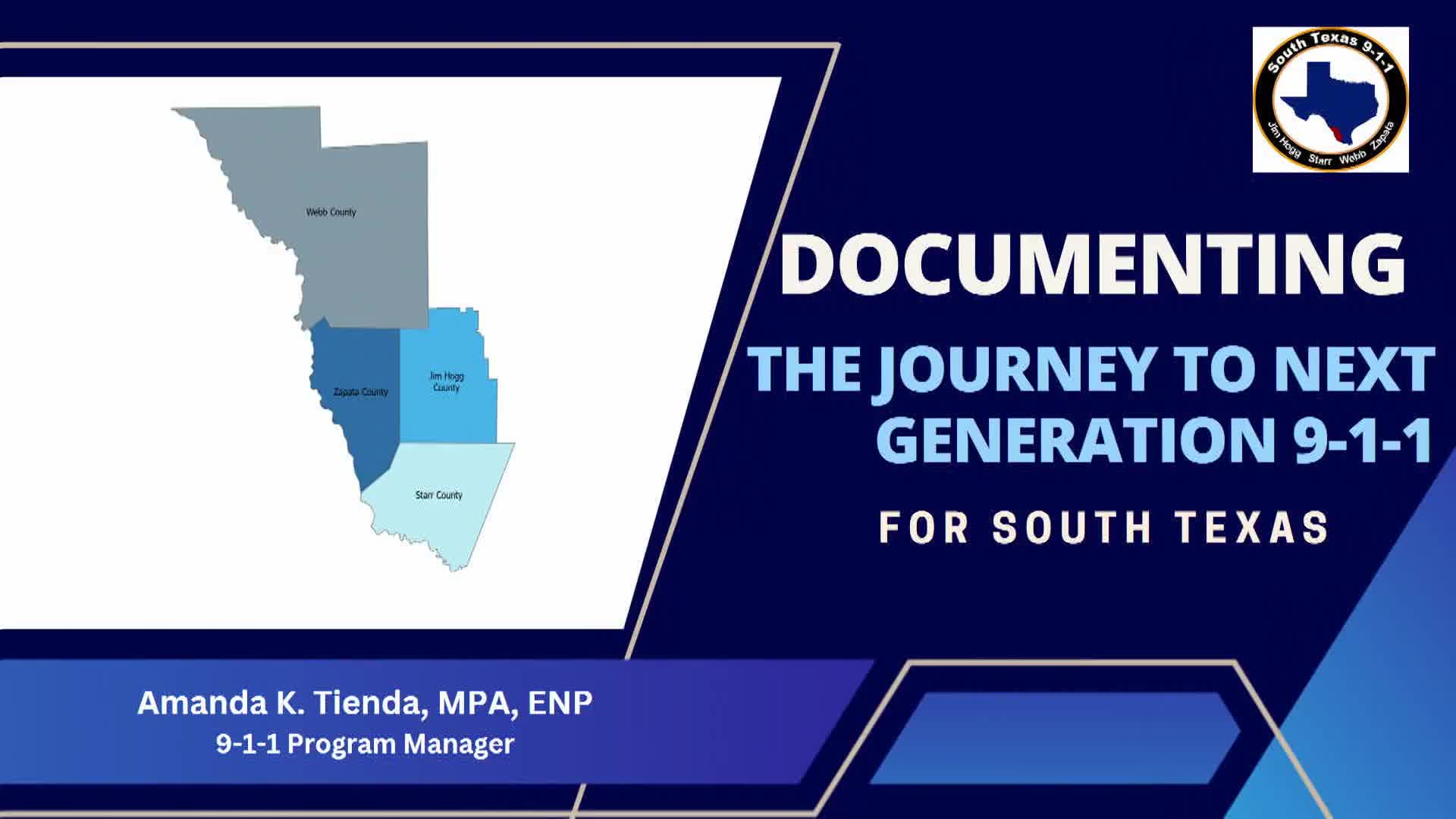
Summary
The South Texas 911 program manager described multi-year work to implement device-based location, video links and a cloud call-handling system for Webb and nearby counties, funded in part by state grants and an additional 2024 allocation. Presenters said full cloud implementation is targeted by December and emphasized SOPs, stakeholder engagement,
Ananda Dianda, 9-1-1 program manager for the South Texas region administered by the City of Laredo, told panelists the region is implementing next-generation 9-1-1 technology to provide device-based location, live video links and a cloud-native call-handling solution across four counties.
"Imagine it's the middle of the night, you go to check your sleeping child, and they're nowhere to be found... that link will lead them to their exact location and provide a new location every 5 seconds," Dianda said, describing how a caller can receive a link that shares location and camera access with call takers. Dianda identified the product used in early rollout as "Carbine Universe" (as referenced in her presentation) and said the region previously launched an over-the-top solution and moved to an ESInet in 2021.
Dianda said South Texas administers 9-1-1 for multiple counties and receives funding through the Texas Commission on State Emergency Communications (CSEC). She said the region requested an additional $1,500,000 in 2024 for next-generation equipment and that a near-$1.9 million implementation cost was part of prior planning. Dianda stated that the region is in the process of implementing a cloud-native call-handling solution and that the goal is to be fully operational by December of this year.
Her practicum emphasized developing standard operating procedures (SOPs), stakeholder engagement, public education and extensive training for telecommunicators. She reported a survey of 25 invited participants with a 68% response rate; she said 100% of respondents supported both stakeholder inclusion and creation of SOPs to improve call delivery and Carbine usage.
Panelists asked about privacy and legal considerations for live video and device access. Dianda said the region uses the vendor—s GovCloud storage and a cybersecurity program (referred to in presentation as Secular), that video links expire after 15 minutes, and video is retained in the cloud for three months; login and access logs record who views material. "We have a device at every one of our centers that proactively monitors all of our sites," she said, describing active cybersecurity monitoring.
Panelists also recommended expanding outcome data in future presentations (for example, projected percentage improvements in response times). Dianda said early-adopter status and multi-year implementation (six years of work) shaped the phased rollout and training approach.
Ending: Dianda said she expects the region to be a model for other areas and urged continued stakeholder outreach, SOP development and public education; no formal city action or vote was recorded during the session.