
Laredo investigator urges civilian participation on police disciplinary review board
Get AI-powered insights, summaries, and transcripts
Subscribe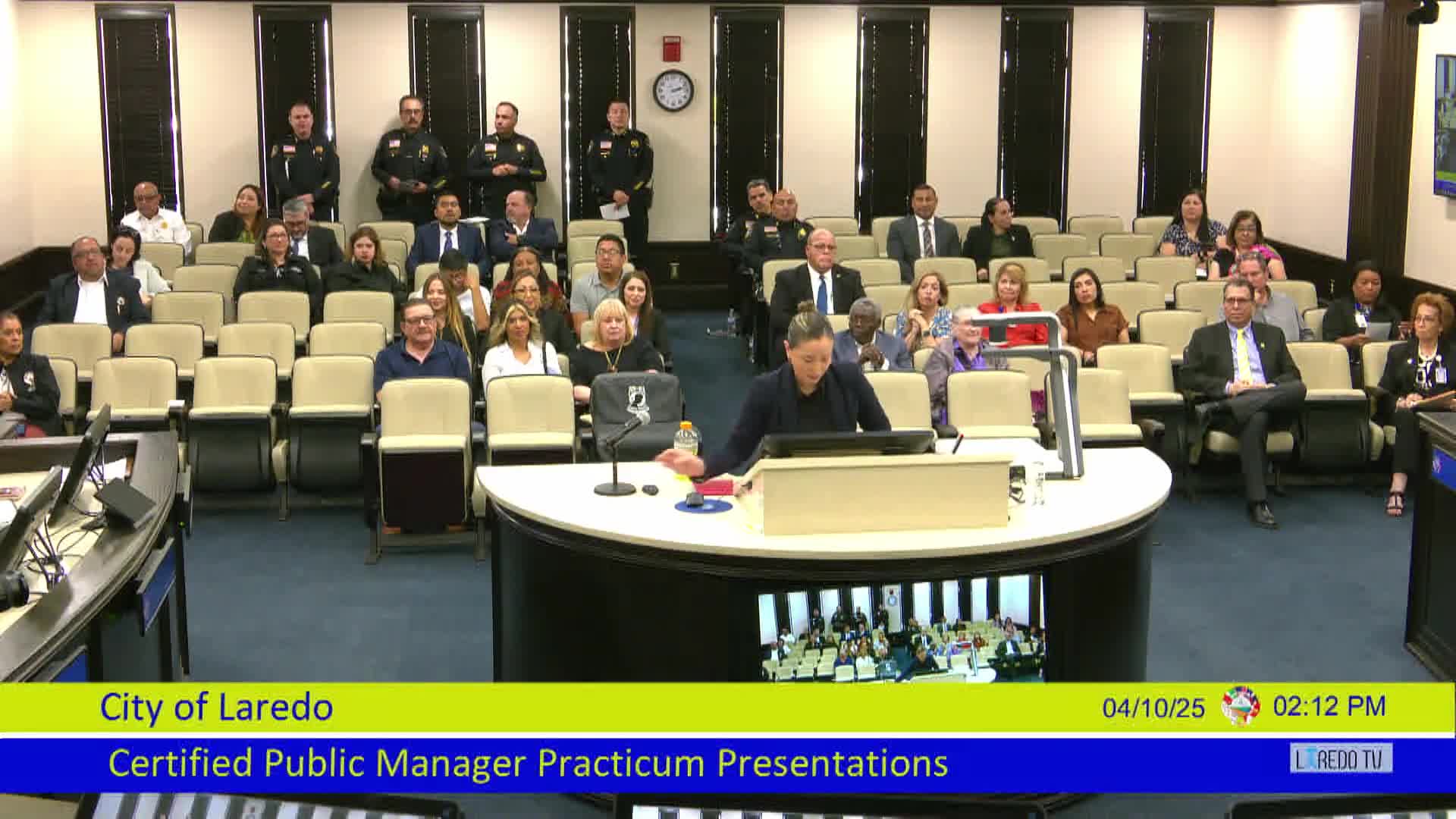
Summary
Investigator Naomi Arlette Simpuego of the Laredo Police Department proposed adding civilians to the department—s disciplinary review board, saying the change would increase accountability, add diverse viewpoints and boost transparency.
Investigator Naomi Arlette Simpuego of the Laredo Police Department presented a plan to include civilians on the department—s disciplinary review board, saying the change would increase accountability, add diverse viewpoints and boost transparency.
Simpuego, who identified herself as an investigator assigned to Internal Affairs, told panelists she surveyed 10 staff members with internal affairs experience and said 70% of respondents thought including civilians would increase the percentage of sustained findings. "By involving civilians, we ensure that the process of reviewing police actions is more open and accessible to the public," she said.
The presentation explained how the current disciplinary review process operates: investigators are assigned cases approved by the chief of police, gather evidence and determine whether allegations are sustained, not sustained, exonerated or unfounded. Simpuego described the existing disciplinary review board as composed of six sworn ranks from the department: an officer, investigator, sergeant, lieutenant, captain and an assistant or deputy chief. She said the department policy currently governs the board—s composition.
Simpuego proposed a first-year action plan that includes publishing volunteer applicant openings on the city website, screening applicants for eligibility, conducting interviews and background checks, training selected civilians on department policy and the police officer association contract, and establishing a coordinator to monitor effectiveness. "This will not cost the city any money as this is on a volunteer basis," she said, while noting selected department members would need to dedicate time to training volunteers.
Panelists asked about the study sample and legal constraints. A panelist noted the survey respondents all had internal affairs experience and asked whether that sample was representative. Simpuego confirmed her survey focused on staff with direct IA experience.
The group also discussed whether the proposal could be implemented administratively or required collective bargaining. Simpuego initially said the board composition appears in department policy, but further exchange with a former chief and others indicated the composition is specified in the collective bargaining agreement and would require negotiation to change. A former member of management stated, "We can't change it as a management. We go to contract." Another panelist clarified that the item is currently part of the bargaining table and is being negotiated.
Panelists recommended expanding research on peer-size departments, citing San Antonio, Austin and Dallas as differing models (some with combined civilian-and-sworn boards, some with full civilian oversight). One panelist suggested adding an educational component for both the public and selected civilian volunteers to ensure constructive participation and to help address morale concerns among officers.
Simpuengo said she had not yet surveyed the police association or management for formal positions, and several panelists recommended outreach to the union and to departmental leadership as a next step.
The presentation concluded with Simpuego—s assessment that including civilians would strengthen community relations and fairness, and with agreement among panelists that more research and negotiation language would be required before implementation.
Ending: The panel encouraged Simpuego to expand her sample, include comparative data from peer cities and consult the police association and city management; no formal action or vote was taken during the session.