Get Full Government Meeting Transcripts, Videos, & Alerts Forever!
Get email alerts on the Economic Development topic
No spam. Unsubscribe anytime.
Kalamazoo Commission creates downtown redevelopment and rehabilitation districts to enable three brownfield projects
Summary
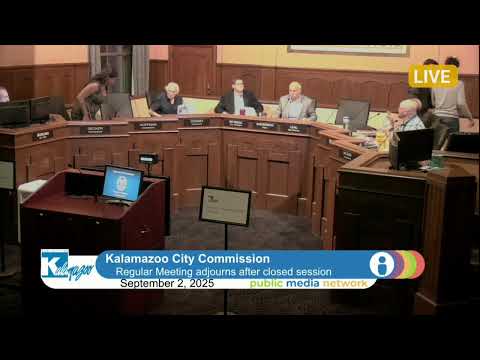
The Kalamazoo City Commission on Tuesday voted unanimously to create two tax‑abatement districts intended to enable a three‑site “transformational” brownfield redevelopment in downtown Kalamazoo.
The Kalamazoo City Commission on Tuesday voted unanimously to create two tax‑abatement districts intended to enable a three‑site “transformational” brownfield redevelopment in downtown Kalamazoo.
The commission adopted a resolution to establish a commercial redevelopment district that includes the former Michigan Avenue courthouse parcel and a separate resolution creating a commercial rehabilitation district for 261 E. Kalamazoo Ave. Both actions were approved by roll call; each passed with all voting commissioners recorded as "yes." The vote only establishes the districts; any tax‑abatement certificates or final project approvals would return to the commission and, for one program, to the Michigan Department of Treasury.
City staff and the project team described the package as a linked set of projects that would reuse historic and underused downtown buildings and leverage state brownfield incentives alongside local tax tools. Development manager Jamie McCarthy told commissioners the courthouse site is envisioned as a historic rehabilitation of “just around a 100,000 square feet” into a hotel with “just over 120 hotel rooms” and restaurant/amenity space while preserving the building’s exterior and character. The other major site discussed, the Spireflex/SpiritPlex building on Kalamazoo Avenue, was presented as a roughly 51,000‑square‑foot office conversion into about 57 residential units using existing surface parking.
McCarthy summarized how the state tax tools would work: under the state statute for redevelopment districts an applicant can seek either a 50% tax abatement for a new facility or a certificate that freezes taxable value prior to a rehabilitation; local approvals set certificate lengths within statutory ranges. ‘‘Creating the district is step one,’’ McCarthy said. ‘‘Once that is created, the property owners in this district then can come forward and apply for a certificate.’’ She noted rehabilitation certificates may run from one to 10 years and redevelopment certificates from one to 12 years, depending on the statute and the application.
Mayor David Anderson stressed that creating a district does not approve project design or permit work. ‘‘I just want to clarify for us ... this is not approving a project. All we are doing with this hearing is we are establishing a district which then gives the opportunity for a developer ... to apply for the benefits that might accrue to that redevelopment,’’ Anderson said.
Commissioners asked about historic protections, taxable values and affordability commitments. Decker asked whether the courthouse is formally designated as a historic resource and McCarthy confirmed the project intends to pursue historic tax credits and work with the state historic preservation office to maintain required character. Decker and others asked that future certificate applications show existing assessed values from the city assessor (available through the BS&A system) and lay out any affordability commitments. McCarthy said those details will be in the certificate application and in a parallel affordable‑housing agreement the applicant is preparing.
Commissioner Pat Prado, who moved the redevelopment‑district resolution, said she was ‘‘excited to see somebody willing to step forward to make a $100,000,000 investment’’ and praised reuse over demolition. Mayor Anderson and staff emphasized the package is being pursued as a single transformational brownfield application because an individual site would not meet the state threshold for that designation; Anderson said the full package likely exceeds $100 million of total investment but cautioned multiple state and local steps remain.
Next steps: the city created the legal district boundaries and will accept any certificate applications. For the commercial rehabilitation option at 261 E. Kalamazoo Ave., the final approval of certificates is issued by the state tax commission after the commission forwards its recommendation. For the redevelopment district, the commission issues certificate approvals locally and submits required filings to the state tax commission.
The commission also noted a related request for 619 Porter is being pursued separately as a Neighborhood Enterprise Zone (NEZ) and will return to the commission in a separate action.