
TxDOT warns carbon-reduction funds for FY27–28 may disappear; MPOs urged to prepare alternatives
Get AI-powered insights, summaries, and transcripts
Subscribe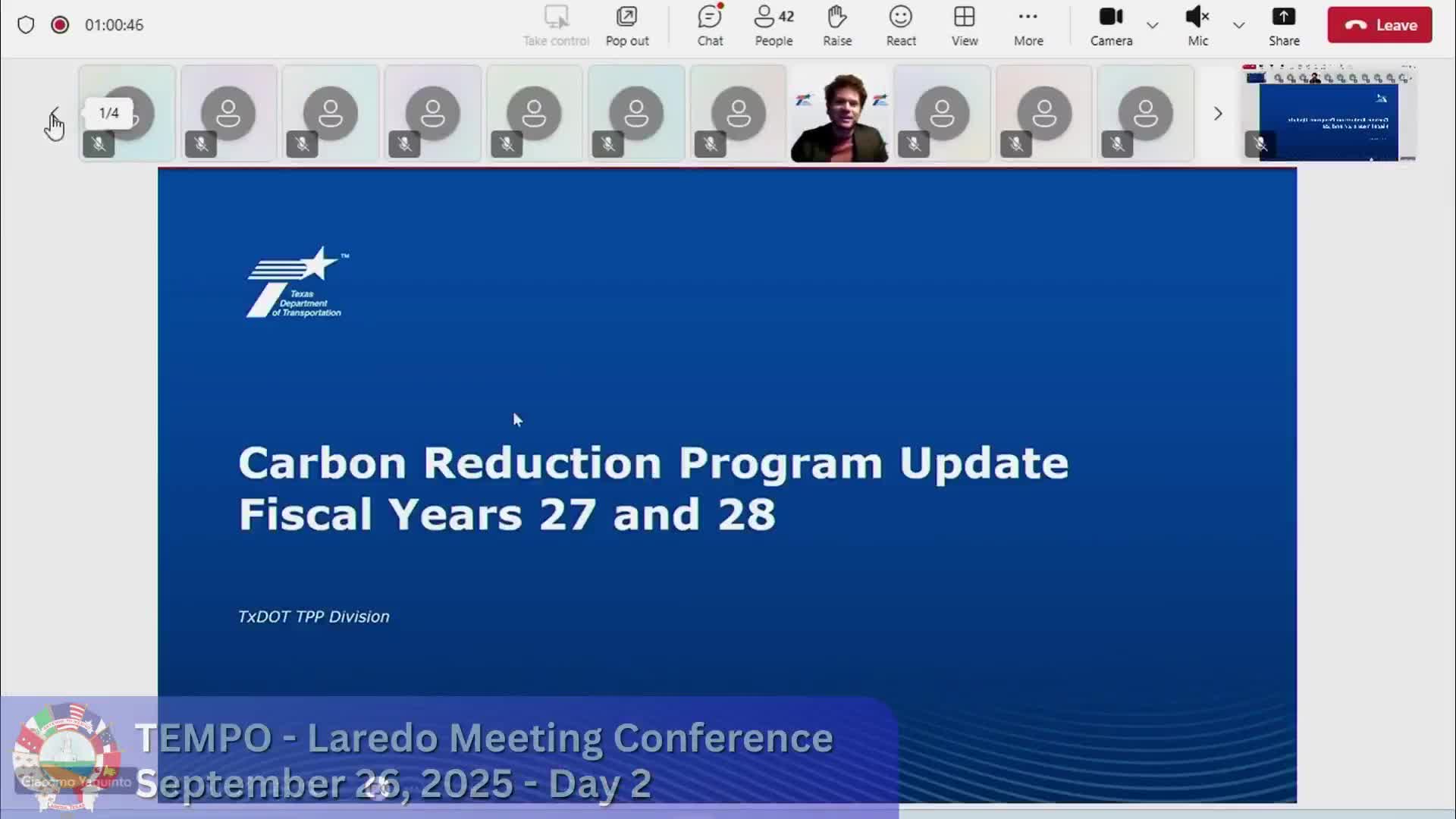
Summary
State planning staff told Tempo attendees that the Carbon Reduction Program (CRP) allocations shown in the 2026 Unified Transportation Program for fiscal years 2027–28 may not continue after FY26; MPOs were asked to verify project readiness, accelerate obligations where possible, and identify alternative funding.
TxDOT planning staff told Tempo meeting attendees that carbon-reduction (CRP) allocations shown in the 2026 Unified Transportation Program for fiscal years 2027 and 2028 may not continue after fiscal year 2026. Giacomo Yaquinto said the department's immediate concern is that programmed CRP dollars for FY27 and FY28 could drop to zero if the program is not extended beyond FY26.
Why it matters: several MPOs have projects programmed in FY27–28 that rely on CRP funding. If the CRP program terminates, projects scheduled to let after FY26 could lose their CRP funding and require alternate sources or schedule changes.
Yaquinto said TxDOT has reviewed programmed projects and identified MPOs and districts with potential exposure, including Bryan/College Station, Corpus Christi, Houston/Beaumont/HJC MPO, FAR and Rio Grande Valley MPO, San Antonio and Alamo Area MPO, Tyler and Waco/Flint Temple MPO. He urged MPOs to review which projects rely on FY27–28 funding, to assess readiness to let, and to begin identifying alternative fund sources if needed.
Key technical point: under current IIJA provisions referenced by TxDOT, CRP funds must be obligated no later than the end of fiscal year 2029. Yaquinto clarified that funding received in FY26 can be programmed in FY26, FY27, FY28 or FY29, but it must be obligated by the FY29 obligation deadline. The immediate risk is reliance on FY27 and FY28 CRP lines that could be eliminated if the program ends after FY26.
TxDOT Deputy Division Director Mildred (TPD) said TxDOT staff and the finance division are working to help MPOs maximize use of available balances and suggested MPOs consider other categories (for example Category 5 or 7) or request district-level reallocation for statewide priorities where justified. She encouraged MPOs to prioritize top projects and work with districts to identify alternate funding sources if CRP lapses.
MPO staff from Alamo Area and other districts asked for written confirmation of the obligation deadline and about practical steps for programming and timing; TxDOT staff repeated that programming across FY26–29 is allowable but emphasized obligation by FY29 and offered to follow up with districts to quantify needs and identify alternatives.