Get Full Government Meeting Transcripts, Videos, & Alerts Forever!
Get email alerts on the County Government topic
No spam. Unsubscribe anytime.
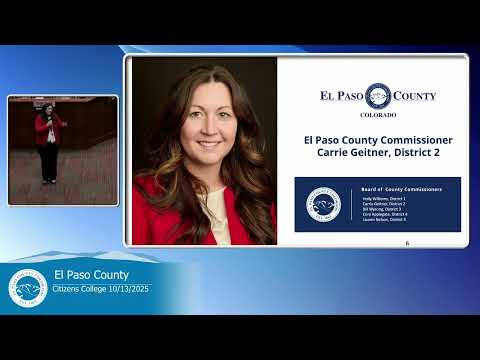
Commissioner Kerry Geithner explains county powers, limits and priorities to Citizen College attendees
Summary
District 2 Commissioner Kerry Geithner described the roles of the board, the countys statutory limits under state law, and priorities such as roads and public safety during an El Paso County Citizen College session.
Commissioner Kerry Geithner (District 2) told Citizen College participants that El Paso County is a political subdivision of the state and therefore "subject to all of the state laws," and that the county has only the authorities the state grants.
Geithner described the three roles the Board of County Commissioners performs: executive, legislative and quasi-judicial. She said the board sets the county budget, oversees land-use decisions in unincorporated areas, and appoints the county administrator and county attorney.
Why it matters: Geithner advised citizens where county and city responsibilities differ and where residents should direct concerns. She highlighted roads as an example of a county-controlled function in unincorporated areas and said county staff measure pavement quality and have increased investment in road maintenance over recent years.
Key points Geithner made: - County authority: "We are a political subdivision of the state. And so what does that mean? Well, it means that we are subject to all of the state laws, and we only have the authorities that the state gives us." She noted the county administers federal and state programs where required. - Roles of commissioners: The board performs executive functions (overseeing administration), legislative functions (adopting rules such as the land-use code) and quasi-judicial functions (hearing individual land-use applications where property rights and community needs are weighed against approval criteria). - Decision-making: Geithner said all actions of the board require a majority vote. "All actions of the board take a majority vote," she said, noting that no single commissioner can act alone and that three votes are needed on a five-member board. - Priorities and budget: Geithner described the countys roughly half-billion-dollar budget and said commissioners focus on public safety, core services and fiscal soundness when setting priorities. She also described the board as working well together despite shared party affiliation.
Public engagement Geithner encouraged Citizen College participants to attend county meetings and to learn how to engage on land-use, budget and other issues. She also previewed Citizen College tours of the sheriffs office, the jail, the coroners office, emergency services and parks.
Ending: Geithner closed by thanking participants for taking an interest in county government and encouraging them to be ambassadors for county services and to provide feedback on what the county should do differently.