
Planning commission adopts rules and recommends code change to let members elect chair and vice chair
Get AI-powered insights, summaries, and transcripts
Subscribe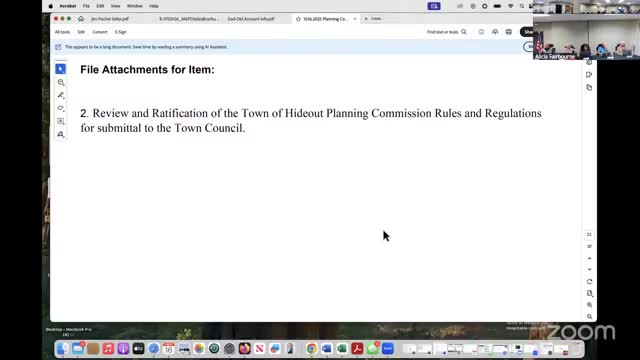
Summary
The Hideout Planning Commission approved updated rules and forwarded recommended amendments to Title 10, Chapter 12 of the municipal code to permit the commission to elect its own chair and vice chair. The commission also clarified alternate-member rotation and training requirements for new members.
The Hideout Planning Commission voted on Oct. 16 to adopt updated planning‑commission rules and regulations and recommended several code amendments to town council, including language that would move selection of the planning commission chair and vice chair from mayoral appointment to election by the commission.
The motion to approve the rules and the suggestion for code amendments passed after staff and counsel explained the proposed redline changes and how they align with neighboring municipalities. The action on rules was recorded as a recommendation to the council; final code changes would require council consideration and adoption.
Key changes and clarifications discussed
- Chair and vice chair selection: Staff and counsel recommended amending Title 10, Chapter 12 so the commission elects its chair and vice chair rather than the mayor appointing them. Commissioners noted most comparable nearby cities allow the commission to choose its leaders; the commission voted to forward that amendment to the council as part of the packet of code changes.
- Alternates rotation and succession: Commissioners revised language so alternates “shall alternate coverage for meetings” (rotating responsibility for attending and voting as alternates). The commission also proposed that, should a regular planning‑commission member resign, the senior-most alternate would serve in the regular seat until the mayor appoints a new alternate (subject to council/codified procedures).
- Training requirements: The commission clarified training expectations. New members must complete the initial two-hour training before they vote, and that requirement must be satisfied within 60 days per municipal code; annual training for all members was noted as required by town code. Commissioners asked staff to tighten the draft language to specify the initial two-hour requirement and the 60-day timeframe.
- Process and notice: Counsel confirmed that proposed rule changes and an amendment to who appoints the chair would be forwarded to the council for consideration; the commission cannot unilaterally change the municipal code.
Timing and related items
Commissioners discussed scheduling for general-plan public meetings and coordination with City Design consultants. The commission asked staff to explore holding the general‑plan outreach meeting around an upcoming commission meeting so more commissioners can attend; staff will coordinate dates with City Design and the council.
A planned vice‑chair appointment was deferred because the commission needs a council-approved code change before it can elect or appoint a vice chair under the newly proposed language.
Vote: the commission approved the rules and recommended code amendments; the motion carried on a recorded vote and will be transmitted to the town council for further action.