Get email alerts on the Property Taxes topic
No spam. Unsubscribe anytime.
Portland work session: assessor warns downtown value drops are shrinking taxable base and increasing "compression"
Summary
Portland City Councilors met Oct. 16 to review property-tax mechanics after Multnomah County Assessor Michael Vaughn and city finance staff said falling downtown commercial market values have reduced taxable value and increased constitutional "compression," a factor already shrinking property-tax revenue available for the city’s general fund.
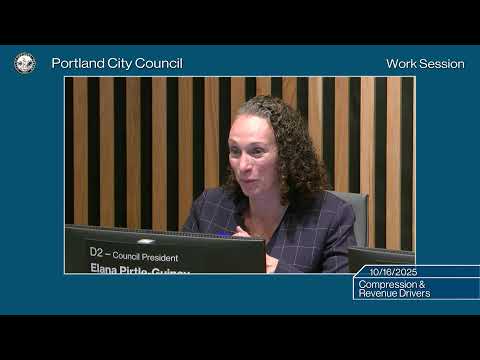
Portland City Councilors met in a work session Oct. 16 to review the city’s revenue picture and to hear Multnomah County Assessor Michael Vaughn explain how recent declines in downtown commercial market values are reducing the taxable base available to the city.
Councilor Clark said she requested the session “because I think we need to take some time to really be educated about what's happening on the property tax in Portland.” The discussion fed directly into near-term budget work: the finance committee will review the city’s fall technical adjustment ordinance Oct. 20, the full council will consider it in a work session Oct. 22, and the ordinance is scheduled for a first reading Nov. 5.
The why-it-matters paragraph: Portland’s property-tax system is governed by long-standing state limits (Measure 5 and Measure 50) that cap the amounts districts can levy and create a maximum-assessed-value (MAV) construct. When market values fall—especially for large downtown commercial accounts—those caps trigger “compression,” a constitutional adjustment that reduces the taxes districts can collect even if budgeted amounts (the city’s extended taxes) are higher. That dynamic is already reducing revenue available for city services and will be an input to the budget choices the council must make this fall.
How the system works, per the assessor: Michael Vaughn, Multnomah County assessor, summarized the legal and technical framework and the central role of three values used in Oregon property taxation: real market value, maximum assessed value (established under Measure 50 and allowed to grow by up to 3% per year unless an exception applies), and assessed (taxable) value, which is the lesser of the two. “Property tax is the administration of state law to fund our communities,” Vaughn said. He described how Measure 5 (a 1990 voter limitation on district levies) and Measure 50 (1997 changes that created MAV) work together to produce compression when market values fall.
Vaughn and city staff walked councilors through city-level numbers the assessor’s office compiled. Key figures cited in the session: - Citywide taxable (assessed) value: just over $79 billion for tax year 2023, about $82 billion in 2024, and about $83.886 billion for tax year 2025 (unaudited figures presented as certified rolls). - The city’s extended tax (the amount the city asks the county to collect) was about $572 million in tax year 2023, $617.8 million in 2024 and roughly $634.5 million in 2025. - Compression (the constitutional reduction in taxes because of Measure 5) lowered the amount the city actually imposed: about $22.7 million in 2023, $29 million in 2024 and $33.8 million in 2025. Vaughn noted countywide compression for the current year totaled about $147 million.
Vaughn emphasized the mechanics with a concrete example. The U.S. Bank Tower (often called “Big Pink”) sold recently for $45 million. The assessor showed how that sale drove a market value reduction for the building’s tax accounts and produced a year-to-year decline in the tower’s tax bills from about $2.6 million in the prior year to roughly $860,000 combined in the current roll — a drop of nearly $2 million. He told the council that, without compression, that property’s tax bill would have been materially higher and that compression compounds the effect of falling market values on tax revenue.
What is driving the downtown declines, and which property types are affected: the assessor’s office and councilors traced the decline to falling market values in office and hotel properties and, in the most recent tax year, to weakening multifamily market values as well. Vaughn said the downtown core has seen larger market declines than many residential neighborhoods. For commercial properties appraisers often use projected income and vacancy rates; higher vacancy and lower rents push investor valuations (and thus assessed market values) down.
Tax increment financing (TIF) and where growth will flow: councilors raised how TIF (urban renewal) interacts with recovery. The assessor and staff explained that when a parcel is inside a TIF district its “base” (the value frozen for existing taxing districts) is held constant and increment above that base is captured by the urban renewal area. If a property later revalues upward (for example, because of new leases or redevelopment), that additional tax revenue typically goes to the TIF authority rather than to the general fund unless the district’s plan or boundary changes. Councilors and staff noted that many potential sources of future decompression—properties that recover value—may produce tax growth that is credited to TIF districts rather than to the city’s unrestricted general fund.
FPDR and other fixed levies: councilors asked about the interaction of fixed or charter-mandated levies such as the Fire and Police Disability and Retirement (FPDR) program. Staff confirmed that growth in those levies can further compress the remaining unrestricted portion of property-tax revenue available to the general fund because constitutional limits and the levy order determine which levies are reduced first.
Budget implications and next steps: Jonas Beery, Portland’s chief financial officer, framed the presentation as a baseline ahead of upcoming budget decisions. He said property taxes are “the star of the show” in this session’s focus, and asked councilors to use the briefing to inform deliberations for the fall technical adjustments and the next budget cycle. Council members repeatedly requested that staff and the assessor provide more granular comparisons with nearby counties (Clackamas, Washington) and additional scenario forecasts for near-term compression and assessed-value trajectories.
No formal decisions or votes on policy changes were taken at the work session. City staff and the county assessor promised follow-up materials and projections; the council scheduled the technical adjustment (tau) consideration for committee and council review later in October and a first reading in November.
Ending note: Councilors left the session with clearer, but still sobering, numbers: downtown market declines have already reduced the city’s taxable base and increased constitutional compression, and the path to restoring prior growth in property-tax revenue is uncertain and may be further constrained by TIF allocations and FPDR obligations. City finance staff, the county assessor and the council plan additional briefings as the fall budget process proceeds.
AI generated
The text on this page is AI generated. Summaries, highlights, analysis, and video transcripts are all produced from the original source material.
AI can make mistakes, so if you spot one, and we will fix it for everyone.
Note: the source content is unaltered by us. Any content source we link to, be it a video, an audio recording, or a document, is presented exactly as its publisher released it. That publisher is usually a government body, sometimes an individual official or another organisation.