Get Full Government Meeting Transcripts, Videos, & Alerts Forever!
Get email alerts on the Westglenn Feasibility topic
No spam. Unsubscribe anytime.
County releases Westglenn feasibility study; community meeting Tuesday to weigh water options
Summary
Morrow County staff presented a feasibility study on Westglenn/Westland water options and will host a Spanish- and English-language community meeting with a data walk and informal survey of residents about connecting to municipal water, deepening wells or household filtration.
Morrow County staff distributed feasibility reports on water and wastewater options for the Westglenn/Westland area and announced a final community outreach meeting at the Sage Center with Spanish translation, a data walk, and an informal (nonbinding) temperature-taking survey for residents.
County staff said the feasibility study examines four broad options: deepen or refurbish private wells, install whole-house filtration systems, construct a decentralized community system, or connect properties to the nearby municipal system. The study’s engineers concluded deepening existing wells is uncertain, whole-house filtration presents regulatory and certification questions and costs that vary widely, and connecting to the municipal system generally offers the most reliable outcome for long-term service — though it can be expensive and some residents object to relying on municipal supply.
County staff emphasized outreach: the feasibility reports will be posted on the CWC and county websites, door-to-door outreach was used to invite residents, and the Sage Center meeting will include Spanish-language materials and translation devices. Staff said they will hand out an FAQ in English and Spanish and run a short, nonbinding vote at the end of the meeting for households in the targeted area to express preferences.
Staff also described a recent county mapping effort that estimates roughly 900 domestic wells in Morrow County and noted that many outlying parcels would be prohibitively expensive to connect to a municipal system. The county's project team said they will continue smaller-group engagements (cottage meetings) and invited advisory-committee members to meet with groups of Westglenn residents to discuss details in a less formal setting.
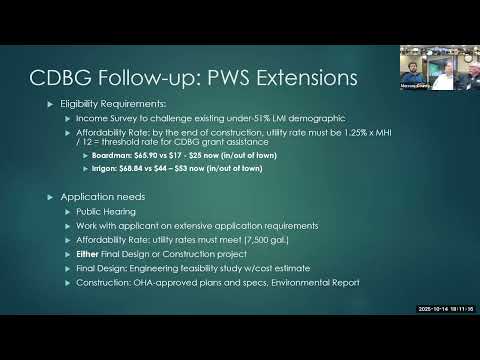
The consortium is supporting city-led project work through letters of support, grant-work collaboration, and targeted studies such as income surveys. Staff recommended scoping an income survey through Portland State University’s Survey Research Lab if the board wants to pursue CDBG public-works eligibility — those surveys typically take 6–9 months, cost about $10,000–$20,000, and produce an area-level result that can be used for up to five years.
Next steps: county staff will post the feasibility report, hold the Sage Center meeting (Spanish translation provided), gather survey results, and continue door-to-door outreach and smaller advisory-group meetings to collect detailed local input.