Get Full Government Meeting Transcripts, Videos, & Alerts Forever!
Get email alerts on the Healthsystem Rmc topic
No spam. Unsubscribe anytime.
Santa Clara Valley Health leaders report Regional Medical Center acquisition is stabilizing services but HR 1 threatens revenue
Summary
Health system leaders told the committee that average daily census and surgical volume at Regional Medical Center (RMC) rose in September and that operational integration has produced favorable financial performance; they warned, however, that HR 1 and federal budget uncertainty could force difficult choices despite recent gains.
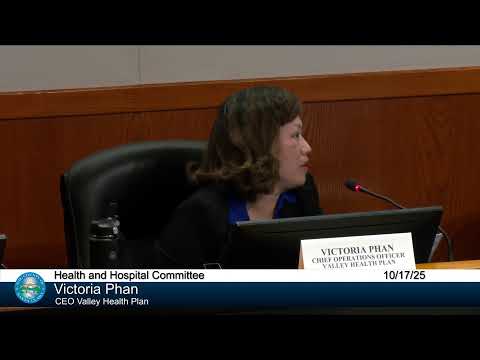
Santa Clara Valley Health System leaders told the Health and Hospital Committee on Oct. 13 that the acquisition and integration of Regional Medical Center (RMC) has improved access and financial performance, while federal budget proposals create a major downside risk.
Paul Lawrence, chief executive of Valley Health System, reported that RMC’s average daily census grew 7 percent month‑over‑month in September to 178 patients and that surgical case volume rose 22 percent over the same period. He said growth in charges reached about $170 million for September and that the acquisition has required no additional general‑fund contribution compared with the year prior to the purchase. "The purchase of RMC has been a huge win financially," Lawrence said.
Lawrence and county leadership credited a rapid electronic medical‑record implementation and operational coordination for the results. Health system staff noted Epic Go‑Live at RMC was completed in 80 days, a timeline Epic recognized, and leaders cited union cooperation and merit‑system rule changes as operational enablers.
At the same time, leaders warned HR 1’s provisions and the federal funding environment create an immediate fiscal threat. County officials said the loss of supplemental Medi‑Cal payments (including global payment and other supplemental programs) would require programmatic adjustments and that staff are working with state health officials and the county’s Intergovernmental Relations office to explore administrative workarounds and alternative revenue strategies.
Other service highlights noted to the committee included the planned restoration of labor, delivery and NICU services at RMC (leadership hoped for the first baby at RMC after re‑opening on Oct. 20), and the county’s Every Woman Counts outreach program, which provided free breast and cervical cancer screening to 556 patients last year and connected 21 percent of those screened to further diagnostic or treatment services.
What the committee did: the committee received the update from Valley Health System by voice vote (two ayes, motion carried). Members asked staff to continue engagement with state officials and to report back on impacts and mitigation options.
Why it matters: RMC’s restored services improve local access to trauma, obstetrics and specialty care; but large federal funding shifts could force difficult tradeoffs across county health services.