Get Full Government Meeting Transcripts, Videos, & Alerts Forever!
Get email alerts on the Legislation Update topic
No spam. Unsubscribe anytime.
Commission hears legislative update covering zoning, annexation, public safety and court rules
Summary
City staff and department heads reviewed recent state bills affecting zoning protests and signage, annexation and disannexation, firefighter health screenings, battery energy storage oversight, and changes to municipal court procedures including the city's new court-of-record status.
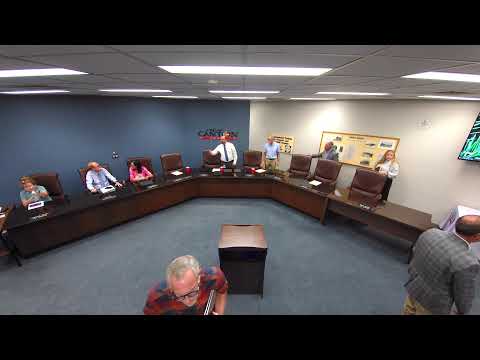
City staff and department heads on Aug. 26 briefed the Canyon City Commission on a range of state legislative changes that officials said could affect local land use, public safety, utilities and municipal-court procedures.
John (city staff lead) told the commission that changes to zoning protest rules and signage will alter local procedures for rezoning notices. Under the new state requirements, notice signs must be posted ahead of planning-and-zoning hearings and online notices published; staff said the sign must be placed 10 days before a P&Z hearing and the legal notice must be published at least 15 days in advance. City staff said the law does not yet specify exact sign text or font and that the city will finalize sign language and dimensions; staff discussed using large (approximately 2 feet by 4 feet) signs that refer to the published online notice.
The legislative update touched on several other land-use and economic-development items, including limits on local regulation of mobile food vendors, changes that make disannexation petitions available to property owners who say required services were not provided after annexation, and a provision allowing single-stairway apartment buildings under 6 stories when 14 specific safety conditions are met. Staff said those measures are intended at the state level to ease housing production in some markets but will require local implementation decisions and, in some cases, additional regulations or inspections.
Public safety and first-responder topics were discussed at length. Staff described a broadly scoped measure often referred to locally as the Uvalde Strong Act, which establishes new requirements for multiagency active-shooter training, after-action evaluations and mental-health resources for responders. The city's fire chief summarized related items that will affect the fire department and EMS: clinical cancer-screening provisions for firefighters, new training mandates, and an expansion of presumptions around heart-attack and stroke claims for first responders. The chief said the city already requires firefighter physicals and that career staff receive annual screenings; volunteers are offered screening and the department has had some volunteers participate.
Officials also discussed battery energy storage systems. The fire chief said that when these facilities are sited outside municipal limits, owners must supply the local fire department with operational plans, hazard analyses and site-specific training and protocols, which will guide emergency response to those facilities.
City staff and the municipal judge reviewed several municipal-court-related bills. Judge Case said the commission adopted Ordinance 12-21 in January to create a court of record and that, effective Sept. 1, 2025, the municipal court will operate as a court of record. “As of 09/01/2025, we are a court of record,” she said. That designation creates concurrent jurisdiction with the district or county courts in certain enforcement actions and removes the automatic trial de novo on appeal, meaning appeals will be traditional appellate reviews requiring a record and transcript rather than a new trial.
Other bills summarized by staff and prosecutors included changes to execution of blood-search warrants across adjacent counties, consolidation of municipal-court security and technology funds for cities under 100,000 population (effective May 29, 2025), increased penalties for certain misuse of official information, new protections and penalties for harassment of utility workers, and enhancements to penalties for driving while intoxicated in school zones. Prosecutors noted a change in driver safety course rules allowing a single course to satisfy multiple qualifying offenses arising from the same criminal transaction (interpreted locally as the same citation). Staff flagged that certified court interpreters will be required for certain contested hearings and that interpreter costs can be substantial.
City officials labeled most items informational; no formal action on state bills was taken. Staff said they will return with implementation recommendations and ordinance changes where local action is required.
The briefing covered multiple departmental impacts and emphasized that many changes will require administrative updates, additional staff guidance and, in some cases, future ordinance amendments or interlocal coordination with county and state agencies.