Get Full Government Meeting Transcripts, Videos, & Alerts Forever!
Get email alerts on the Street Parking And Bike Safety topic
No spam. Unsubscribe anytime.
Council advances loading-zone authority after heated debate over Center City and 40th Street bike lanes
Summary
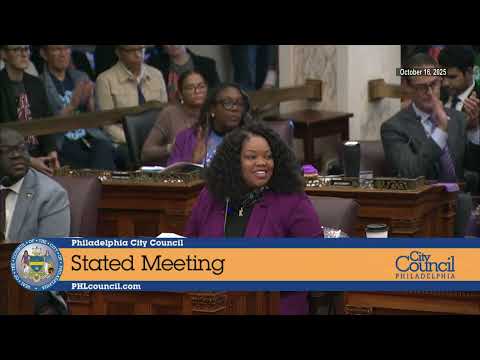
Philadelphia City Council on Thursday advanced measures to expand the city’s ability to designate time-limited loading zones and other curb regulations, a move supporters said would improve safety for people biking and walking and opponents warned would allow the Streets Department to act without adequate local input.
Philadelphia City Council on Thursday advanced measures to expand the city’s ability to designate time-limited loading zones and other curb regulations, a move supporters said would improve safety for people biking and walking and opponents warned would allow the Streets Department to act without adequate local input.
The most consequential items were an ordinance (bill 250718) that, as amended, would let the Streets Department adopt and revise time-limited and other parking, stopping and standing rules — including designated loading zones — across a defined Center City area, and a companion ordinance (bill 250712) authorizing parking and stopping regulations on both sides of 40th Street between Chestnut Street and Kingsessing Avenue. Councilmember Jamie Gauthier introduced the 40th Street measure; Councilmember Jeffrey J. Young offered the amendment to the Center City bill.
Council members and dozens of speakers during a public-comment period described the legislation as a safety and curb-management tool. "Safety over everything," said Jeremy Blatstein, a transit advocate, as he urged passage and cited crash data for affected corridors. Will Tong, a Southwest Philadelphia resident, described how the 40th Street reconfiguration has made it safer to get his daughter to school: "For my family, who was struck by a car in this neighborhood, the status quo has failed my family," Tong said. "Let's wipe 40 Seventh Street off our high injury network map."
Proponents — including bicycle advocates, Families for Safe Streets and residents who ride or walk the corridors — said legal recognition of loading zones prevents vehicles from parking in bike lanes and reduces crashes. "Loading zones make sense as part of the overall design of the street," said Eliza Yowsey, a District 1 resident. Multiple witnesses recounted collisions or near-misses; Jeremy Blatstein told council the corridor had seen "45 crashes and 4 serious injuries in the past five years," urging quick action.
Opponents, including some Society Hill residents and the Society Hill Civic Association, argued the Streets Department has exercised poor judgment on past reconfigurations and warned against granting broad, ongoing authority without more community process. "We are opposed to granting the Streets Department blanket authority to revise, alter, or eliminate parking or loading zones on any Philadelphia street using only their broad discretion without community input," said Theresa Feo.
Council amended the Center City bill on the floor to refine scope and placed the measure on the final-passage calendar for the next session. The 40th Street ordinance was called up and included in the consent agenda; it was approved as part of the day's consent package. Council did not vote final passage on the amended Center City bill in this session.
Council members repeatedly framed the measures as balancing curb management, safety and neighborhood concerns. Councilmember Gauthier, author of the 40th Street bill, said she prioritized safety in the Third District. Councilmember Young, who offered the amendment to the Center City measure, said the amendment was circulated and adopted by the membership.
What happens next: the amended Center City bill (250718) will return on the final-passage calendar at a subsequent session after being updated; the 40th Street ordinance (250712) was placed on the consent agenda and passed as read at this meeting. The Streets Department and council staff will be expected to implement and, where required by the adopted language, publish changes to curb regulations.
The debate underscored a recurring tension in Philadelphia: how to quickly deploy safety infrastructure and curb regulations while preserving opportunities for localized public input and mitigating unintended impacts on deliveries, accessibility and neighborhood routines.