Get Full Government Meeting Transcripts, Videos, & Alerts Forever!
Get email alerts on the Sage Grouse topic
No spam. Unsubscribe anytime.
BLM draft sage-grouse plan draws mixed support; committee authorizes state comment
Summary
The Bureau of Land Management released a multi-state draft amendment to greater sage‑grouse plans; Wyoming officials, county commissioners and industry raised concerns about adaptive management, compensatory mitigation and potential restrictions. The Select Federal Natural Resource Management Committee authorized co-chairs to finalize and submit a
The Bureau of Land Management’s draft range‑wide amendment to greater sage‑grouse management drew extensive testimony before the Select Federal Natural Resource Management Committee, with state officials, counties and industry urging clarifications and more state control. Committee co‑chairs authorized staff to finalize and submit formal comments before the public deadline.
Andrew Archuleta, BLM state director for Wyoming, said the draft amendment consolidates range‑wide science and includes five to six alternatives. He described the preferred alternative (Alternative 5) as “conservation with additional flexibility for development” and said BLM and Wyoming agencies have been working to reconcile differences, with adaptive management the primary unresolved item. Archuleta noted the draft is out for public comment and that BLM expects comments are due June 17; he said a final EIS and governor’s consistency review would follow, with a record of decision likely in November under the current schedule.
Wyoming Game and Fish officials said they seek state primacy in population assessments and adaptive management decisions. Will Schultz, who oversees habitat protection, and Doug Brimeier, deputy chief of wildlife, urged that the state conduct annual population analyses and that adaptive triggers not rest solely on a single model BLM proposed to use. "The state should provide the population analysis on an annual basis," Schultz said, noting field staff and multiple datasets are available to the state and must be considered alongside any model outputs.
County leaders and industry witnesses likewise urged revisions. Bob Budd, chair of the Sage Grouse Implementation Team and director of the Wyoming Wildlife and Natural Resource Trust, summarized progress toward negotiation and said Alternative 5 is Wyoming's recommended path; he flagged adaptive management language as the remaining issue. County commissioners, represented by Jeremiah Ryman and Commissioner John Espie, said 19 counties are cooperating agencies and urged better cumulative‑impact and socioeconomic analyses. Industry groups — represented by Colin McKee of the Petroleum Association of Wyoming and others — objected to provisions on compensatory mitigation proximity, BLM control over mitigation design, and a default no‑new‑authorizations approach in the adaptive-management sequence.
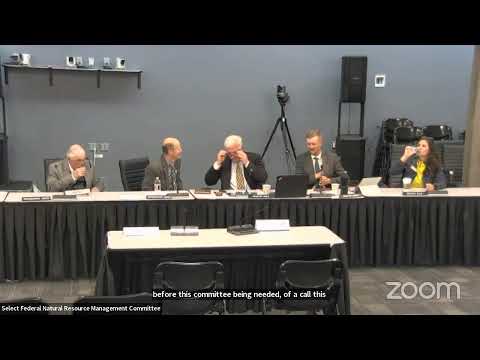
Committee action: Co‑Chair Heiner moved that the committee submit formal comments on the BLM Greater Sage Grouse Resource Management Plan Amendment; the committee authorized the co‑chairs to finalize and sign the letter and submit it before the comment deadline. Committee staff circulated a draft to members and will work with the co‑chairs to file it.
Why it matters: The BLM amendment covers multiple states and federal lands; it could affect future leasing, permitting and mitigation for energy, mining and infrastructure projects on BLM lands in Wyoming. Stakeholders told the committee that Wyoming’s existing executive‑order and state‑led processes already address many management needs and that the federal rule should align with state plans.
Next steps: The committee will finalize and submit its comments; BLM and cooperating agencies continue to negotiate language for the final EIS and record of decision timeline.