Get Full Government Meeting Transcripts, Videos, & Alerts Forever!
Appropriations panel hears that HR 1 immediately tightens SNAP eligibility, risks benefits for tens of thousands in Connecticut
Summary
Department of Social Services officials told the Appropriations Committee that provisions of HR 1 that took effect on passage on July 4 change SNAP rules for heat-and-eat, noncitizen eligibility and work requirements and will put roughly 36,000 people at risk of losing benefits unless they qualify for other exemptions or meet new work standards.
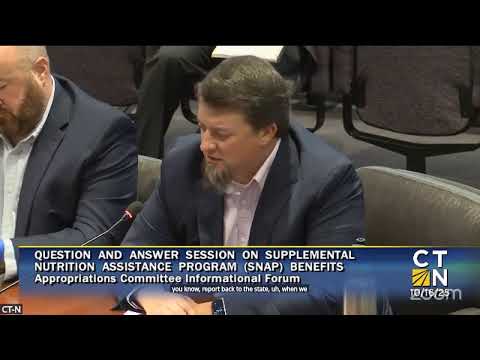
Commissioner Heather, of the Connecticut Department of Social Services, told the Appropriations Committee an informational hearing that HR 1’s SNAP provisions took effect on passage July 4 and that some changes are already being implemented.
The changes ‘‘were actually made effective upon passage of the bill on July 4,’’ Commissioner Heather said. She described four major provisions she said were in the bill: the elimination of SNAP-Ed funding, restrictions to the “heat-and-eat” mechanism that previously increased SNAP benefits for households receiving LIHEAP, new limits on which noncitizens qualify for SNAP, and substantially expanded work and community-engagement requirements for adults.
Those shifts, agency officials told lawmakers, carry immediate operational and outreach tasks and could cause benefit reductions or closures for sizable groups. ‘‘Only towns or areas with an unemployment rate of greater than 10% can be exempted from the work requirements. And there are no towns in the state of Connecticut where there is a 10% or higher unemployment rate,’’ Deputy Commissioner Peter Hadler said, explaining why prior geographic ‘‘town exemptions’’ no longer apply.
Why it matters: The department outlined a first cohort of roughly 1,500 people whose benefits may end in early December because they have already exhausted the three-month limit for able-bodied adults without dependents (ABAWDs) or related categories, and broader counts that underpin planning: about 36,000 people the department estimates are at risk under the expanded work-age rules and roughly 50,000 households that previously benefited from the heat-and-eat mechanism. Dan Giacome, the agency’s SNAP director, said the department’s current internal payment-error rate is about 8.7 percent — above the 6 percent threshold at which states pay no…
Already have an account? Log in
Subscribe to keep reading
Unlock the rest of this article — and every article on Citizen Portal.
- Unlimited articles
- AI-powered breakdowns of topics, speakers, decisions, and budgets
- Instant alerts when your location has a new meeting
- Follow topics and more locations
- 1,000 AI Insights / month, plus AI Chat