
Commissioners approve Arcadia Creek subdivision with conditions despite residents' flooding, safety concerns
Get AI-powered insights, summaries, and transcripts
Subscribe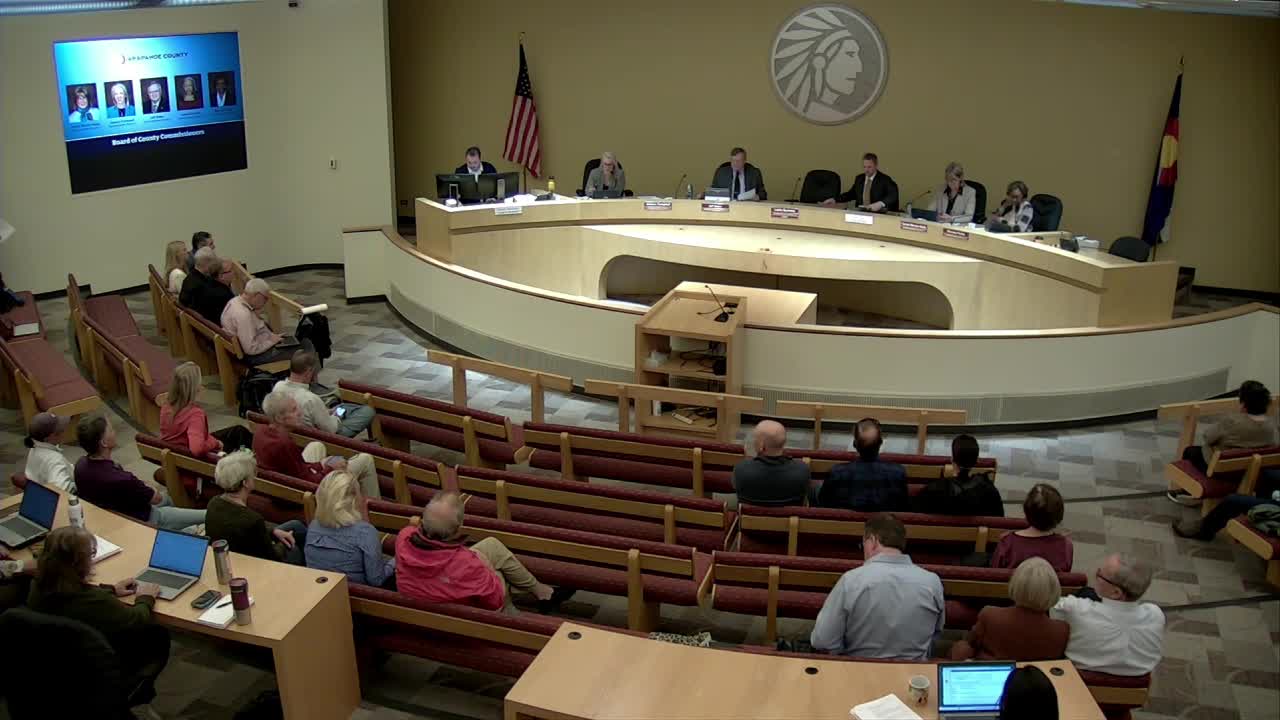
Summary
The Arapahoe County Board of Commissioners approved Arcadia Creek minor subdivision filing No. 1 (PM22‑006) on Sept. 23, 2025, imposing conditions including a maintenance agreement, a cash‑in‑lieu payment and limits on construction access. Residents and nearby homeowners urged the board to deny variances tied to Christianson Lane, citing flooding,
The Arapahoe County Board of Commissioners voted 3–1 on Sept. 23 to approve Arcadia Creek subdivision filing No. PM22‑006, subject to multiple conditions intended to address traffic, drainage and long‑term maintenance of Christianson Lane. Commissioner Campbell moved to approve the minor subdivision; Commissioner Fields seconded. Commissioners Campbell, Fields and Chair Pro Tem Jeff Baker voted yes; Commissioner Warren Gully voted no.
The vote follows a continuation of a public hearing first held Aug. 12, 2025, and a new limited comment period at this meeting restricted to a maintenance plan document that was not available to the public before the August hearing. Dozens of residents and property owners spoke in person about safety, flooding and traffic on Christianson Lane, a private roadway that serves the proposed subdivision and surrounding properties.
Why this matters: The applicant proposes to widen and improve Christianson Lane to provide access to new housing in Jefferson County and Arapahoe County parcels tied to the Arcadia Creek development. Residents say the lane is narrow, subject to regular flooding, and used daily by schoolchildren; they urged the board to deny variances that would reduce roadway standards or avoid detention ponds. The board’s decision places legally enforceable conditions on the subdivision approval but does not, by itself, eliminate existing private access rights that the county’s legal staff said run with the land.
Opponents and residents focused on flooding and safety. DJ Stines, a homeowner at 6391 S. Zenobia Court, said, “What I’m opposed to is my house flooding every 8 to 10 years, and the math proves it.” Several speakers including Kim Manning, Mick Manning and Susan Scheibel described children walking to school along the lane and said existing drainage and vehicle speeds make the corridor unsafe. Anne Larson, who said she had regularly intervened to prevent dangerous situations, urged commissioners to visit the lane, saying, “It is not safe to allow one more piece of traffic going down that lane as long as we have children in that area.”
Staff and engineers explained why the county’s standard detention approach was not feasible in the lane’s floodplain and described alternative measures. Tiffany Clark, land development engineering manager with the Southeast Metro Soil & Water Authority, testified that the developer will detain runoff on the larger site and that, site‑specific modeling shows reductions in peak discharges for some downstream channels (for example, a modeled reduction for Dutch Creek from about 14.25 cubic feet per second to 10 CFS and for a nearby channel from about 9.63 CFS to 8.7 CFS). Clark and county engineering staff said the widening and added storm inlets on Christianson Lane should convey runoff more efficiently and reduce ponding on the roadway; they also noted constraints on placing detention ponds inside the mapped floodplain.
County engineering manager CELA Rephamel described the variances under consideration: (1) reduced private roadway width from the standard 36 feet to an approximately 28‑foot tract in sections, (2) no guardrail or 4‑foot sidewalk over a culvert on the private drive connecting to Christianson Lane, (3) a modified crown profile on Christianson Lane to facilitate drainage, and (4) a waiver related to on‑site detention because the site will convey some flows to detention ponds located in Jefferson County. Rephamel said designs will still have to meet ADA requirements for pedestrian access where required.
On legal authority and access rights, county counsel and outside counsel told the board that the applicant and subsequent landowners have recorded access rights that run with the land and that the county lacks authority to restrict ingress and egress rights that are embodied in existing court decrees and recorded instruments. The county attorney’s office advised commissioners the board cannot, by refusing the minor subdivision, eliminate the developer’s access rights, which would continue to exist through separate legal instruments.
Motion and conditions: Commissioner Campbell read the approval motion into the record and listed staff‑recommended conditions. Key conditions attached to approval include: prior sign‑off on staff comments; payment of a total cash‑in‑lieu fee of $3,092 (allocated $1,612 to Littleton School District, $1,420.80 to public parks and $59.20 to other public purposes); construction of improvements to West Christianson Lane per county engineering standards and within the surveyed bounds described in prior court orders; a recorded maintenance agreement or escrow arrangement consistent with the county’s Infrastructure Design and Construction Standards (no building permits until the agreement is approved); specification that approved improvements be installed within the driveway confines defined in prior quiet‑title decrees unless otherwise agreed; prohibition on using Christianson Lane for construction access; and a covenant requiring the Arcadia Creek subdivision to remain an age‑restricted community (55+ under the Housing for Older Persons Act, 42 U.S.C. § 3607(b)). The motion text and conditions appear in the official minutes and were read into the record by Commissioner Campbell.
Public record and enforcement: County staff said the maintenance plan that triggered the limited comment period provides for routine maintenance (annual crack sealing, sweeping), periodic treatments (chip seals) and a full surface replacement estimated on a 20‑year cycle with an inflation factor. Staff said the maintenance funding is to be held in an escrow account or equivalent controlled by the homeowners association or controlling entity; county staff acknowledged that on private roads the county has limited direct enforcement tools beyond conditions tied to final plat approval and building permits.
Vote: Commissioner Fields — Yes; Commissioner Warren Gully — No; Commissioner Campbell — Yes; Commissioner Jeff Baker (chair pro tem) — Yes. Outcome: approved, with conditions.
What happens next: With the board’s approval, the developer may proceed to finalize plat documents and satisfy conditions before recording. County staff will require final engineering sign‑offs, the maintenance agreement/escrow evidenced prior to issuance of building permits, and payment of the cash‑in‑lieu fees described in the motion. Several residents said they intend to pursue continued oversight of drainage performance and the recorded maintenance commitments.
Voices heard (selected): DJ Stines (resident), Kim Manning (resident), Mick Manning (resident), Susan Scheibel (resident), Anne Larson (resident), Eric Anden (resident), Tiffany Clark (Southeast Metro Soil & Water Authority, land development engineering manager), CELA (Sila) Rephamel (Arapahoe County engineering services division manager), Commissioner Warren Gully, Commissioner Campbell, Commissioner Fields, Chair Pro Tem Jeff Baker, county counsel (Hader).