
Palo Alto interviews candidates for Parks and Recreation Commission; Cubberley, after‑school programs and field access dominate questions
Get AI-powered insights, summaries, and transcripts
Subscribe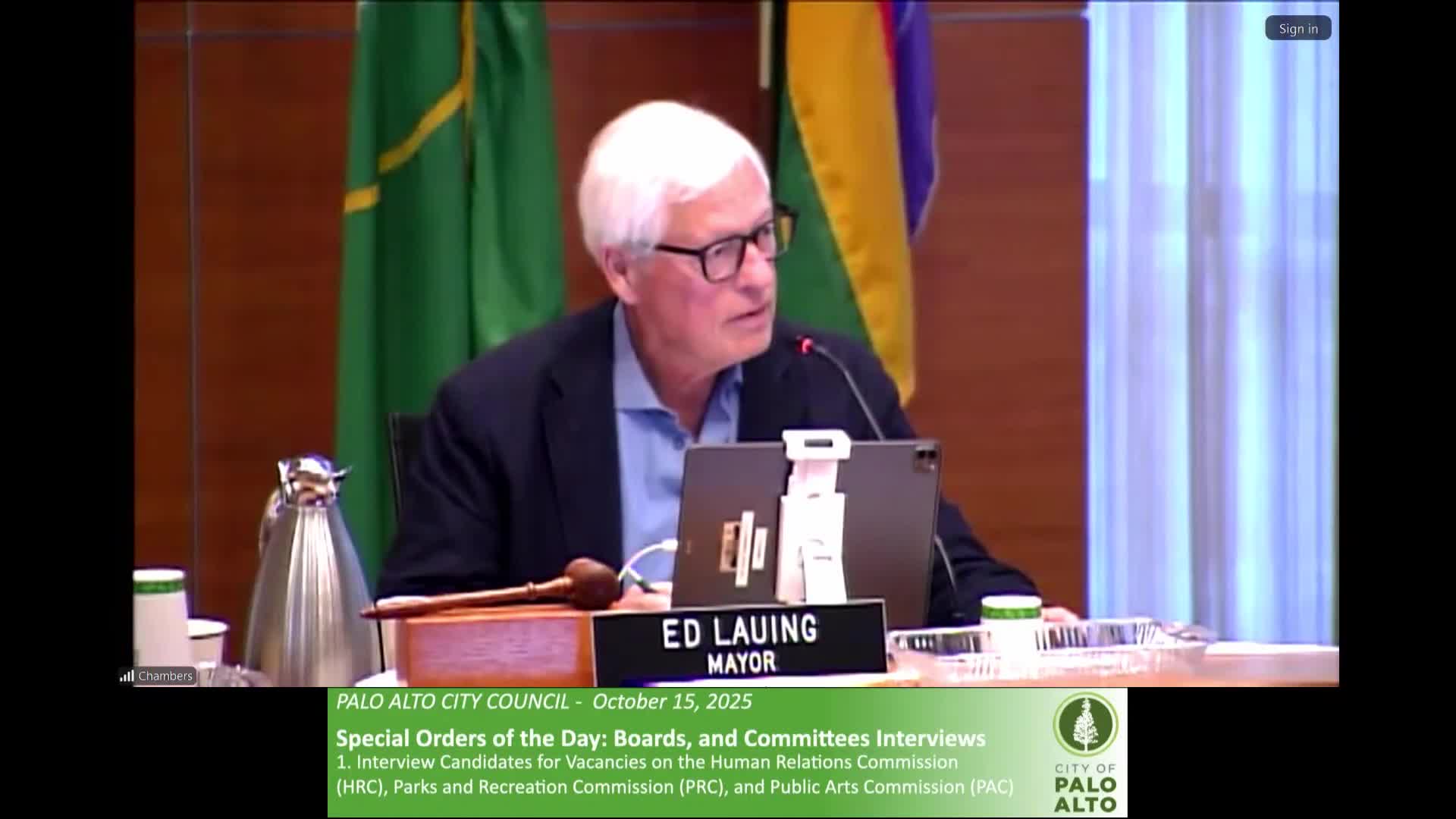
Summary
Council questioned prospective Parks and Recreation commissioners about Cubberley planning, after‑school opportunities, field access and environmental stewardship. Several applicants emphasized youth programs and fundraising.
PALO ALTO, Calif. — During interviews on Oct. 15, candidates for the Parks and Recreation Commission told the Palo Alto City Council they want to expand after‑school offerings, improve athletic-field access and help advance the long-running Cubberley redevelopment plan.
Why it matters: Parks and recreation policy affects fields, playgrounds, community centers and after‑school programming that residents use daily. Council members pressed applicants about balancing competing uses (sports, open space, arts), environmental stewardship and partnerships to fund projects.
The council heard from multiple applicants in 10‑minute interview slots. Bobby (last name on file with clerk) described a long history with city programs and emphasized the need for more after‑school options and arts studios; he said Mitchell Park programs “saved my life” when he was a youth and urged better local options to avoid costly travel for families seeking activities.
Brenton Hamlin said he brings business and gardening experience from volunteer work at Gamble Garden and Half Moon Bay State Park. Roger (Roger Smith), who described organizing Friends of the Palo Alto Parks and fundraising campaigns, said he would pursue public–private partnerships to supplement city budgets and called out needs at Foothill Preserve and for better restroom facilities.
Applicants repeatedly raised Cubberley — the former school site under long discussion — as a top priority. Candidates endorsed preserving space for arts and studios, more athletic fields and a phased approach to working with the Palo Alto Unified School District. Several applicants recommended activating Cubberley in pieces while negotiations continue.
Other recurring themes: more affordable programming and child-care-adjacent spaces to support families with tight housing; clearer signage at parks; improved digital field‑reservation visibility; rotation and maintenance plans for turf vs. artificial surfaces; and ranger‑led educational walks in open space.
Council members asked applicants how they would balance environmental protection with increased public access, how to manage competing field users and how to bring younger and more diverse volunteers into park stewardship. Multiple candidates said they would rely on listening to residents, partnering with nonprofit groups and, when needed, seeking targeted fundraising for smaller projects such as restrooms or signage.
No commission appointments were decided during the meeting. Council members said they will consider the interviews when filling three full‑term Parks and Recreation Commission seats at a later meeting.