
Palo Alto Council holds interviews for Human Relations Commission; candidates emphasize youth mental health, interfaith outreach and homelessness
Get AI-powered insights, summaries, and transcripts
Subscribe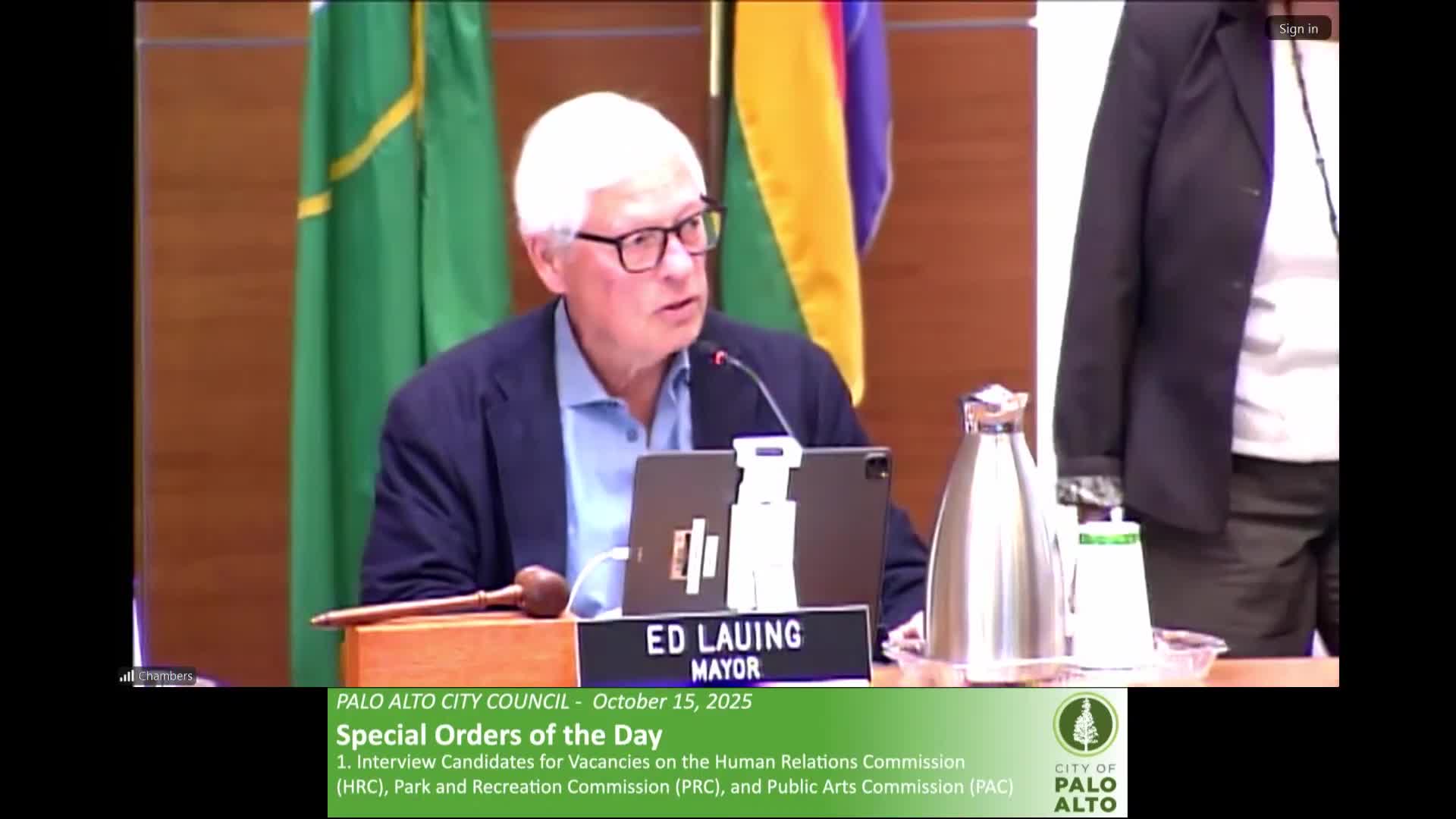
Summary
Council interviewed multiple candidates for three Human Relations Commission vacancies. Applicants highlighted listening sessions, youth mental-health partnerships and continued work on hate-incident response and outreach to RV dwellers and faith communities.
PALO ALTO, Calif. — The Palo Alto City Council interviewed a slate of candidates on Oct. 15 for three full-term openings on the Human Relations Commission (HRC), hearing detailed statements and follow-up questions about hate-incident response, youth mental health, interfaith dialogue and outreach to people living in RVs.
The interviews, held during the council’s special meeting, opened with the city clerk’s announcement that the fall recruitment for HRC, Parks and Recreation Commission and Public Art Commission ran from Aug. 22 to Sept. 24 and that there are three full-term vacancies on each body. Mayor Lowing introduced the HRC segment and candidates took 1–2 minute opening remarks followed by council questions.
Why it matters: The HRC advises the council on discrimination complaints, community healing and inclusion programs. Candidates’ proposals and experience provide a view of what the commission might press the council to prioritize in the year ahead, including school and youth-focused partnerships, listening sessions with faith leaders, and outreach to residents without permanent housing.
Several candidates described prior HRC or community work. Michelle Krause, a two-term HRC member and current vice chair, said she had “taken leadership in the area of the HESRAB funding to the NGOs of the city of Palo Alto” and described the commission’s recent listening sessions and a multi-agency workshop on hate incidents that included the FBI and county DA. She told the council she tried to “talk and ... listen” when disagreements arise and that she would like to see the council use the HRC more as a listening body.
Dr. Bridget Alge, a Stanford researcher and forensic scientist, spoke about combining “academic knowledge and boots on the ground experience,” describing international work in conflict zones and a focus on data-driven approaches to policy. She said she would push for town-hall-style convenings that produce concrete follow-up actions, and warned against “town halls that have no outcome and no teeth.”
Sridhar Karnam, who said he is an HRC commissioner appointed about five months ago, listed public health and public safety as his top priorities and encouraged “always-on” programs and regular check-ins with community leaders. Several applicants — including Sunny Daikwa, who emphasized youth mental health and prior nonprofit organizing, and Allison Rosen, a clinical neuropsychologist who highlighted suicide-prevention work and partnerships with the JED Foundation — identified youth mental-health initiatives and school partnerships as immediate priorities.
Candidates also described outreach to faith communities and interfaith convenings. Michelle Krause and Karnam referenced recent interfaith listening sessions; Karnam said he had attended Hindu, Jewish and Muslim community events to hear perspectives across groups. Several candidates connected that work to a larger goal of reducing polarization locally.
No formal appointments or votes on HRC roster changes occurred during the meeting. The interviews were presentations and question-and-answer sessions; the council scheduled appointments for a later agenda.
What council members pressed on: Council members repeatedly asked candidates to convert listening sessions into measurable outcomes, to explain how they would work with schools and county partners, and to identify short-term projects that could produce visible “wins.” Multiple council members asked applicants to describe temperament and conflict-management approaches for a commission that handles emotionally charged complaints.
Looking ahead: Council members will consider these interviews in a later decision-making session to fill the three full‑term HRC vacancies. Candidates emphasized continuing interfaith work, scaling youth mental-health partnerships and improving outreach to unhoused residents and RV dwellers as likely near‑term objectives for the commission.