Get Full Government Meeting Transcripts, Videos, & Alerts Forever!
Get email alerts on the Affordable Housing topic
No spam. Unsubscribe anytime.
Arapahoe County adopts land-development code changes to incentivize affordable housing; board sets half-mile rezoning radius
Summary
The Board approved LDC24-004, a multi-part affordable housing code amendment that creates multifamily and mixed-use zone districts, establishes a three-tier incentive structure (10%, 25%, 50% affordable units) with associated density and fee reductions, and sets a half-mile locational radius where mixed-use rezoning applications are eligible.
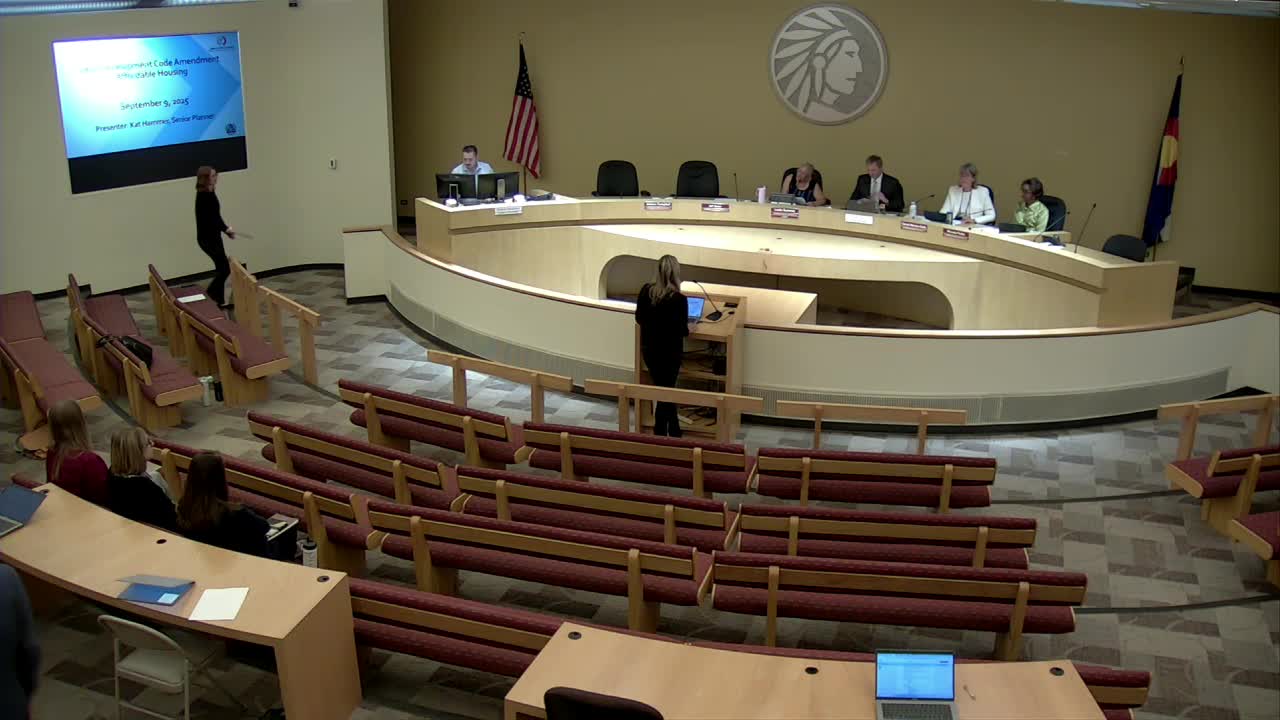
The Arapahoe County Board of Commissioners on Sept. 9 adopted a proposed land-development code text amendment aimed at accelerating affordable housing development in unincorporated parts of the county.
Senior planner Cat Hammer presented the county-initiated amendment (case LDC24-004). Staff described a multi-part package that creates a new multifamily zone district and a mixed-use zone district, adds several residential use types (including live-work units, assisted living, overnight shelters and transitional housing), and establishes a three-tiered incentive program for projects that include affordable units.
Under the adopted three-tier approach, projects must provide at least 10% affordable units to qualify for Tier 1 incentives, 25% for Tier 2 and 50% for Tier 3. The tiers carry graduated incentives: density bonuses (10%/25%/50%), possible additional building height (up to one or two stories above base, not to exceed overall height caps), reductions in certain fees and expedited review timelines, and reduced building-permit fees tied to the percentage of affordable units. For Tier 3 projects (50% affordable), Open Space staff told planning staff they would waive park/open-space land dedication or cash-in-lieu requirements for the affordable units, although market-rate units within the same development would still be subject to dedication or in-lieu payments.
The amendment also adjusts parking and manufactured/mobile-home rules. Staff said state law changes remove minimum parking mandates for multifamily developments over 20 units; county code will not impose minimum parking requirements for multifamily, though staff noted developers can and sometimes will provide parking. The code update reduces right-of-way and parking standards for new manufactured-home subdivisions (from 60 feet to 45 feet for right-of-way in the draft) and reduces required off-street parking spaces per residence for those subdivisions.
Hammer told the board the county had pursued public outreach, industry review and planning commission study sessions. A public-posting period ran from May 27 to June 26; the planning commission voted 3–2 to deny the item after hearing concerns including the waiver of neighborhood outreach meetings for the highest-incentive tier, potential rezoning of parcels near existing parks or open space, and allowable density near transit. Staff emphasized the draft would not itself rezone any property; it establishes which parcels would be eligible to apply for a rezoning to the new mixed-use district if they lie within the adopted locational criteria.
Commissioners asked for clarification on the locational buffer for permitting applications to seek rezoning to the mixed-use district. Staff recommended a half-mile radius from transit stations/corridors; Commissioner Warren Gulley said he favored the half-mile; the board adopted the half-mile locational criterion in the motion. Commissioner Fields moved to approve the amendment, with the standard stipulation that staff may make minor corrections with county-attorney approval; the motion passed on a voice vote.
Staff said the amendments include a streamlined administrative path for multifamily project review (a two-step planned-unit-development option rather than the current three-step process), reduced site-plan review timelines for qualifying developments, and a framework for recorded affordable-housing deed restrictions where projects are not using tax-credit financing. Engineering and building divisions were noted as working on complementary fee reductions and expedited review processes for qualifying projects.
Staff emphasized the draft does not rezone property on adoption; property owners still must apply for rezoning and public hearings at the planning commission and county-commissioner levels would be required for any rezoning requests.