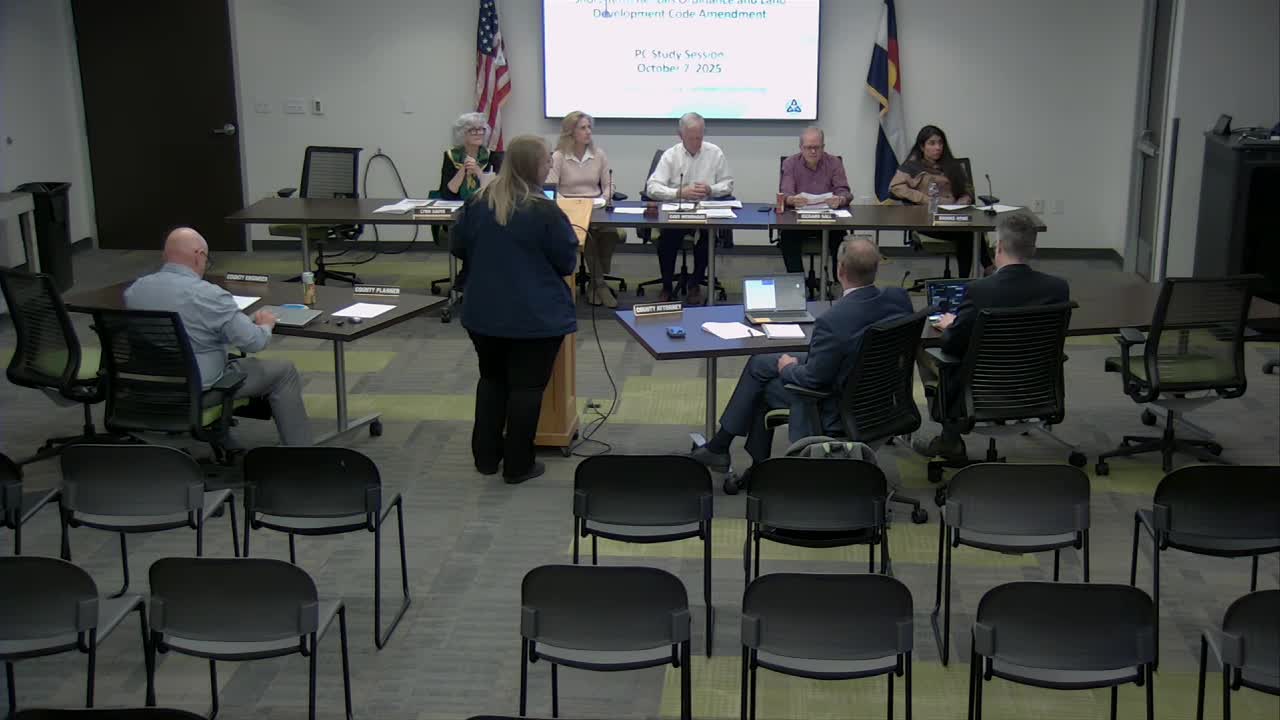
Planning Commission studies proposed short-term rental regulations, debates primary-residence vs. 180-day cap
Loading...
Summary
Staff presented draft land development code amendments and two ordinance options to license short-term rentals in Arapahoe County. Commissioners questioned buffers, parking, enforcement, ADU rules and proposed fees; public comment period remains open through Oct. 10.
The Arapahoe County Planning Commission held a study-session discussion on proposed short-term rental (STR) regulations, reviewing a land development code (LDC) amendment and two draft ordinances that would authorize a county licensing program.
Planner Caitlin Mars presented background and two ordinance options: one that limits licenses to primary residences and a second that allows owners to license properties for up to 180 days per year. "Arapahoe County does not currently, regulate short term rentals, so they are in allowed use by right," Mars said, describing community outreach and complaints about parking, noise and party-house behavior that prompted the proposed regulations.
Nut graf: Staff requested Planning Commission feedback on the narrow LDC amendment (which determines where STRs would be allowed) and provided two ordinance drafts that the Board of County Commissioners would consider if the county elects to license STRs. The commission’s input will inform next steps; the public comment window for the ordinance drafts was open through Oct. 10.
Key provisions and staff proposals disclosed during the study session include: - Two ordinance approaches: a primary-residence requirement (licensee must be owner or long-term lessee and show proof of primary residence) versus an owner-only model with a 180-day annual cap on rentals. "If it's a primary residence draft, you would have to be the owner or the lessee," Mars said. "If it's the 180-day cap, then only the owner can be the licensee in that case as the way the draft is written." - A 500-foot separation requirement between whole-house STR licenses and a proposed countywide cap of 100 licenses for multifamily structures, with a lottery/wait list option if demand exceeds localized caps. - Licensing content: a one-year license, local responsible agent (LRA) who must be reachable (respond by phone) and able to arrive on site within 60 minutes for after-hours issues, parking plans (minimums proposed tied to bedrooms), life-safety documentation (photo evidence of electrical panels, fire extinguishers, pools/hot tubs maintenance), and a good-neighbor notice to adjacent neighbors after approval. - Fees: staff proposed a nonrefundable application fee of $200 and an annual license fee of $350, with a first-year review period and potential lottery to allocate licenses in high-demand areas.
Commissioners pressed staff on enforcement and administration. Jason Reynolds said the county expects to use a contractor (Host Compliance) to detect listings and help manage enforcement; he told commissioners staff anticipated using contract resources plus existing staff time and that the program is designed to be self-funding through fees. "Using that contracted resource and the automation that they provide, we do not anticipate needing to add employees," Reynolds said.
Board concerns and clarifications included how ADUs would be treated (staff proposed allowing ADUs on parcels larger than 9 acres to be licensed but otherwise prohibiting ADU STRs), how multifamily caps would be allocated, whether pets and event-hosting should be restricted, and how grandfathering would be handled (staff proposed no automatic grandfathering; applications would be processed and a lottery used where separation limits apply). Commissioners discussed tradeoffs: the primary-residence option aims to keep homes in permanent housing use, while the 180-day cap aims to limit total STR activity.
Public outreach: Staff reported the early 2023 outreach had generated more than 200 responses; the current public-comment period for the draft ordinance was open and had received under 30 comments at the time of the session. Mars said the item was scheduled to return to Planning Commission for further discussion and to the Board of County Commissioners for ordinance readings on Nov. 18 (first reading) and Dec. 9 (second reading), depending on schedule.
Ending: The discussion did not produce a Planning Commission recommendation on the ordinance; commissioners were asked to provide feedback on the LDC amendment at a subsequent meeting.