
County staff, federal lobbyists brief commissioners on possible D.C. trip and 2026 state/federal legislative priorities
Get AI-powered insights, summaries, and transcripts
Subscribe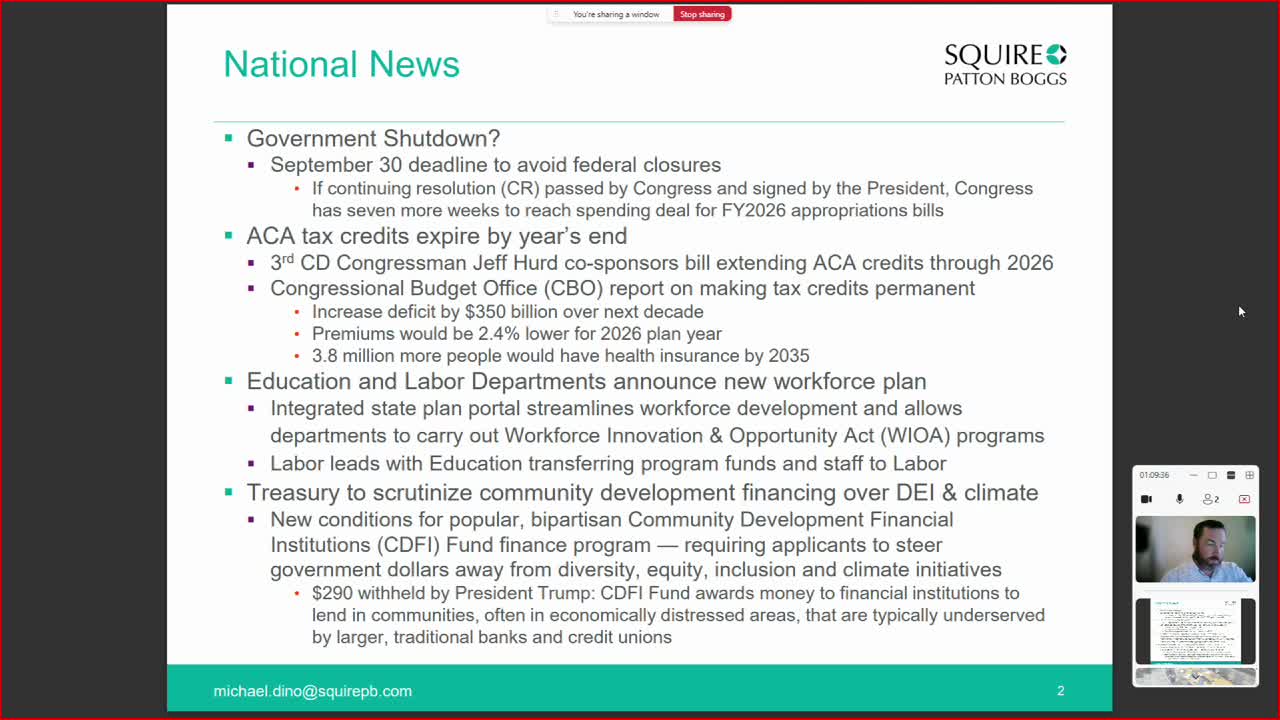
Summary
Arapahoe County received an update from its federal lobbyist Tuesday on the uncertain appropriations outlook and discussed a proposed Washington, D.C., outreach trip to press county priorities and pursue agency and congressional support.
Arapahoe County commissioners heard a federal‑affairs briefing Tuesday that outlined risks in the federal appropriations cycle, potential impacts to county programs and a proposed Washington, D.C., outreach trip to meetings with federal agencies and the delegation.
Why it matters: Federal appropriations and agency direction affect grant programs, transportation projects and social‑service funding the county uses. Staff and the county’s federal lobbyist said the near‑term outlook is uncertain because Congress may need to pass a continuing resolution (CR) to prevent a government shutdown; lawmakers are negotiating extensions and policy priorities that could affect program funding and eligibility.
What the county heard: Mike Dino, the county’s federal lobbyist, summarized the nationwide appropriation dynamics and how debates over continuing resolutions and the Affordable Care Act tax credits could shape funding for public programs. In his briefing Dino described the fast‑moving nature of the negotiations and the risk that a short CR, agency staffing changes and new program priorities would influence agency responsiveness and grant pipelines.
Planned D.C. trip and goals: County staff proposed a D.C. trip to meet agency officials and the congressional delegation to introduce Arapahoe County programs and to advocate for specific congressionally directed spending and grant priorities. Staff proposed one‑page topical fact sheets as leave‑behinds for agency visits and suggested dividing commissioners and department directors across meetings so delegation and agency contacts receive focused, program‑specific requests.
Commissioner discussion: Commissioners and directors emphasized producing concise leave‑behind materials that frame county needs in ways the current federal leadership will find useful (examples: workforce and employment outcomes, program efficacy and ‘‘counterfactual’’ impacts such as the number of households kept out of homelessness as a result of county programs). Staff said they will prepare tailored talking points and a briefing book for the delegation.
State and federal priorities: staff presented draft state and federal legislative priorities and guiding principles for 2026. Federal priorities included maintaining funding for essential services and infrastructure, clarifying eligibility rules for safety‑net programs and advocating for multi‑year reauthorization of transportation funding. Commissioners asked staff to sharpen language used in state priorities so the board’s requests are framed as collaborative solutions and to call out recent state public‑health budget cuts where appropriate.
Next steps: staff will refine the legislative priorities wording, prepare one‑page fact sheets and confirm meeting schedules for the D.C. trip once the congressional schedule clears. The board set a target to finalize legislative priorities in October and noted a November legislative dinner where the priorities will be discussed with local partners and the delegation.
Ending: County staff will return with revised text and handouts for approval; commissioners directed staff to highlight local program impacts and to prepare measurable, concise asks for agency visits.