Get Full Government Meeting Transcripts, Videos, & Alerts Forever!
Get email alerts on the Transportation Infrastructure topic
No spam. Unsubscribe anytime.
Arapahoe County staff outline $25M-a-year shortfall, urge developer partnerships to build roads and stormwater
Summary
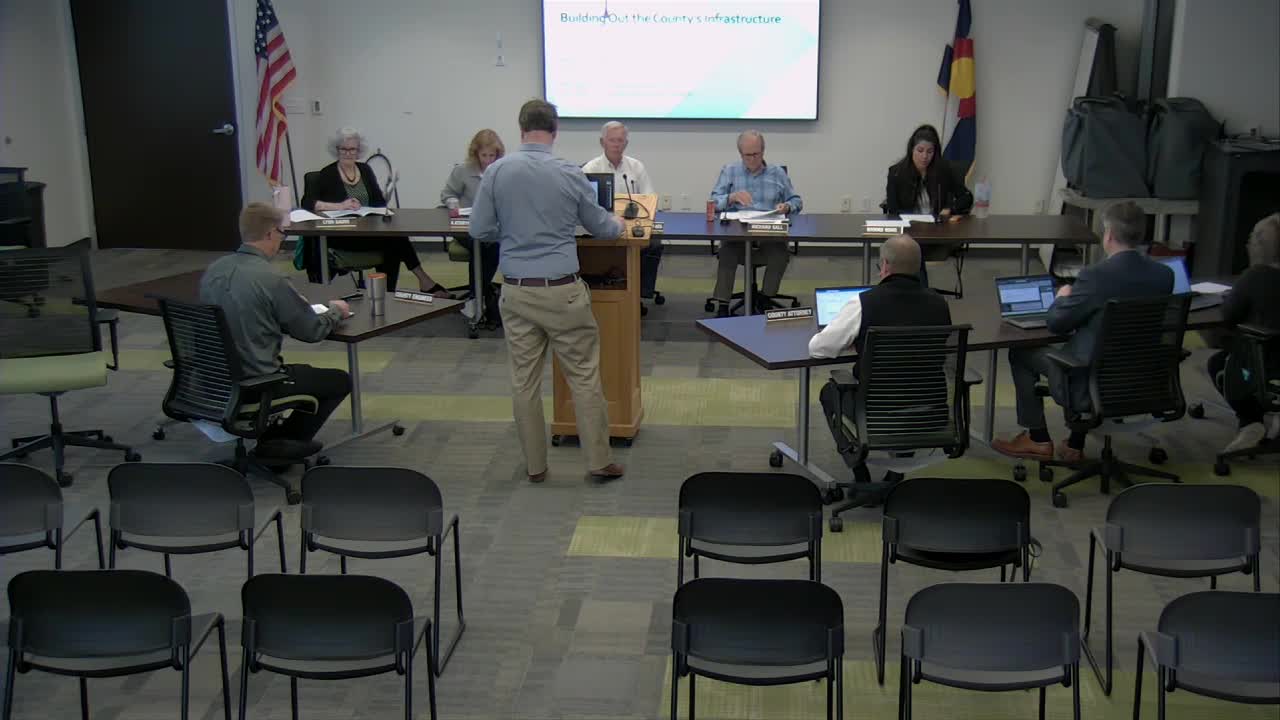
At a June 3 Planning Commission study session, Arapahoe County staff described a large gap between transportation and stormwater needs and county funding, and detailed how private development has funded or accelerated public improvements in recent projects.
Arapahoe County officials told the county Planning Commission on June 3 that the county faces a substantial shortfall in funding needed to maintain existing levels of service for roads and stormwater, and that private development has been and will continue to be a primary source of funding and construction for major public improvements.
Joe Scheel, of the Arapahoe County Engineering Services Division, and James ("Jim") Kotcher, Transportation Division manager, told commissioners the county’s five‑year need to preserve current levels of service on the road network is about $25 million to $30 million per year and that the county typically receives far less in capital funding. "We asked for $5,600,000 and they generously gave us half a million," Kotcher said, summarizing recent budget outcomes. He said large projects such as the I‑70/Monahan interchange are on the order of tens of millions of dollars — Kotcher cited a roughly $40,000,000 construction cost and a higher financed cost — and noted that turning gravel roads to pavement and other upgrades also require significant capital.
The presentation explained how county development review and master plans determine when developers must construct or pay for improvements. Scheel said traffic impact studies and drainage studies are required components of land‑use applications; those studies are reviewed against the Arapahoe County development and engineering criteria and the county’s 2040 Transportation Master Plan and master drainage plans. "The purpose of the traffic study is to evaluate the impact that the proposed development will have on existing traffic, infrastructure and operations," Scheel said.
Scheel and Kotcher walked commissioners through signal warrants from the Manual on Uniform Traffic Control Devices and stressed that meeting a warrant alone does not automatically require a traffic signal: an engineering study must also show the signal is the appropriate remedy. Scheel also described typical stormwater controls used to protect downstream properties and water rights, such as detention ponds, water‑quality measures that hold smaller storm events on site, and stream bank stabilization work.
Staff presented multiple developer partnership case studies. For the Waste Management project at Quincy and Harvest, the developer installed a traffic signal and turn lanes and constructed roughly $572,000 in roadway and traffic improvements plus about $409,000 in stream‑stabilization work connected to detention and Murphy Creek outfall, Scheel said. For larger developments, staff highlighted Sky Ranch (near I‑70 and Monahan) — described as roughly 775 acres with potential for about 4,000 dwelling units — where the interchange at I‑70 limits permitted development and staff said private bonding, an area impact fee (estimated by staff at about $7,000 per new home under discussion) and federal grants are being considered to finance an estimated $40,000,000 interchange upgrade.
Staff also reviewed the Copperleaf area and a prior development agreement in which the county advanced money to widen Quincy Avenue; the developer later reimbursed the county when their parcel developed. Kotcher said right‑of‑way dedications and developer‑built public infrastructure reduce the county’s direct capital need and can accelerate projects, but that incomplete development leads to sidewalk gaps and uneven infrastructure along corridors.
Commissioners asked about grant availability, CDOT processes and the implications for affordable housing. Kotcher said much of the county’s outside funding is federal and that the amount and character of available grants can change with federal and state priorities. The presentation noted CDOT’s 1601 process (state oversight and requirements for projects affecting interstate highways, including funding plans and transportation demand management) as a constraint for interstate interchange work. On affordable housing, staff said incentives under consideration include reduced engineering and planning fees, expedited plan review, additional density allowances, and potential reductions in certain local impact fees (for example, open‑space fees) but that some costs — including school district fees and market forces — lie outside county control.
The presentation concluded with staff urging that partnerships — impact fees, developer construction, grants and targeted county investment — are the county’s primary path to build out the network outlined in the 2040 Transportation Master Plan, and that absent additional funding the county will continue to defer projects and see service levels decline. A staff announcement later in the meeting noted a June 17 public hearing with items including a hotel‑to‑multifamily conversion and a gas plant facility.
Questions and technical clarifications from commissioners and staff were recorded throughout the study session. The county staff repeatedly distinguished between discussion items (options and constraints), direction (staff developing funding or design plans), and formal actions: no regulatory changes or final approvals resulted directly from the study session itself.