Get Full Government Meeting Transcripts, Videos, & Alerts Forever!
Get email alerts on the Wireless Communications Code Amendment topic
No spam. Unsubscribe anytime.
Arapahoe County planning commission recommends rewrite of wireless communications rules
Summary
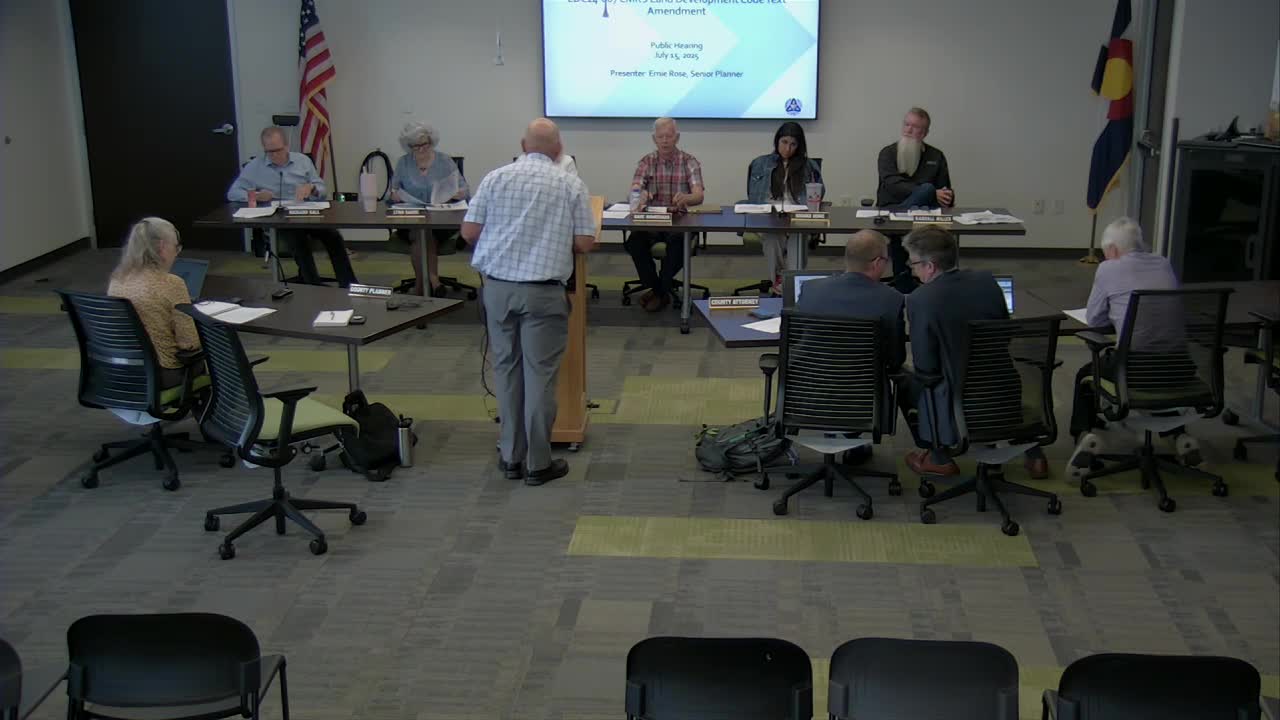
Arapahoe County Planning Commission on July 15 recommended approval of LDC 24-007, a land development code amendment that retitles and expands the county’s CMRS rules to cover “wireless communication facilities,” and aligns local permitting with FCC requirements and recent state legislation.
Arapahoe County Planning Commission on July 15 recommended approval of LDC 24-007, a land development code amendment that retitles and expands the county’s commercial mobile radio services (CMRS) rules to cover “wireless communication facilities,” and aligns local permitting with Federal Communications Commission requirements and recent state legislation. The commission voted 6-0 to forward the amendment to the Board of County Commissioners for public hearing.
The change updates terminology, adds preferred antenna types, clarifies review criteria for eligible facility requests, describes administrative processes for modifications and repairs, and adds several right-of-way entries (attached structures, rooftop antennas, alternative tower structures, small cell facilities and temporary facilities). Ernie Rose, senior planner in the public works department, told commissioners the revisions also require applicants to show that other siting options are not feasible and set an administrative process for replacing and upgrading equipment.
"The proposed revisions retitle the CMRS codes from CMRS to wireless communication facility. It incorporates potential technological advances across all types of wireless communication, complies with Federal Communication Commission, regulation, delineates the criteria for eligible facilities, promotes the collaborative use of both new and existing wireless communication locations," Ernie Rose said.
Why it matters: commissioners and staff said the update is intended to bring county code into compliance with federal rules that impose a 90-day review “shot clock” for certain wireless siting decisions and to reflect recent state legislation referenced in the staff presentation (transcript reference: "House Bill 25 10 56"). County staff said the revision helps ensure internal consistency across the land development code and clarifies what types of wireless facilities may be allowed in the public right of way.
Staff and outreach: Rose said staff worked with Clarion Associates on the draft and conducted outreach to roughly two dozen wireless providers; the only written responses staff received were a community comment and a letter from counsel for Verizon Wireless. Rose said staff and county counsel met with industry representatives to review proposed edits and accepted some technical clarifications.
Commissioner questions and concerns: Commissioner Miller asked about the 90-day timeline and whether the county had previously been required to act within 90 days. "I mean, I know we can't change anything, but it talks about this 90 days, you know, we have to act on something within 90 days. Otherwise, it becomes automatic approval. Has that always been the case?" Miller asked. County staff and consultant Don Elliott said the 90-day requirement reflects federal regulations and that the county has either completed reviews within that timeframe or reached agreements with applicants to toll the clock when additional information was needed.
Don Elliott of Clarion Associates described the stakeholder process and pushed back on the suggestion that industry dictated the draft. "This is not all the things Verizon asked for. They asked for several other things that the county and the county attorney and the staff said, no," Elliott said.
Jason Reynolds, with planning, noted that not all right-of-way wireless facilities are "small cell" installations and cited a macro facility at the southeast corner of Quebec and Dry Creek as an example of a non–small-cell support in the right of way.
A number of commissioners expressed wariness about appearing to let large providers dictate code language. Rose and Reynolds said the draft originated with Clarion Associates, was vetted internally, and was sent to industry and other stakeholders so objections could be identified and resolved before formal hearings.
Action: Commissioner Sabe moved to recommend approval of LDC 24-007 as presented in the staff report, subject to a recommended stipulation. Commissioner Latsis seconded. The roll call recorded aye votes from Commissioner Howe, Commissioner Miller, Commissioner Saul, Commissioner Sauve, Chair Pro Tem Latson and Chair Morehouse; the motion passed 6-0.
Next steps and meeting context: The commission’s recommendation is advisory; the Board of County Commissioners will consider the amendment at a future public hearing. Staff announced that the next planning commission agenda (Aug. 5) will include an affordable housing land development code amendment. The meeting concluded after the vote.
Votes at a glance
- Motion: Recommend approval of LDC 24-007 (CMRS / wireless communication facilities land development code amendment) as presented, subject to recommended stipulation number 1. Motion made by Commissioner Sabe; seconded by Commissioner Latsis. Vote: 6-0 in favor.
(Quotes and attributions are drawn from the hearing transcript.)