Get Full Government Meeting Transcripts, Videos, & Alerts Forever!
Get email alerts on the Budget Transparency topic
No spam. Unsubscribe anytime.
Committee advances budget‑transparency measures; administration urges caution on early lapse estimates
Summary
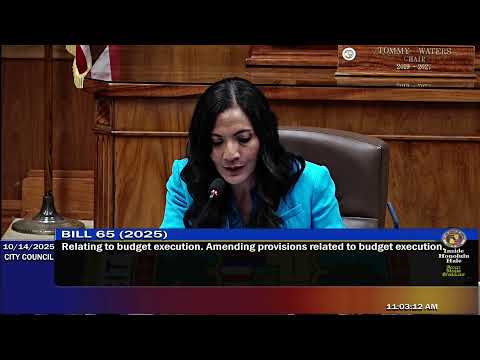
The committee moved Bill 64 (reporting of appropriations with the mayor’s budget) to second reading and public hearing and amended and advanced Bill 65 (quarterly consolidated reporting of budget transfers) to CD1. The Department of Budget and Fiscal Services opposed both measures as originally written, citing administrative burden and inaccuracy
The Budget Committee on Oct. 14 forwarded two measures aimed at improving budget transparency — Bill 64 (requiring the mayor to submit an appropriations report with the annual budget documents) and Bill 65 (requiring consolidated quarterly reporting on budget transfers) — but the administration raised concerns about scope and timing and asked for further refinement.
Administration concerns: Andy Kawano, director of the Department of Budget and Fiscal Services (BFS), told the committee that estimating lapsed appropriations five months before the fiscal year ends risks producing inaccurate figures and creates an additional administrative burden. Kawano noted that departments provide actual lapse trends for completed years as part of the regular budget cycle and that some activities (for example, police overtime or emergency responses) are difficult to predict in advance. “To put out what we think is gonna lapse… I think is really not the right thing to do,” Kawano said.
Committee perspective and examples: Council Chair Waters said more granular reporting would help the council and public better understand carryovers and how city managers are using funds; she cited figures in committee discussion about large carryover balances (committee discussion referenced roughly $785.1 million in restricted carryover and $451.9 million in unrestricted carryover for FY26 in the record during debate). Waters argued that organized, consistent reporting would strengthen accountability.
Outcomes: Bill 64 was reported out for second reading and scheduling of a public hearing. Bill 65 was amended (CD1) to remove a particular exhibit reference and the amendment was reported out for second reading and scheduling of a public hearing, with noted reservations from one councilmember and the department. Both measures will move forward for further public consideration and possible technical revisions.
Why it matters: the measures aim to standardize reporting on lapses and transfers to give the council and public better visibility into how appropriations are executed and carried forward from year to year; the administration requested additional work to ensure the data provided would be accurate and useful rather than misleading.