York City SD reports gains in English-language development program; 100 students exited program last year
Summary
District ELD staff told the school board on Oct. 15 that targeted instruction, new curriculum and coaching produced measurable gains for English learners, including roughly 100 exits from the program and higher-than-average growth on state metrics.
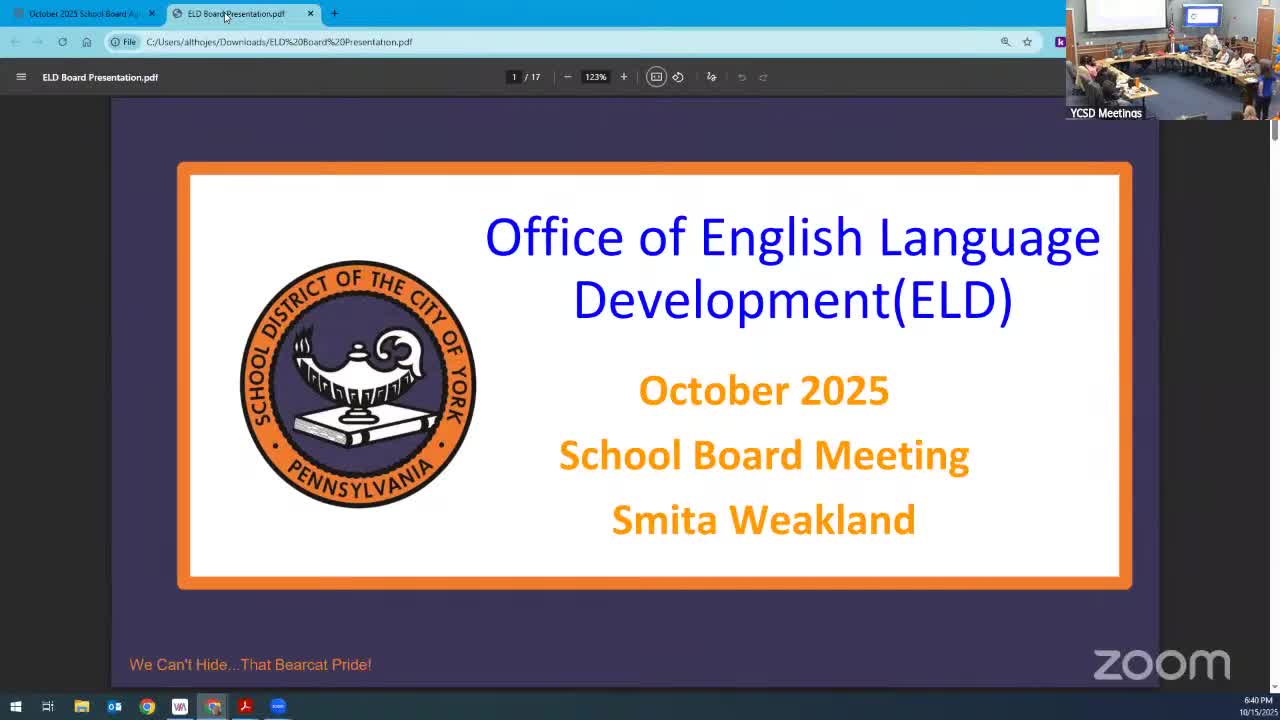
Smita Weekland, supervisor of English Language Development for the School District of the City of York, told the school board Oct. 15 that the district’s focused ELD program and new curriculum are producing measurable gains for English learner students.
Weekland said the district serves 1,859 English learners (about 28.7% of enrollment) who speak 25 home languages and represent 51 countries of origin. She described an ELD program built around targeted instruction, coaching and a language-level model that groups students by English proficiency rather than strictly by grade.
Weekland told the board the program uses a pre-K–12 ELD curriculum and coaching cycles to support teachers, and that the district supplements classroom work with programs such as Imagine Learning (K–8) and Summit (at the high school). She said those systems, combined with professional learning for teachers, helped 100 students “exit” the ELD program last school year and produced other positive metrics: 45% of English learners exceeded growth targets on the state’s reporting metric, compared with a state average of about 31.7%. Of 96 senior English learners last year, 94 graduated with their class, Weekland said.
ELD staff who spoke at the presentation described classroom practices and supports. Jen Shelton, an ELD specialist at Steam Academy, said teachers use a skills-based approach (for example, teaching the same compare-and-contrast skill adapted to pre-K through eighth grade). Holly Crowder, an ELD teacher at Ferguson, said the Bearkat Family Welcome Center provides interpreters at family celebrations and helps parents complete applications such as those for VOTEC programs. Anna Sebastian, an ELD specialist at the high school, highlighted coaching, curricular supports (ELD 1–3 courses) and tools that allow teachers to monitor students across mixed-level classes. Jen Busick, the district’s new ELD coach, said her role is to align instructional practice across buildings and support teacher collaboration.
Weekland walked the board through assessment and benchmark data. She said 1,701 English learners took the annual English language proficiency test administered in January–February (referred to in the presentation as the district’s ACCESS test) and that the district’s average score was 2.69 on that assessment scale. She also presented Imagine Learning benchmark data showing a decline in the share of students at the lowest proficiency band (beginning) from 53% in August 2024 to 36% at the end of the year, and an increase in students at or above grade level in literacy from 31% to 50% over the same period.
Weekland said the district intentionally provides ELD services starting on day one, not delayed, and that the Bearkat Family Welcome Center served about 968 families during the last school year and 384 families over the summer. She described Title III funding and parent classes (adult English, financial literacy, identity-fraud prevention and homeownership sessions) as part of family engagement efforts.
Board members asked about classroom capacity and how ELD supports general-education teachers. Weekland said the district uses a pull-out model with 30-minute ELD groups in K–8, noting scheduling and resource tradeoffs with co-teaching. She said the district has worked to scale a language-level grouping model across buildings over the past two years and that results at several schools indicate language-level grouping is producing gains.
Weekland identified ongoing priorities as continued coaching alignment, support for dually identified special education/EL students, and deeper family partnerships. She thanked ELD teachers, bilingual aides, welcome-center staff and central office administrators for supporting the work.
Weekland and the ELD staff provided multiple concrete numeric details, which they attributed to district assessments and vendor benchmark reports during their presentation. No board action was taken on the ELD presentation; it was provided for information and discussion.