Get Full Government Meeting Transcripts, Videos, & Alerts Forever!
Get email alerts on the District Finance topic
No spam. Unsubscribe anytime.
Tallmadge City Schools project multimillion-dollar state funding drop, board adopts four-year forecast ahead of levy vote
Summary
District presenters told the Tallmadge City Board of Education the district will lose roughly $1.7–$2.0 million in state aid over three years because of valuation-driven reductions in the state share; the board voted to adopt and submit the four‑year forecast required by state law and continues to urge passage of a renewal levy.
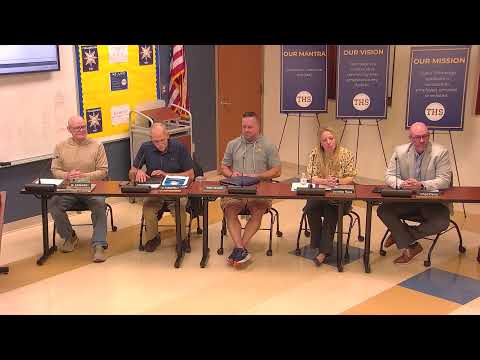
Tallmadge City Schools officials told the Board of Education on Oct. 15 that a rise in local property valuation has reduced the district’s state funding share and will lower state payments by roughly $1.7 million to more than $2 million across the next three fiscal years, and the board voted to adopt the district’s four‑year financial forecast for submission to the state.
District staff presented detailed calculations showing that the district’s state share per student declined from about $3,001.95 in fiscal 2024 to a projected lower amount by fiscal 2027. A district presenter summarized the effect in dollars: with an average daily membership of roughly 2,400 students, the reduced state share produces an aggregate revenue loss in the low millions each year.
The presentation framed the revenue loss as a valuation-driven effect of state funding rules — including the phase-in process for valuation changes — and contrasted Tallmadge City Schools with districts that sit on the so‑called 20‑mill floor, which do not experience the same automatic state-share declines when valuation rises.
Officials told the board the forecast submitted to the state does not assume passage of any new levy money (state rules do not permit assuming a future levy when preparing the forecast), though the district’s internal numbers do assume the district’s historically successful renewal levies will pass. The presenters said the district is also implementing several cost-control measures reflected in the forecast: a wage freeze for fiscal 2027 and forward and an anticipated reduction of eight staff positions as part of the state-required working plan to eliminate an identified future deficit.
“The state share went in fiscal year ’24 to … and from ’24 to ’27 we’re losing over $2,000,000 in state revenue simply because our valuation went up,” the presenter said during the slide presentation. “When you look at a district … and you get a million seven to $2,000,000 drop in three years, that’s catastrophic. This is why we’re on the ballot.”
Board members and staff also described other adjustments embedded in the forecast: reduced capital outlay spending, shifting capital costs into Permanent Improvement funds tied to an existing replacement levy, and modest reductions in contracted services and in the Sixth District Compact allocation. The presenter said those line‑item adjustments, together with the wage freeze and staff reductions, are necessary to keep the district out of deficit in the third forecast year absent additional revenue.
Board action: After the presentation the board voted to adopt and submit the four‑year forecast and accompanying notes to the state as recommended by district staff. The motion passed on a voice vote with board members registering their approval.
Why it matters: Board members emphasized the forecast’s implications for operations, personnel and classroom programs, and they urged voters to consider the renewal levy on the November ballot as the primary route to restoring local revenue flexibility. District staff reiterated that state law and the funding formula — and not local action alone — produced the projected decline in state aid when local valuation rose.
Looking ahead: Officials said the forecast will be posted with the accompanying notes and that staff remain available to meet individually with residents for detailed explanations. The district will continue outreach on the renewal levy and will revisit the forecast if election results or state policy change the district’s revenue outlook.