
City outlines Vic Trace reservoir replacement, community outreach and plan to use construction manager at risk procurement
Get AI-powered insights, summaries, and transcripts
Subscribe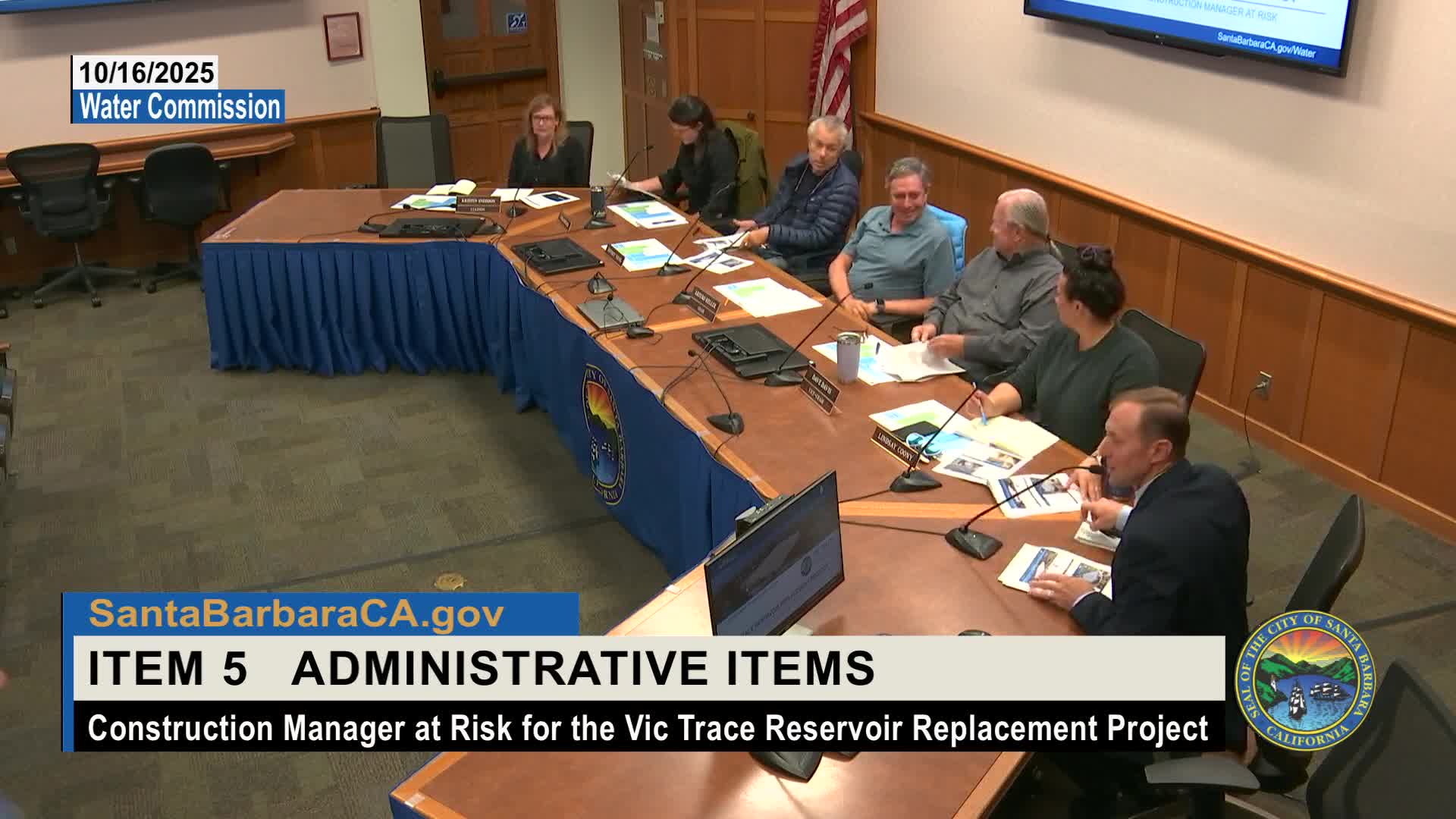
Summary
Staff described a planned replacement of the Vic Trace reservoir, neighborhood outreach, CEQA schedule and the city's decision to pursue construction manager at risk (CMAR) procurement to reduce risk and incorporate constructability review and guaranteed maximum pricing.
The Water Commission heard an update Oct. 26 on the Vic Trace Reservoir replacement project in the Alta Mesa neighborhood and on the city’s planned procurement using a construction manager at risk (CMAR) delivery method.
Water staff said Vic Trace — a reservoir built in 1956 that stores roughly 10 million gallons and serves about 60,000 people — is at roughly 15% design and is scheduled for significant replacement to address seismic risk, water-quality needs, site security and stormwater capture. Project staff described extensive community outreach, including an in-person neighborhood meet-and-greet attended by dozens of neighbors, and said the next public milestone will be the initial CEQA scoping workshop expected in December followed by a draft EIR in late spring.
Project managers said they intend to pursue SRF (State Revolving Fund) low-interest loan funding in December and are exploring other financing, including municipal bonds. Kelly Bork, a project team member, said the city is coordinating with multiple internal departments (police, fire, parks, IT) and with Architectural Review Board (ABR), planning commission and other advisory bodies as part of CEQA and planning reviews.
On procurement staff explained that a March voter-approved city code change now allows alternative delivery methods. The project team recommended CMAR, citing benefits such as contractor constructability input during design, schedule and sequencing expertise to minimize community impacts, early identification and shared understanding of risks and a guaranteed maximum price (GMP) at 100% design. Staff said CMAR can reduce change orders by surfacing constructability and pricing issues earlier in the process and by placing contingencies and risk items into a negotiated risk registry rather than leaving them as unknown change orders during construction.
Staff said four qualified CMAR proposals were received and, after interviews and reference checks, the team selected Kiewit (presented as Kearney Pacific/Kearney Pacific in materials) as the recommended firm. Staff described Kiewit as an experienced water/wastewater contractor with prior CMAR experience and said the selected firm emphasized local union relationships and workforce agreements. Staff also emphasized the city will keep a conventional bid path as a fallback: if the parties cannot agree on a GMP, the city can still competitively bid the work under a traditional low-bid model.
Commissioners asked about cost escalation and change-order risks observed after the COVID-era inflation spike. Staff said construction-cost increases have moderated somewhat and the CMAR process helps identify and manage material and schedule risks, though large unknowns remain. Staff said the project budget estimate in preliminary design is approximately $130 million and that costs were projected forward to 2029 when construction is expected; they said the CMAR procurement will allow more precise cost accounting as design proceeds. The project timeline given to the commission showed ongoing CEQA and planning in 2025–2026, design completion in 2027 and construction beginning thereafter, subject to funding and permitting.