
Staff report: inspection finds key pipeline defects in Sheffield Tunnel; CCWA settles long-running contract lawsuit
Get AI-powered insights, summaries, and transcripts
Subscribe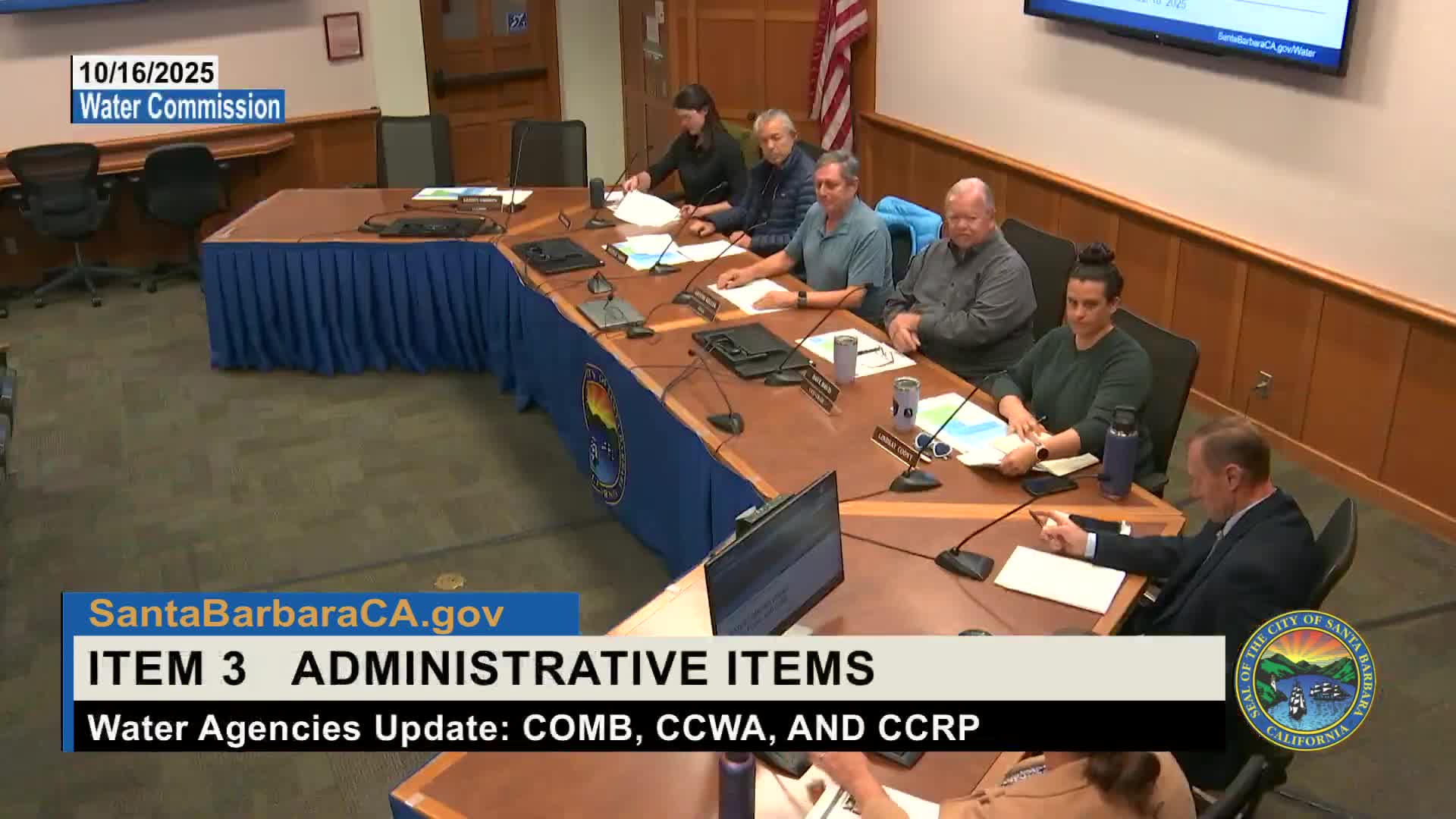
Summary
City staff told the Water Commission that inspections of the South Coast Conduit inside the Sheffield Tunnel found significant joint and band deterioration and that CCWA settled a 2021 lawsuit with the county, including a $5.8 million payment to the county.
The Santa Barbara City Water Commission was briefed Oct. 26 on inspection findings showing deterioration in the South Coast Conduit inside the Sheffield Tunnel and on a settlement that transfers the State Water Project contract holder role from Santa Barbara County to the Central Coast Water Authority (CCWA).
The briefing, delivered by Dakota Corey, the city's water supply and services manager, and other staff, described an inspection this spring inside the Sheffield Tunnel — a 6,100-foot concrete tunnel carrying a 30-inch diameter portion of the South Coast Conduit from the Sheffield Pump Station toward Parma Park — that identified “severe mortar cracks” and steel band failures at multiple joints. Corey said 15% of the 503 joints examined showed deficiencies rated “type 4 or worse.” He called the findings a “significant maintenance concern” because the tunnel has no redundancy and a catastrophic failure could interrupt deliveries to Montecito Water District and Carpinteria Valley Water District.
The city presentation said the Kachuma Operations and Maintenance Board (COME), a joint powers agency that includes the city and three neighboring districts, is prioritizing repairs. Planned near-term actions include monitoring seepage, performing a winter video inspection of the inside of the tunnel and replacing two large control valves at the Sheffield Control Station to allow isolation of conduit sections. Staff said the conduit was formed in 12-foot segments joined by steel bands and double gaskets and that the pipeline is more than 70 years old. Philip Maldonado, acting principal engineer, said the contract for on-call control-systems integrators is used frequently and that the proposed contract increase provides authority to fund repairs as specific work is identified.
Corey said COME is pursuing a phased approach, has experience securing grants for similar projects and, at its September board meeting, approved prioritizing the control-station valve work and the inside-tunnel video inspection, scheduled for this winter. City staff said access and confined-space complications inside the tunnel make repairs challenging and that replacement or internal lining technologies are being evaluated.
Corey also briefed commissioners on CCWA developments. He said a lawsuit initiated in June 2021 over management changes to State Water Project contract provisions has been settled. Under the settlement, CCWA will become the holder of the State Water Project contract (previously held by Santa Barbara County), CCWA and member agencies will dismiss the case with prejudice, CCWA will pay the county $5,800,000 (the city's share is “just over $445,000,” staff said) and the county retains an option to reacquire up to 1,700 acre-feet per year of “suspended Table A” water if CCWA later pursues reacquisition projects.
Staff explained “suspended Table A” as the difference between the original contracted 57,700 acre-feet and the amended 45,486 acre-feet (12,214 acre-feet). Staff said the suspended volume has value in regional water markets and to certain agencies that can bank or use that water during wet years; the city said it historically has not sought to acquire more Table A volume.
Finally, staff summarized activities by the Kachuma Conservation and Release Board (CCRB), which coordinates actions related to Kachuma Project water rights and downstream releases for steelhead protection. Staff said CCRB and COME continue federal consultation tasks with the Bureau of Reclamation and the National Marine Fisheries Service and that CCRB recently refunded a portion of the member billing because some budgeted funds were unused in FY25.
Commissioners asked about the tunnel inspection frequency, who pays for repairs, the practical downtime for repairs and the city's role in delivering emergency “health-and-safety” water downstream if sections of the conduit are isolated. City staff said COME is funded through member agency contributions, that the control-station valve work was advanced within existing COME budgets by reprioritizing projects, and that lining the entire pipeline could require additional funding or grants. Corey said the city could likely supply “some level of health-and-safety water” during an outage but not the full conduit volume.
City staff said COME attempted an earlier internal inspection but initially had to withdraw crews because of communication and confined-space safety issues; improved communication technology enabled the full inspection this spring. Council member Steinle, who said the city has voting representation on COME and chairs that board, told the commission that COME unanimously approved pursuing the work.
The presentation closed with staff noting possible environmental risks if chlorinated water leaked into creeks during a failure and reaffirming that COME will pursue grant funding, monitoring, and a phased repair approach.