
WSBA and state courts roll out Lawyers in the Classroom to expand civics education
Get AI-powered insights, summaries, and transcripts
Subscribe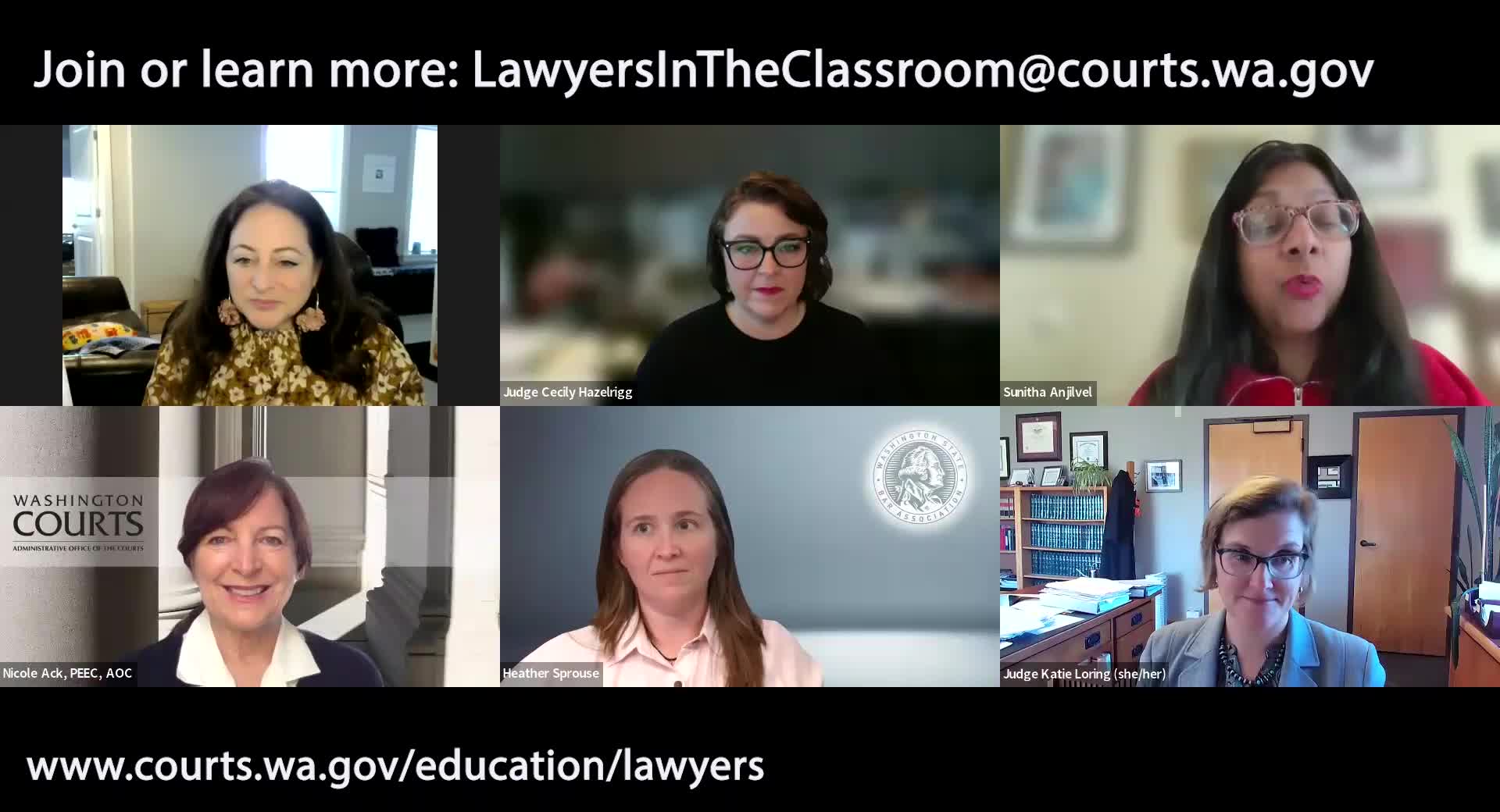
Summary
Washington State Bar Association and state court educators introduced 'Lawyers in the Classroom,' a volunteer program pairing legal professionals with K–12 teachers to teach civics and the rule of law; volunteers may record hours as pro bono service and sign-ups are coordinated through the Administrative Office of the Courts and WSBA.
Sunitha Angelvel, president of the Washington State Bar Association, introduced Lawyers in the Classroom at a WSBA online session, calling the program part of the WSBA’s rule of law ambassador work and urging lawyers to bring civic lessons into K–12 classrooms.
The program builds on an existing Judges in the Classroom model run by the Board for Judicial Administration’s Public Engagement and Education Committee and the Administrative Office of the Courts. Nicole Ack, senior court program analyst for the Administrative Office of the Courts, said the materials and lesson plans are available online and that volunteers can sign up by emailing her with “Lawyers in the Classroom” or “LITC” in the subject line. "Put lawyers in the classroom or LITC in the subject line," Ack said, explaining she will help match volunteers to teachers and act as a liaison.
Why it matters: WSBA leaders framed the program as an “upstream” effort to strengthen public understanding of the courts and the rule of law by exposing students to legal professionals. Angelvel said, "Every lawyer automatically becomes a rule of law ambassador when they take their professional oath," and added that the time volunteers spend in classrooms "can be submitted as pro bono hours annually." Program leaders said the initiative aims to counter misinformation, build relationships between legal professionals and K–12 students, and increase civic literacy.
Program structure and classroom approaches: Panelists said lesson plans are available for elementary through high school and can be adapted. Judge Catherine Loring of the San Juan County Superior Court described using prepared lessons on topics such as search and seizure in schools, freedom of expression, and student drug testing. She noted many high school lessons include hypotheticals and role-play: students are often assigned positions to argue and then compare classroom outcomes with real cases.
Judge Cecily Hazelrigg, chief judge of Division 1 of the Washington Court of Appeals, encouraged volunteers to prepare for the power imbalance inherent in adults addressing children and to practice cultural competence when discussing identity, race, gender and socioeconomic topics. "Proximity to youth ... from a position of power ... has the potential to do great good. We also have the potential to ... unintentionally do some harm," Hazelrigg said, urging volunteers to develop "self-awareness, self-regulation, humility." Hazelrigg also described alternate formats she has used, from tailored talks about her path to the bench to in-class lessons comparing state and federal constitutions.
Logistics, partnerships and flexibility: Panelists said volunteers should try to work through existing personal or local school relationships—alumni ties, neighborhood schools, or children’s schools—or allow the Administrative Office of the Courts and WSBA to make initial introductions. The presenters said lessons were updated in 2019 and can be further revised; they welcomed volunteer input on updates. The group said the program is open to public, private and tribal schools and that virtual visits (for example, by Zoom) can be an option when in-person visits are difficult.
Professional-credit guidance and coordination: Panelists said volunteering is generally eligible for pro bono reporting; continuing legal education (CLE) credit for presenting to nonlawyer audiences is not generally available, though panelists said they would seek a definitive answer on MCLE rules regarding preparation time. Ack and WSBA staff asked volunteers to copy both the Administrative Office of the Courts and WSBA contacts when contacting schools so organizers can track participation and assist with materials.
Participation tips and next steps: Panelists recommended that new volunteers start with prepared lesson plans, consider partnering with another attorney, and keep teachers apprised of pre-reading or handouts so class time runs smoothly. To volunteer, speakers directed attorneys to email Nicole Ack with geographic preferences and indicated WSBA staff would help publicize the program to teachers. "If you contact schools that you're interested in or teachers, just copy me," Ack said, adding that showing the program is backed by the court system often eases classroom access.
The session closed with organizers thanking volunteer judges and staff and reiterating the sign-up instructions and support offered by the Administrative Office of the Courts and WSBA.