
Planners flag constraints for utility‑scale wind in Spokane County: airfield buffer, critical areas and aquifer risks
Get AI-powered insights, summaries, and transcripts
Subscribe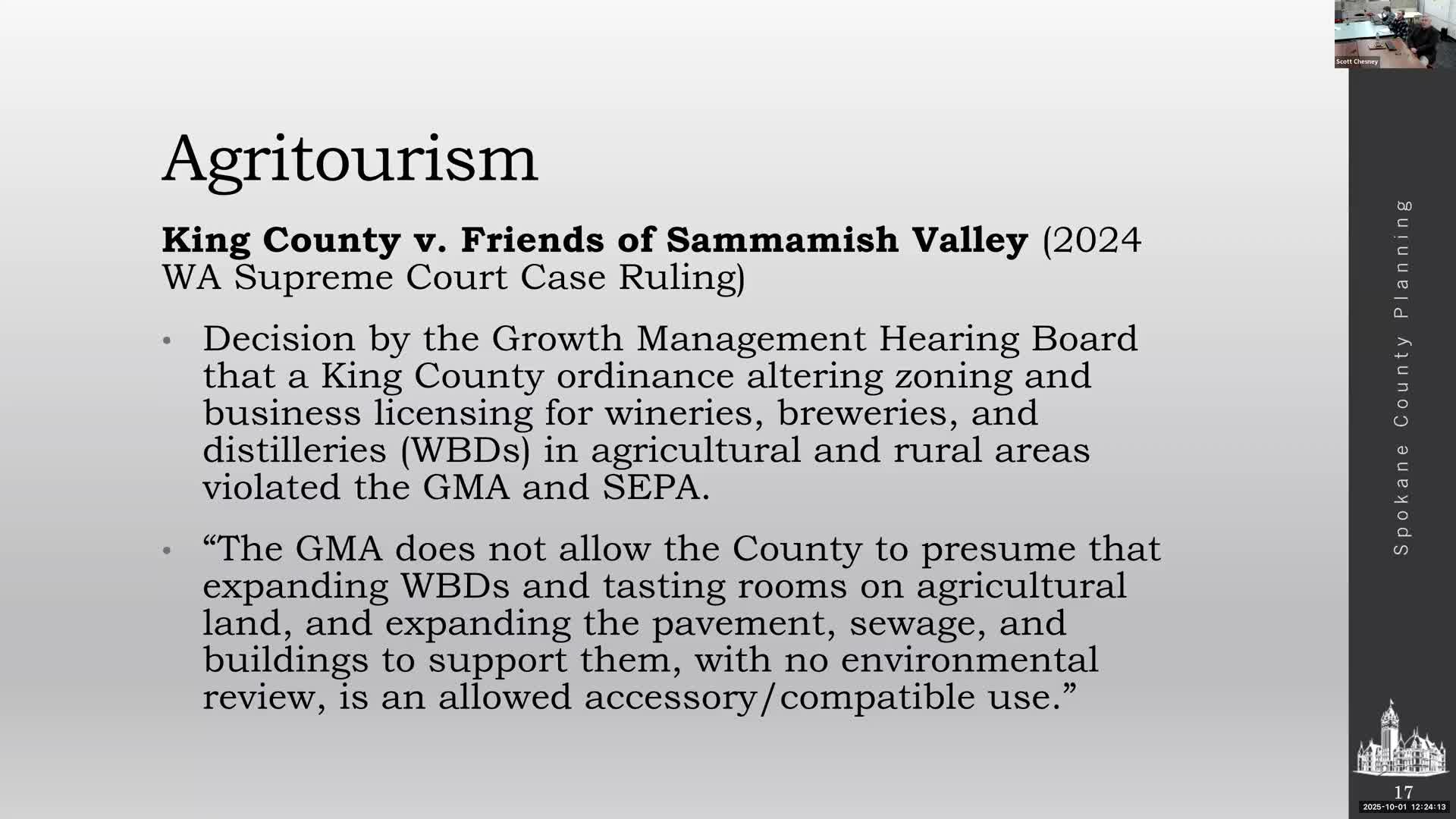
Summary
Spokane County staff presented a preliminary suitability analysis for utility‑scale wind energy that identifies limited unconstrained sections in the county, cites a 5.8 m/s viability threshold, a 15‑mile buffer around Fairchild Air Force Base and potential groundwater and agricultural impacts as major constraints.
Spokane County planning staff told residents at a virtual open house that while energy companies have expressed interest in utility‑scale wind development in parts of the county, multiple environmental, agricultural and safety constraints make suitable, lawful siting rare.
Scott Chesney, speaking for Spokane County Planning, summarized the county’s preliminary technical filters for wind: a practical wind‑speed threshold (staff cited about 5.8 meters per second as a low viability threshold), avoidance of mapped critical areas and biodiversity corridors, protection of prime agricultural soils, and a 15‑mile safety buffer around Fairchild Air Force Base recommended by the base.
Why this matters: Each filter reduces the acreage that could be used for turbines. Staff said that, after mapping wind speed, soils, aquifer protection, critical areas and buffers around municipalities and Turnbull (a wildlife/refuge area), six sections in the county’s southeast corner remained the least constrained — but even those areas face legal and agricultural limits.
Chesney noted two specific constraints planners are studying: (1) foundations and access roads for large turbines require substantial ground disturbance and can remove productive farmland from agricultural production, and (2) constructing turbine foundations near shallow groundwater or aquifers could alter groundwater flow or introduce contamination risk. He said roughly one acre of land is taken per turbine for the tower footprint, not counting temporary construction disturbance or the network of access and maintenance roads.
Staff also flagged aviation safety: Fairchild Air Force Base asked the county for a 15‑mile buffer; planners said tall turbines within departure corridors could present hazards if military aircraft lose thrust and cannot safely clear high obstacles. The county is coordinating with Fairchild and the governor’s office on recommended military airfield buffers.
Chesney referenced recent Washington case law involving agricultural land uses and the Growth Management Act: courts have found in some appeals that land‑use changes that materially degrade agricultural character can violate GMA and SEPA if impacts weren’t fully considered in environmental review. That precedent, he said, will be a controlling legal consideration if utility‑scale wind proposals would remove significant acreage from farming.
Ending: Staff described the wind analysis as preliminary and subject to further study in the rural element audit and the county’s EIS. No siting decisions or county approvals were made at the open house; planners said any future proposals would require detailed environmental review, interagency coordination and likely mitigation to address agricultural, groundwater and aviation concerns.