
U.S. EPA, responsible parties outline multi‑year plan to remove 51,000 drums from Fremont barrel fill near Springfield
Get AI-powered insights, summaries, and transcripts
Subscribe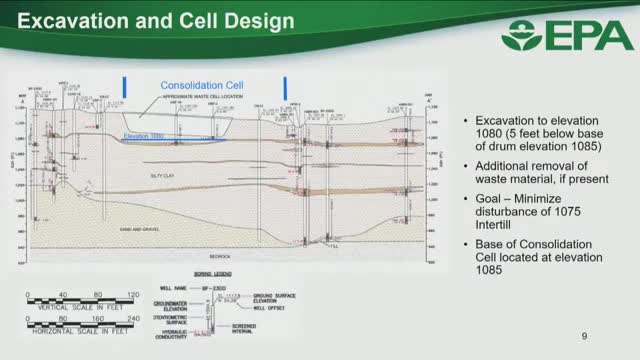
Summary
Federal and state regulators and contractors told the Springfield City Commission they are at 30% remedial design and expect multi‑season drum removal to begin in late 2026 or early 2027, with monitoring and safety controls to protect a nearby aquifer.
Representatives of the U.S. Environmental Protection Agency, the Ohio Environmental Protection Agency and contracted firms briefed the Springfield City Commission on plans to excavate more than 51,000 buried drums at the Fremont City barrel fill site and to build a new hazardous‑waste containment cell on site.
The update, delivered during a city commission work session, said the project is at the 30% design stage, that three baseline groundwater monitoring events have been scheduled, and that responsible parties under a federal consent decree are expected to pay for the work. Officials said drum removal will occur one barrel at a time and could take multiple construction seasons.
The project matters because the barrel fill is close to the aquifer that supplies drinking water to Springfield and other communities in southwest Ohio. Commission members and community stakeholders have pressed for a cautious approach to avoid causing contamination during excavation.
Officials said there are roughly 50 waste cells at the site, each containing about 1,000 drums, for a total of more than 51,000 buried drums. The work is planned in phases, beginning at the north end of the site. Crews will excavate drums, transfer them to a consolidation area for hazard categorization and “bulking” of like materials, and then transport liquids and other wastes off site for disposal or incineration. Contractors estimated a typical good day could remove about 100 drums.
Technical presenters described the engineered liner and cap system that will be built for materials remaining on site. The proposed hazardous‑waste cell will include (from the bottom up) a compacted low‑permeability clay layer, a 60‑mil high‑density polyethylene (HDPE) liner, a leak detection layer, a primary HDPE liner, a leachate collection system and protective soil layers. After emplacement, the cell would be capped with multiple layers including a geosynthetic clay liner, another HDPE layer, a geocomposite drainage layer and approximately 30 inches of soil.
A site‑wide monitoring plan will establish baseline groundwater and groundwater‑related conditions. Presenters said one sampling event has already been completed (last fall/winter), and two additional baseline sampling events are planned — one this fall/winter and one in the spring — before construction begins. Monitoring wells on site will be sampled during baseline and periodically during the remedial action to verify that excavation activities are not causing off‑site impacts.
Officials said the schedule is guided by the consent decree and regulatory review. The team has submitted 30% design documents to the U.S. EPA and Ohio EPA; the next deliverable is expected to be the 90–95% design, targeted for December 2025. Remedial design completion is currently projected for 2026, with field work targeted for late 2026 if approvals and final design align, though presenters acknowledged start could slip to early 2027.
On funding, presenters said the consent decree originally estimated a little over $27,000,000 for response costs, but that total has likely increased and that the responsible parties — not city tax dollars — are bearing the expense.
Commissioners and presenters discussed safety and community protections. Officials said the site will be closed to the public once excavation begins, work hours will likely be daylight hours, perimeter air monitoring and worker monitoring will be in place, and routine briefings with first responders are planned. Presenters estimated there could be about 35 personnel on site performing different tasks during active work, and emphasized the slow, deliberate removal process to reduce the risk of releases to soil or groundwater.
Commissioner praise and next steps: Commissioner Estrop thanked the project team and noted the matter carries the force of a federal court order. Presenters said they plan to return with the 90–95% and final designs early in 2026 and continue stakeholder briefings.
The work session concluded with a procedural motion to adjourn, which commissioners approved by roll call.