Get Full Government Meeting Transcripts, Videos, & Alerts Forever!
Get email alerts on the Community Engagement Playbook topic
No spam. Unsubscribe anytime.
Caltrans presents draft Statewide Community Engagement Playbook; subcommittee focuses feedback on Chapter 4
Summary
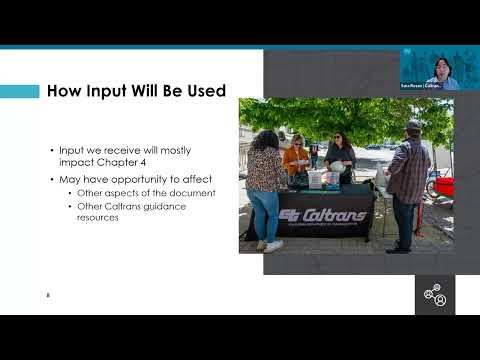
Caltrans staff presented a draft Statewide Community Engagement Playbook and sought feedback from the interagency Transportation Equity Advisory subcommittee during an Aug. 18, 2025, webinar focused on Chapter 4, which lays out recommended engagement methods, partners and equity considerations.
Caltrans staff presented a draft Statewide Community Engagement Playbook and sought feedback from the interagency Transportation Equity Advisory subcommittee during an Aug. 18, 2025, webinar focused on Chapter 4, which lays out recommended engagement methods, partners and equity considerations.
The Playbook aims to help Caltrans staff coordinate internal roles and responsibilities, reduce community confusion and fatigue, and “right‑size” engagement so affected communities can participate meaningfully, Sarah Rosen, of Caltrans’ Advancing Community Engagement office, told the subcommittee.
Members and staff said the draft should (1) define “meaningful engagement” and provide clear expectations for when and how communities can influence decisions, (2) address accessibility beyond ADA compliance, including safety and the digital divide, (3) expand tribal outreach and tribal‑specific surveying, and (4) preserve and publicize successful engagement examples such as open‑freeway community events.
Rosen described the Playbook as one tool among several the agency is developing, including a director’s policy and district playbooks. She said Chapter 4 focuses on how Caltrans teams work with partners, tribes, community‑based organizations, the media and elected officials; recommends virtual, in‑person and hybrid methods; and includes guidance on Title VI nondiscrimination, language access and equity priority communities. “Recognizing that every function has been doing their part of engagement, but how do we work a little bit better internally for a better process when we're engaging with all of our externals,” Rosen said.
Subcommittee members urged more specificity. “It needs to be an ongoing process,” said Leilani, a subcommittee member, arguing that engagement cannot be treated as a one‑off checkbox. Michelle Rousey, also a member, asked the Playbook to include “people with disabilities” alongside “seniors” to avoid excluding disability communities. Andres Ramirez urged more detail on digital outreach and safety: when discussing the media, he asked, “Does that include social media platforms?” and added that hybrid options and other safety measures matter because “people… are really fearful right now.”
Members recommended practical, hands‑on outreach tools. Ramirez described temporary, pop‑up demonstrations and “kit of parts” approaches that let residents experience proposed street changes, and several members cited successful District 11 events that temporarily closed freeway right‑of‑way for Ciclovía‑style outreach and community planning. “Those have been some of the most effective community engagement events,” Randy, a Caltrans staff member moderating the meeting, said, and suggested documenting such case studies so other districts can replicate them when funding allows.
Carrie Akimy Hernandez urged the Playbook to address indigenous stewardship and large tribal events, citing the Klamath dam removal as an example of cross‑agency and tribal partnership work that touches transportation planning. Rosen said Caltrans plans a separate tribal survey and is coordinating with internal tribal liaisons and environmental analysis staff; she invited subcommittee members to review the draft survey.
The group discussed sequencing engagement across project phases. Randy noted that chapter 3 (the project sequence chapter) identifies planning and the Project Initiation Document (PID) as the stages with the most ability for community input, and said Caltrans seeks to ensure public engagement plans are prepared and implemented early in the process so input can shape scope.
Next steps and timelines Rosen provided: the internal working version of the Playbook is targeted for late 2025 (dates have slipped toward December/January), the subcommittee comment form closes Sept. 1, 2025, Caltrans expects to send an external stakeholder survey in or around January 2026, and a final Playbook is planned for spring 2026. Rosen asked members to list statewide organizations that should receive the external survey; the agency plans an executive summary and informational briefings to accompany the survey.
The subcommittee suggested additional stakeholders for the external outreach list, including independent living centers and statewide disability advocacy groups. Rosen said the survey will target statewide organizations (examples she named included AARP, NRDC, California Environmental Justice Alliance and Disability Rights California) and that district‑level playbooks would address more local outreach needs.
The presentation and discussion produced no formal vote. Caltrans staff said comments collected through the Smartsheet form will be synthesized into the final Playbook and other engagement tools.
Reporting and meeting logistics: subcommittee members were reminded the Playbook comment form closes Sept. 1; the Data Implementation subcommittee meets Aug. 19, the Transportation Planning and Program Guidance subcommittee meets Aug. 25, and full committee dates include Sept. 5, Oct. 15 and Dec. 3.
The Playbook presentation and the subcommittee’s detailed suggestions will be incorporated into a revised draft for additional review and an external survey, Caltrans staff said.