Get Full Government Meeting Transcripts, Videos, & Alerts Forever!
Get email alerts on the School Budget topic
No spam. Unsubscribe anytime.
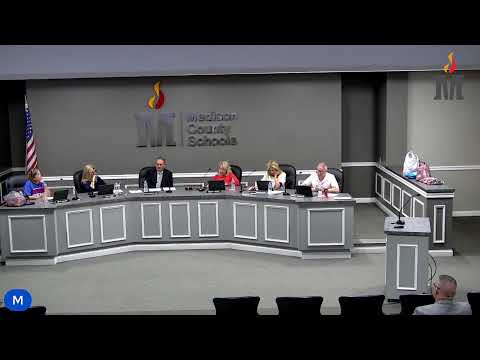
Madison County Board of Education approves balanced 2025–26 working budget after presentation
Summary
At a special meeting Sept. 25, the Madison County Board of Education approved a balanced 2025–26 working budget after a detailed presentation from district finance staff outlining revenue sources, staffing allocations and projected costs.
The Madison County Board of Education on Sept. 25 approved the district's 2025—26 working budget after a presentation by finance staff outlining revenue, major expense categories and staffing allocations.
Finance staff member Mark Woods presented the budget, telling the board the working general fund budget totals $146,817,309.80 and is balanced without drawing on contingency. He said local revenue will make up roughly half of general-fund revenue, the state about 48.5 percent, and federal/discretionary sources make up the remainder.
Woods told board members that salary and fringe benefits make up the largest share of the general fund, at about 78.28 percent, and said the district has kept administrative and business-support spending relatively low to prioritize instructional funding. He described special-education spending as heavily supported by the general fund: the district receives about $2 million in federal special-education dollars while spending roughly $14 million of its own general-fund resources to meet local needs.
Woods reviewed other major cost drivers: student transportation, plant operations and utilities (about $3.15 million for utilities for schools), and the recurring cost of step increases and annual raises. He told the board that a 1 percent increase in general-fund salaries equals roughly $1 million in direct salary costs and additional benefits costs; he estimated steps and a 2 percent increase together add approximately $3 million in recurring costs.
On revenue assumptions, Woods said the district budgets property-tax collections conservatively (97 percent collection rate), increased motor-vehicle tax estimates by $300,000 based on new assessments, and left investment-income projections unchanged following recent Federal Reserve rate cuts. He said SEEK/state base funding assumptions were left flat in the working budget because the district had not yet received final state data needed for final recalculation.
Woods also noted several restricted and one-time items that affected comparisons with the prior year: the end of a federal GEAR UP grant and the final spend-down of ESSER funds contributed to lower totals in some restricted funds compared with last year. He said the district continues to carry obligated purchase orders for buses from fiscal year 2024 and is working with transportation staff to resolve delivery and product-quality issues.
Board members asked clarifying questions about benefits cost assumptions, bus purchase timing and whether the packet would be posted publicly. Woods said some details require context and recommended publishing the material with explanatory notes.
Motion and vote: Board member Miss Brock moved to approve the 2025—26 working budget as presented; Miss Burford seconded. The board voted in favor and the motion carried.
Why it matters: Woods said preserving contingency and pacing one-time federal funding were priorities to avoid long-term deficits. The approved working budget keeps the district's contingency intact and emphasizes instructional spending, according to Woods.
Additional context: Woods thanked previous administrators for fiscal practices that, he said, have contributed to the district's strong bond rating. He said the district continues to monitor revenue and will revisit the working budget during the January adjustment cycle if updated SEEK numbers or other material changes occur.