Get Full Government Meeting Transcripts, Videos, & Alerts Forever!
Get email alerts on the Electrification Policy topic
No spam. Unsubscribe anytime.
Bend advisory board approves letter urging caution on electrification fees, highlights affordability concerns
Summary
The Bend Economic Development Advisory Board voted Oct. 20 to send a letter to Bend City Council on electrification policy options that stresses affordability concerns and asks for more data and education rather than immediate fees.
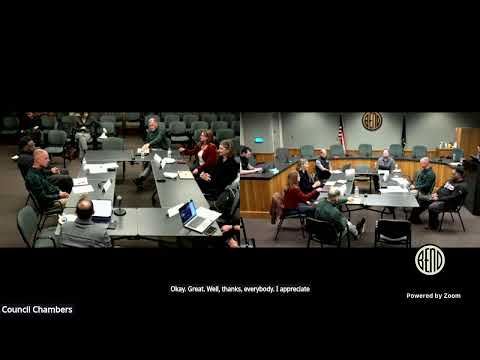
BEND, Ore. — The Bend Economic Development Advisory Board voted Oct. 20 to approve a recommendation letter to the Bend City Council outlining the board’s position on proposed electrification policy options and urging caution about imposing fees that could affect housing affordability.
The board’s motion, read into the record by Jen Lynch, a BDAB member and partner at Portland Seed Fund, moved “to approve the recommendation letter to the Bend City Council on behalf of the Bend Economic Development Advisory Board regarding electrification policy options as presented on 10/20/2025.” The motion carried. The board did not record a roll-call vote in the meeting transcript.
Board members who discussed the letter emphasized concerns about the potential impact of any fee on housing affordability and asked for more education and data on electrification outcomes. Sarah O’Dendahl, interim CEO and government affairs director at the Bend Chamber of Commerce, told the board the chamber supports a message that centers housing affordability: “I think if we can be prospectively looking forward to just really being singularly focused around housing affordability and the cost of electrification as as a fee on housing affordability,” she said, the city can better balance decarbonization with housing goals.
At the Oct. 20 meeting board members noted there has been public engagement on the issue: board members said roughly a dozen people commented at a recent City Council session and that community views were split. A BDAB participant who attended council and other business-leader meetings told the group that public comment at council included young residents and that many speakers on both sides lacked detailed data about likely carbon or cost impacts of a fee.
BDAB members also discussed local and private programs aimed at reducing greenhouse-gas emissions without fees. A participant described two local programs that could reduce reliance on fossil gas: an initiative to produce reduced-carbon pipeline gas that could supply homes, and a heat-pump pilot coordinated with a local utility. The board said it prefers encouraging education and voluntary programs alongside continued evaluation of policy options.
The vote followed a short set of comments and a recommendation that the draft letter, prepared primarily by staff member Cyrus, reflect the board’s prior conversations by stressing affordability, requests for data, and support for voluntary or incentive-based approaches. Board members agreed to submit a joint letter alongside EDCO and the Bend Chamber, per remarks from O’Dendahl.
Votes at a glance: - Motion to approve Sept. 8 meeting minutes — motion carried (no roll-call recorded in transcript). - Motion to approve BDAB recommendation letter to Bend City Council on electrification policy options (as presented 10/20/2025) — moved by Jen Lynch; second not specified in the transcript; outcome: approved.
Why it matters: Bend City Council is considering electrification policy options that could include fees or regulatory changes. BDAB’s letter asks council to weigh housing affordability impacts and to rely more on data and education, signaling the business community’s desire for measured policy steps rather than immediate fees.
What’s next: BDAB submitted the approved letter to council and will continue to monitor council discussion at upcoming sessions. The board also mentioned other related City Council agenda items — including transient room tax and tree-preservation code updates — that could affect local business and development priorities.