
Port Saint Lucie council adopts $869.8 million budget, lowers city millage to 4.975 mills
Get AI-powered insights, summaries, and transcripts
Subscribe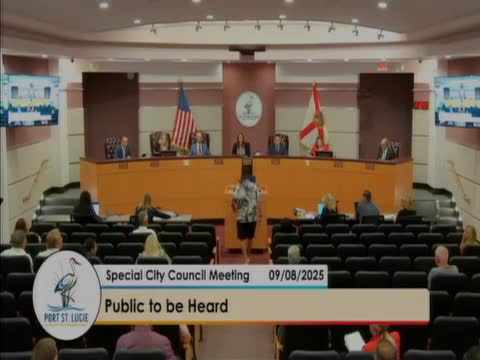
Summary
After a public hearing and public comments urging intergovernmental coordination, the Port Saint Lucie City Council approved an operating millage of 4.6607 mills (total 4.975) and a fiscal 2025–26 budget of $869,811,393, and adopted the city's capital improvement program.
Port Saint Lucie City Council on Monday adopted its fiscal year 2025–26 budget, setting a total ad valorem millage of 4.975 mills and approving a $869,811,393 spending plan that includes $648 million for operations and $222 million for capital projects.
The action came after a public hearing and public comments urging coordination with other taxing authorities, including the county and the fire district, to reduce overall property tax bills. The council voted unanimously to approve ordinance 25-49 (millage), ordinance 25-50 (budget appropriation) and resolution 25-R-47 (capital improvement program).
Caroline Sturgis, director of the Office of Management and Budget and Procurement, summarized the proposal as the council's “commitment to fiscal responsibility, strategic investment, and enhancing the quality of life for our Port Saint Lucie residents.” Sturgis told the council the proposed millage — an operating rate of 4.6607 mills plus 0.3143 mills for voted debt — represents a 0.08-mill decline from the prior year and would mark the 10th consecutive annual reduction in the city's millage rate.
In the presentation, staff said the proposed budget totals $869,811,393 (a 2.2% increase over the adopted budget), with $648,000,000 for operations and $222,000,000 for capital projects. The proposal increases full-time staffing by 65.8 positions to a total of 1,539, and includes funding for 20 new sworn police officers and seven civilian positions. The administration said long-term debt has been reduced about 35% over 16 years to a projected $681,000,000, and the city will maintain a 20% general fund emergency reserve of $35,800,000.
During the public comment period, Joe Lowery, a Port Saint Lucie resident, urged the city to “get together with the fireboard and also the county and let's try to figure out how we can work together and get the millage rate down.” Council members and staff responded by explaining limits on local authority and describing ongoing, multi-year planning and funding constraints. Councilwoman Morgan, who serves on the fire board, explained that the countywide fire district relies primarily on ad valorem property taxes (about 77% of its revenue) and ambulance billing, and that the district is studying an assessment to lower its millage.
Officials also explained a recent $6 increase to the stormwater fee. Councilmembers and staff said the city’s stormwater system includes more than 200 miles of canals, approximately 1,200 miles of swales, more than 6,000 culverts, and other infrastructure; the fee increase is intended to fund projects exposed as needed by recent storms. Councilman Pickett and other members noted stormwater projects and master plans span decades and that growth does not fully pay for infrastructure costs because state law caps local revenue collection.
Councilmembers reiterated that the city controls a relatively small portion of a typical property tax bill — about 21–22 cents of every tax dollar — and that most of a property owner’s bill goes to other taxing authorities, including the school district and the county. Sturgis and the mayor reminded residents that TRIM (Truth in Millage) notices mailed by the property appraiser reflect several taxing authorities and that the county property appraiser determines assessed values and applies state provisions such as the Save Our Homes assessment limitation.
Votes at a glance: the council voted unanimously to approve - Ordinance 25-49: Adopt ad valorem millage for fiscal year 10/01/2025–09/30/2026 (operating 4.6607 mills; voted debt 0.3143; total 4.975). Motion made as recommended by the city manager; second not specified. Outcome: approved (5–0). - Ordinance 25-50: Adopt the fiscal year 2025–26 budget and appropriate $869,811,393. Motion: approve ordinance 25-50. Outcome: approved (5–0). - Resolution 25-R-47: Adopt the capital improvement program for fiscal year 2025–26. Motion: approve resolution 25-R-47. Outcome: approved (5–0).
Council members said the city will continue to publish details, including a tax-tool on the city's website that lets property owners estimate their city portion of the tax bill, and staff offered to provide more detail to residents who asked about specific fees or projects. The council scheduled a second public hearing and final adoption for Sept. 23 at 5:30 p.m., the standard two-hearing process for millage and budget adoption under state law.
The council adjourned after the votes.