
Longwood residents challenge recording ban at police lobby; commission appoints special magistrate for trespass appeals
Get AI-powered insights, summaries, and transcripts
Subscribe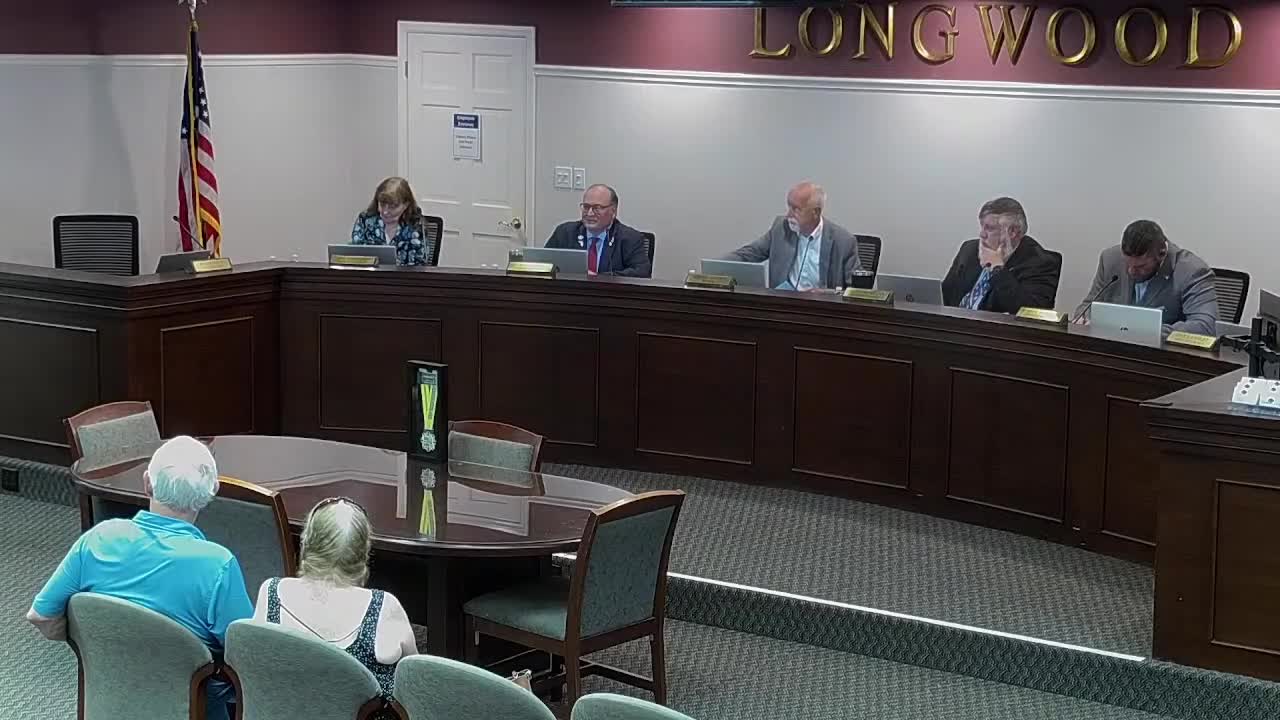
Summary
After extended public comment criticizing a city ordinance that restricts audio/video recording in some public spaces, the Longwood City Commission unanimously appointed Special Magistrate Amy Goodblatt to hear appeals of trespass warnings issued under the ordinance.
The Longwood City Commission on Aug. 18 unanimously approved the appointment of Special Magistrate Amy Goodblatt to hear appeals of trespass warnings issued under Ordinance 23-22-66, a measure that residents say has been used to bar recording in the police department public lobby. The motion to appoint Goodblatt passed on a 5-0 roll call.
Supporters of the magistrate appointment and city staff said the role will provide an independent due-process forum for people who wish to appeal a trespass warning given under the ordinance. "This is due process given to the person that receives a warning under this ordinance," the City Attorney said, describing the magistrate's role as determining whether to uphold or overturn a warning.
Why it matters: the ordinance and its enforcement touch on a frequent point of friction between residents and municipal staff—whether people can record interactions with public servants in limited public forums such as police lobbies. Residents at the meeting said the city ordinance risks chilling constitutionally protected recording of government activity and could convert a civil trespass warning into a criminal matter if the warned person returns.
Public comment drew sustained attention. Matt Armstrong, who identified himself as a journalist, said he was "the guinea pig" and "the first one to be trespassed for recording in the public lobby," describing an incident in which he recorded routine interactions and was subsequently issued a trespass warning. Armstrong told the commission he sought either a magistrate hearing or rescission of the trespass: "The First Amendment is there for a reason. It's the very first one for a reason," he said.
Other speakers echoed that view. Foshin Pink told commissioners, "There's no expectation of privacy in public," and argued the city ordinance improperly restricts citizens recording government activity. Tom Jefferson, citing legal distinctions around forum type, urged commissioners to ensure any time/place/manner restrictions are narrowly tailored and noted that the police station lobby appears to operate as a limited public forum with a private room available for sensitive reports.
Commissioner Kevin McMillan (District 3) said he weighed residents' rights alongside concerns for victims reporting sensitive matters and concluded the restriction constitutes a reasonable time/place/manner limitation: he expressed concern that a person entering the lobby might not know a private room is available and could immediately begin speaking. McMillan moved to appoint the magistrate; the motion was seconded by Deputy Mayor Abby Shoemaker and approved by a 5-0 vote (Mayor Brian D. Sackett, Deputy Mayor Abby Shoemaker, Commissioner Tony Boney, Commissioner Kevin McMillan, Commissioner Chris Morgan).
City staff and the attorney clarified how the appeals process will work: the magistrate will consider whether the trespass warning was properly issued and may uphold or overturn it. The attorney said the magistrate is already under contract to the city and that using the same contract for this duty avoids the difficulty of obtaining an outside magistrate.
The commission did not rescind the ordinance or the trespass warnings at the meeting. Commissioners and staff noted fiscal and operational concerns: one commissioner warned that repeated appeals could have budgetary consequences, and speakers emphasized that the appointment aims to provide an independent forum for fair adjudication.
The commission's decision establishes the appeals pathway; individual appeals under Ordinance 23-22-66 will be scheduled with the magistrate as requests are filed. No change to the ordinance language was adopted at the Aug. 18 meeting.