Council rejects annexation and land‑use change for Luffs Groves property; staff cited utilities, road and buffering concerns
Summary
Port St. Lucie council denied a developer’s request to amend an existing annexation agreement and change 464.5 acres from industrial/commercial to mostly low‑density residential, citing unresolved infrastructure, right‑of‑way and wastewater plant compatibility issues.
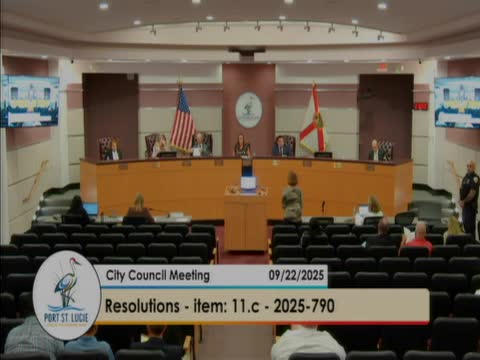
Port St. Lucie — The City Council on Sept. 22 voted to reject a first amendment to an existing annexation agreement and a companion large‑scale comprehensive plan amendment that would have changed the future land use for roughly 464.5 acres owned by Luffs Groves, LLLP and proposed for development by D.R. Horton.
The measures would have converted land previously entitled for industrial and commercial uses to 397.89 acres of low‑density residential, allowed up to 1,350 single‑family residential units where prior entitlements had included 500 multifamily units, and removed industrial entitlements. The council’s denial follows staff recommendations and a prior Planning & Zoning Board recommendation of denial.
City planning staff, utilities staff and council members said the applications raised significant unresolved issues about compatibility with the adjacent Glades Wastewater Treatment Plant, timing and funding for access controls, right‑of‑way widths, and eligibility for mobility fee credits. Bridget Keene, senior planner for the Planning & Zoning Department, told the council the application would reduce industrial land supply in the city and that staff and the applicant remained at an impasse on several annexation agreement terms, including timing for payment of a proposed $150,000 contribution toward a motorized gate system and right‑of‑way conveyance and design standards.
Kevin Matajak, utility systems department, described the Glades facility as designed for potential future expansions (currently permitted for 12 million gallons per day and planned to be expanded). Matajak warned that siting low‑density homes closer to the plant could lead to recurring complaints about noise, odors and operational activity and said past mitigation for neighbors has cost the city “hundreds of thousands” of dollars. He recommended strict mitigation if residential development were to be approved.
Steve Garrett of Lucido & Associates, speaking for the applicant and D.R. Horton, outlined commitments the developer had offered during negotiations: building the first two lanes of McCarty Road and the proposed East‑West connector (Astoria Boulevard) through the property at the developer’s expense; payment of mobility fees; dedication of a 12‑acre park site and a 5‑acre public site (2.5 acres for a fire station pad, 2.5 acres for a city institutional site); and other infrastructure upsizing. Garrett said the developer would not seek mobility‑fee credits for the first two lanes of those internal roads and committed to building initial park improvements up to the park impact fee credit amount.
Council members who commented cited two recurring themes: (1) the city should preserve limited industrial and commercial land for employment and tax base, and (2) verbal commitments must be written into any annexation agreement to be enforceable. Councilwoman K. Morgan and other members said they would not support adding new residential entitlements when the city still has unbuilt residential capacity and when staff and the applicant had not reached agreement in the text of the annexation agreement.
After discussion the council moved to deny the annexation amendment (Resolution 25‑R‑58) and then denied the companion large‑scale comprehensive plan amendment (Ordinance 24‑04) at second reading. Both votes carried; the council recorded the motions as approved following a motion and a second (rollcall tallies were not specified on the record).
The applicant had proposed several buffering and public benefit provisions, including a roughly 250‑foot landscaped buffer adjacent to the wastewater plant, an additional 50‑foot berm, and a 50‑foot landscaping berm along the eastern frontage, but staff and utilities officials said those measures did not resolve operational and long‑term compatibility concerns.
Council members urged continued conversation with the developer, saying the city wanted property owners to be able to use their land but that any change of entitlements must be accompanied by enforceable, written infrastructure commitments and clear protections for city utilities operations.
Next steps: Because both the annexation agreement amendment and the comprehensive plan amendment were denied, applicant representatives and staff indicated they would need to reassess and may return with revised proposals. The council directed staff to continue negotiations where appropriate and to present required documentation in writing if future commitments are made.