
Port St. Lucie council votes to operate BMX track as city-run facility; staff to report in 60 days
Get AI-powered insights, summaries, and transcripts
Subscribe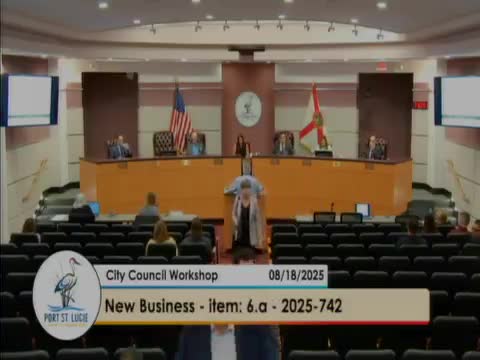
Summary
Council selected a city-run operational model for the new BMX facility at Tradition Regional Park, approved a motion to proceed and asked the city manager for a status update in 60 days; staff outlined staffing, revenue and timelines.
The Port St. Lucie City Council voted to pursue a city-run operational model for the new BMX track at Tradition Regional Park and directed the city manager to report back within 60 days with an operations and staffing plan. The council approved the motion by voice vote; the meeting record shows no roll-call tally in the minutes.
Brad King, director of Parks and Recreation, briefed the council on construction progress, staffing options and conservative revenue projections. King said construction began after a contract approved by council on June 23, 2025, that site work and grading are underway and that the BMX contractor projects a roughly four-month build timeline, weather permitting. Staff said the park’s Phase 1 opening is expected in the first quarter of 2026.
King and staff presented two operating models: a hybrid model with a nonprofit (501(c)(3)) partner running sanctioned USA BMX programming and the city overseeing site maintenance and general public access; and a city-run model (staff-recommended) where the city would manage all operations, programming, staffing, rentals, sponsorships and revenue. Staff recommended the city-run option to retain revenues and control programming standards.
Council members asked detailed questions about staffing levels, fees, security costs, equipment rentals and timelines. Staff estimated the city-run model would require 6–10 full-time-equivalent positions (with some existing budgeted positions usable across park operations) and presented a conservative annual revenue estimate of about $221,000 from bike rentals, clinics, up to 70 local races per year, concessions, merchandise, track rentals and sponsorships. Staff said revenue estimates were conservative and drawn from comparable operations with downward adjustments.
King said the proposed BMX track will be an “all-wheel” hard-surface facility designed for bicycles, scooters, skateboards and adaptive wheelchairs; staff noted the surface requires less ongoing ground maintenance than dirt tracks. Staff described potential community programming including youth clinics, after-school programs and private rentals and said national bodies such as USA BMX and the UCI (Union Cycliste Internationale) had expressed interest in sanctioned events.
Council members discussed funding structure and oversight. Multiple council members favored establishing an enterprise fund for the BMX operation over time rather than relying long-term on the general fund. Vice Mayor Caraballo and other council members asked for a multi-year pro forma, clarity about police/security cost recovery for large events, and contractual terms that would require sanctioning bodies and promoters to cover event-related public-safety costs.
Brad King said the legal department is reviewing a draft USA BMX sanctioning agreement; staff also reported outreach to designers and operators, including Action Sports Design and designer Mike McIntyre, and noted staff and contractors have visited comparable tracks in Okeeheelee (West Palm Beach), Oldsmar and sites in Texas for operational research. Staff said the city has drafted a track-operator job description and would begin recruitment when the council’s direction was clear.
After discussion, a council member moved to proceed with a city-run operation and asked for a city manager update in 60 days; another council member seconded. The mayor called for a voice vote: “All those in favor? Aye.” The motion carried and staff were instructed to return with a business plan, financing options, staffing plan and other details.
What’s next: Staff will prepare a staffing plan, refine revenue estimates and return to council with an operations plan, legal agreements (including the USA BMX sanctioning agreement) and recommended fee structure. Staff estimated that some park components might open earlier, but several council members cautioned that a conservative timeline and staged “soft-opening” approach could be necessary to avoid early operational shortfalls.