
Port St. Lucie removes Northeast Bypass from 2025 mobility plan; council seeks further input on fee changes
Get AI-powered insights, summaries, and transcripts
Subscribe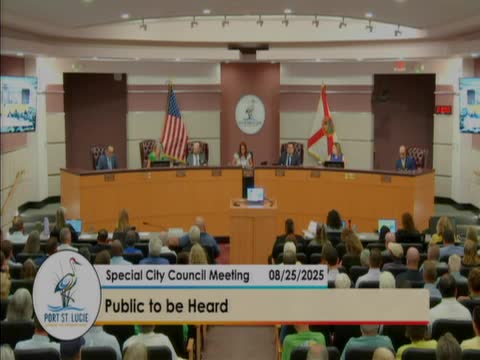
Summary
At a special workshop Aug. 25, the Port St. Lucie City Council removed the proposed Northeast Bypass from the 2025 Mobility Plan and directed staff to refine the plan and fee schedule, including options for phasing and how developer-constructed roads and county roads are treated.
Port St. Lucie City Council members removed the proposed Northeast Bypass from the city's long-range mobility plan during a public workshop on Aug. 25 and asked staff to return with refined project lists and phased fee options for further public and stakeholder review.
The council voted to delete the bypass from the 2040'2050 corridor list after extended presentations by city staff and the plan consultant, Jonathan Paul of New Urban Concepts, and public comment raising neighborhood, environmental and property-value concerns. The motion passed by voice vote with council members indicating the motion carried.
The workshop was intended to give council policy direction so staff can finalize a technical report and draft a mobility-fee schedule. Paul told the council the mobility plan identifies corridors and multimodal projects citywide and provides the project basis required under state law for a developer-paid mobility fee. He said the plan as drafted included scenarios that (a) include or exclude developer-required first-two-lane roadways from the fee calculation, and (b) include or phase in county-owned roads now governed by an interlocal agreement (ILA) that expires in 2027.
Why it matters: the mobility fee is a one-time impact assessment charged on new development to pay for transportation improvements tied to growth. Changes to the plan'for example whether the plan treats the first two lanes of certain "developer access" roads as a developer obligation or as fee-funded city infrastructure'drive large swings in the calculated fee. The draft showed differences of roughly $9,000 to $18,000 per typical single-family house depending on which scenario is used and what corridors remain in the plan.
Council discussion focused on three distinct policy choices: whether to include developer-access first-two-lane costs in the fee, whether to include county roads now covered by the ILA, and whether to create a separate West assessment/benefit area for future west-of-95 growth. Council members and city staff repeatedly emphasized this is a workshop for direction, not a final vote on an ordinance. The mayor and several council members said they want more detailed corridor studies before committing to major corridors; others said the plan has already brought needed transparency and public engagement.
The council gave these working directions during the meeting: exclude developer-required first-two-lane site-access roads from the mobility-fee base (but continue to process developer credit requests on a case-by-case basis as required by law); do not include county-owned roads in the fee now (the ILA remains the mechanism for county projects but staff should plan for the ILA's expiration in 2027); create or maintain a West assessment/benefit area to account for development pressures west of Range Line; and phase in any adopted fee increase over multiple years. Council members signaled preference for a multi-year (up to four-year) phase-in to reduce near-term shock to housing affordability and to allow further study.
Public comment at the meeting stressed affordability concerns and local neighborhood impacts. St. Lucie County public works director Patrick Diane told the council the county'city interlocal has been the operative method for coordinating county road projects and urged caution about moving county roads into a municipal fee without agreement. Developers and local real-estate speakers urged careful treatment of credit rules and warned that sharp, immediate fee increases could slow new-home sales.
What happens next: staff and the consultant will produce a revised technical report and fee schedules reflecting council direction, post the materials online, hold stakeholder workshops (next scheduled Sept. 9) and return to council with proposed ordinance language and fiscal analysis. The council specifically asked staff to identify corridor- and area-specific studies (PD&E or corridor studies) to reduce uncertainty for high-impact items before finalizing fee figures.
Quotes (from the transcript): "This is not a workshop about extraordinary circumstances... this is a workshop about what projects the city council desires to include in the mobility plan and how to effectuate the fee if the new plan is adopted," consultant Mary Savage Dunham said during the presentation.
Ending: The removal of the Northeast Bypass narrows the immediate long-range corridor list, but council members and staff agreed the mobility plan remains a living document. The council directed staff to return with refined maps, phased fee options and recommended studies for high-priority corridors before a first reading of any implementing ordinance.