
Palm Bay staff present proposed FY26 budget prioritizing public safety, roads and fleet replacement
Get AI-powered insights, summaries, and transcripts
Subscribe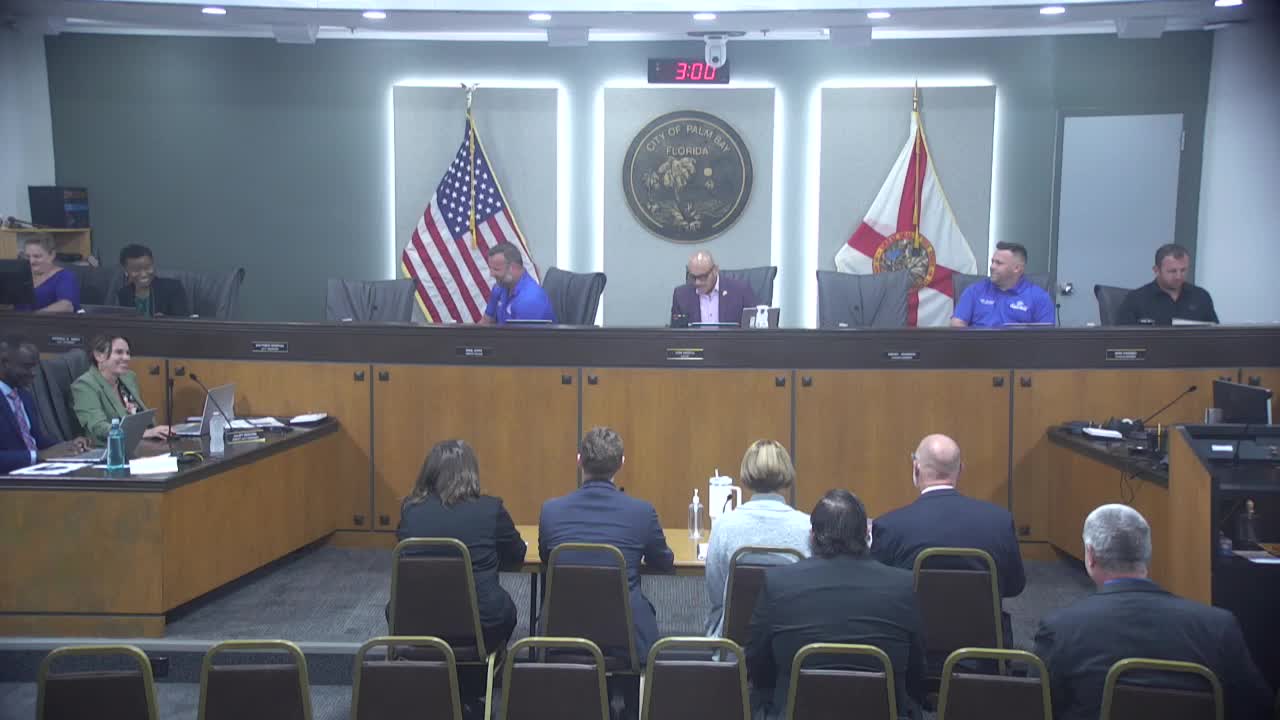
Summary
City staff presented a proposed FY26 budget that preserves the current millage, emphasizes police and fire spending, adds road maintenance funding and creates a fleet replacement reserve; staff set budget adoption public hearings for Sept. 8 and Sept. 24.
City staff presented the City of Palm Bay’s proposed fiscal year 2026 budget at a council workshop, outlining a $155 million general fund proposal and broader capital and enterprise spending that staff said is designed to prioritize public safety, road maintenance and long-term fiscal stability.
City Manager Matthew Morton opened the presentation and turned the discussion over to finance staff. Angelica Collins, assistant finance director, said the proposed budget is built on the current ad valorem tax rate of 6.7339 mills and does not increase the millage. “My name is Angelica Collins. I'm the assistant finance director, and I oversee budget and capital and asset management,” Collins told council. Jessica Hinchman, budget program administrator, and Shane Bird, budget analyst, joined Collins in the detailed review. Capital program details were presented by Sean Spillers, capital asset program administrator.
The nut graf: staff presented a budget that they described as maintaining core services while seeding reserves and targeted capital investments. The proposed general fund totals about $155 million, with roughly $85 million earmarked for police and fire combined and $55.78 million in debt-service obligations. Staff also proposed dedicated road maintenance transfers and new reserves to reduce reliance on midyear budget amendments.
Most important figures and priorities: staff said general fund revenue is projected near $155 million, about $67.3 million of which would come from property taxes at the current 6.7339 rate. Public safety represents the largest share of general fund spending (about $85 million). Debt service is listed at $55,780,000. Council was told staff plan to continue a $3.25 million transfer to road maintenance plus an additional $1.25 million from local option gas tax for road-related work. The proposal also includes a $600,000 emergency fleet replacement reserve and a $1 million public-safety land/reserve set‑aside for future station or headquarters needs. Staff built a $20.2 million general fund balance into the FY26 proposal to reduce frequent midyear budget amendment requests.
Staff stressed that one-time federal stimulus dollars are declining and that recurring revenues and reserves must cover future capital needs. Collins and Hinchman explained that some year‑over‑year increases reflect project carry‑forwards: the presentation combines new FY26 funding with roughly $191 million in carry-forward encumbrances that staff said are already earmarked for projects (largely utility and stormwater work). Spillers summarized capital funding as roughly $104 million carried forward from existing projects plus about $56 million in proposed additions, for a combined capital program that staff said would total about $160 million for FY26 across all funds. Utilities and GO‑road bond projects make up the largest shares of that total, Spillers said.
Tax rate and taxpayer impact: Collins said the budget is built on maintaining the 6.7339 mill rate; staff also illustrated the effect of the city’s 3% charter cap and homestead protections. Using a $300,000 hypothetical taxable value, staff calculated the city portion of a property tax bill would rise by about $42.71 at the maintained rate while the city’s debt‑service levy would fall by about $30.17, producing a net city impact of about $12.54 annually in the example cited on council slides. Collins noted that new construction added to the roll remains exempt from the 3% cap for the first year and reported about $619 million in new taxable value added for FY26 (down from $691 million the prior year).
Public safety purchases and tradeoffs: councilors pressed staff on potential cuts if they were to adopt the rollback (3% cap) rate instead of retaining the current rate. Collins said moving to the cap (6.3658 mills in staff examples) would require roughly $3.637 million in reductions. Morton said, preliminarily, that cuts would likely involve deferring the outright purchase of two of four proposed fire engines (i.e., buy two now, defer two) and trimming operational items rather than eliminating the newly proposed reserves. Morton said he did not recommend cutting the contingency or the public‑safety land/reserve set‑asides. Councilman Hammer said he would not support losing fire trucks and sought assurance the funding would be preserved; Morton noted there is a preliminary financing letter that would allow multi‑year payments for apparatus if council chose that option.
Capital and equipment discussion: council and staff discussed a proposed purchase of a specialized walking excavator (referred to in the presentation as a “Kaiser” or “walking excavator”). Kevin Brinkley, the city’s new public works director (introduced at the meeting), described the machine’s capabilities and cautioned it is not inexpensive to buy or maintain; he noted some neighboring jurisdictions operate similar equipment. Brinkley and Spillers said the machine could replace outsourced canal/ditch work over time; initial cost estimates cited in the presentation were roughly $600,000–$700,000 compared with about $500,000 a year currently paid to contractors for that work. Council asked that staff return with a proof‑of‑concept, local vendor comparison and operational plan before approving purchase, and City Manager Morton agreed to bring more analysis back to council prior to procurement.
Other changes and department impacts: staff described personnel and pension cost drivers, including anticipated contract increases for IAFF (fire) and FOP (police) units, a 5% cost‑of‑living projection for general employees, and an actuarial pension contribution increase they estimated at roughly $2.6 million for FY26. Personnel services remain the largest general‑fund expense category, representing more than 70% of the proposed general fund budget. Staff also described program‑level shifts such as moving smaller recurring capital needs into operating programs to create predictable annual replacement budgets (for example, valve and hydrant replacements in utilities).
Process, timeline and public engagement: staff said the required truth‑in‑millage and public hearing schedules were adjusted after a county calendar conflict; the first public hearing to adopt the budget was scheduled by staff for Monday, Sept. 8 at 6 p.m., with the second public hearing on Wednesday, Sept. 24 at 6 p.m. Staff urged council direction to present a proposed millage at adoption hearings and to return with any policy changes during the upcoming months.
Reception and next steps: multiple council members thanked finance and departmental staff for the work. Some members expressed support for maintaining the current millage to preserve public safety purchases; others asked staff to return with refined analyses and requested that the new public works director and capital staff prepare additional proof‑of‑concept details (for the Kaiser/walking excavator) and options for phasing apparatus purchases if needed.
Ending: staff emphasized that the FY26 proposal seeks to balance immediate public‑safety needs, ongoing capital projects and fiscal prudence; council directed staff to refine materials and return with targeted analyses before formal adoption in September.