
Council adopts public‑hearing time limits but removes proposed speaker‑card requirement after concerns about optics
Get AI-powered insights, summaries, and transcripts
Subscribe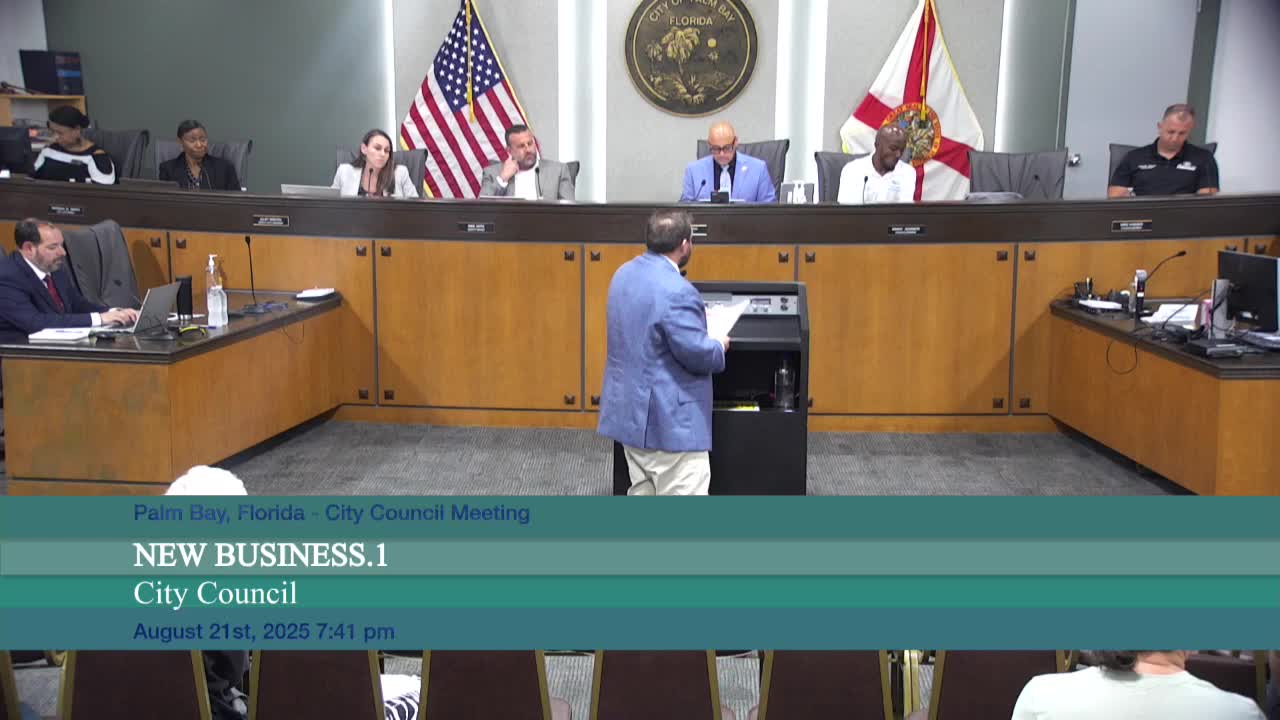
Summary
City Council voted 4‑1 to adopt new time limits for public‑hearing speakers but, at the request of council members and following public comment, amended the ordinance to remove a requirement that speakers submit a speaker card before addressing public hearings.
Palm Bay’s City Council adopted an ordinance to add uniform time limits for public‑hearing speakers and simultaneously removed a proposed requirement that speakers submit speaker cards for all public hearings.
Deputy Mayor Jaffe introduced the measure, saying he wanted a clock on public hearings to prevent individuals from monopolizing unusually long speaking time. City Clerk Mrs. Jones explained the change clarifies time limits for public hearings that previously applied only to quasi‑judicial and land‑development proceedings.
During public comment several residents expressed concern that requiring speaker cards could create a perception of limiting public access. Ruth Caulfield said the proposed language risked silencing people who are “aggrieved or adversely affected.” The city attorney clarified that parties who are formally aggrieved or are parties to a land‑development hearing are not affected by the change to general public‑hearing time limits; the new rule applies to non‑party public commenters in non‑quasi‑judicial hearings.
After discussion, Deputy Mayor Jaffe moved to adopt the ordinance with the exception of the proposed speaker‑card requirement; the motion passed 4‑1. Councilman Johnson said the change was sensible but expressed concern about optics and timing; he voted against the final motion.
Why it matters: the ordinance creates predictable time limits for public‑hearing comment and aims to make meetings more efficient, while council’s amendment preserves the longstanding ability for members of the public to step to the podium without prior paperwork in most non‑adjudicatory hearings.
The ordinance’s effective procedures will be published by the clerk’s office and applied at future public hearings; aggrieved parties in land‑development matters remain governed by existing, separate time rules.