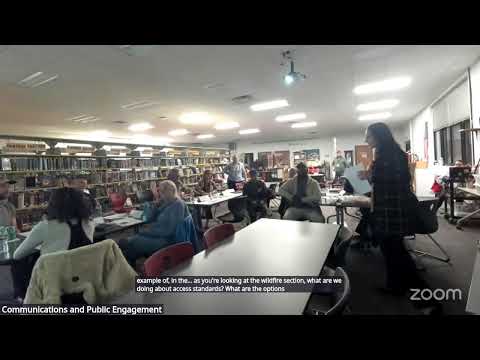
Planners introduce existing-conditions and hazard assessment studies; committee given homework to review
Loading...
Summary
Staff introduced a draft existing-conditions study and a hazard vulnerability assessment that will inform policy recommendations; committee members were asked to review the documents and note potential policies or actions.
Planning staff introduced two draft studies — an existing-conditions study and a hazard-vulnerability assessment — and asked committee members to review them before the next meeting and note possible policy or action ideas.
The planning staff described the existing-conditions study as a snapshot compiled from census, GIS and other available local data. “This document…doesn’t make any recommendations. This is gonna be an appendix to the plan, and it's just a snapshot in time of the existing conditions of the community,” a planning staff member said. The draft will be distributed to committee members by email; staff said the draft is not complete and that some data (for example, FEMA datasets) are still being collected.
The hazard vulnerability assessment focuses on future exposure and sensitivity to hazards, staff said. It uses several data sources and ratings (including a dataset prepared by Land of Sky Regional Council’s ExcelAdapt program) to evaluate exposure to flood, tree-fall, and wildfire hazards and to rate adaptive capacity at structure and neighborhood scales. The assessment will identify which structures or roads are most at risk and where adaptive capacity differs between otherwise similar buildings.
A Forest Service–affiliated meeting participant raised wildfire concerns and the role of downed trees from recent storms. “We’re incredibly worried about it because of the so a lot of that downed debris…within the next 5 to 10 years when all those big trees start drying out,” the participant said, noting that fallen timber can make fire access roads impassable. Staff acknowledged some hazard layers are pre-Hurricane Helene and that some datasets are not yet updated.
Why it matters: staff said the hazard work will allow the county to identify exposure and adaptive-capacity differences so future policies and actions can be targeted where risk and vulnerability intersect.
Schedule and homework
Staff said they will email the draft studies to the committee (and provide a high-level overview for members short on time) and that the next meeting would be November 10 after skipping an October 27 meeting date. Committee members were asked to read the studies and note potential policies or actions they think the county should consider — for example, changes to access standards for wildfire-prone areas — and to prepare questions for upcoming design workshops. Staff said the existing-conditions study will be an appendix and that policy recommendations will be developed in the next phase.
Ending
The staff emphasized the studies are evolving and that members will be expected to review the materials and help select policies and actions in the new year.