
Commission gives staff consensus to prioritize pay-as-you-go financing for new transfer station
Get AI-powered insights, summaries, and transcripts
Subscribe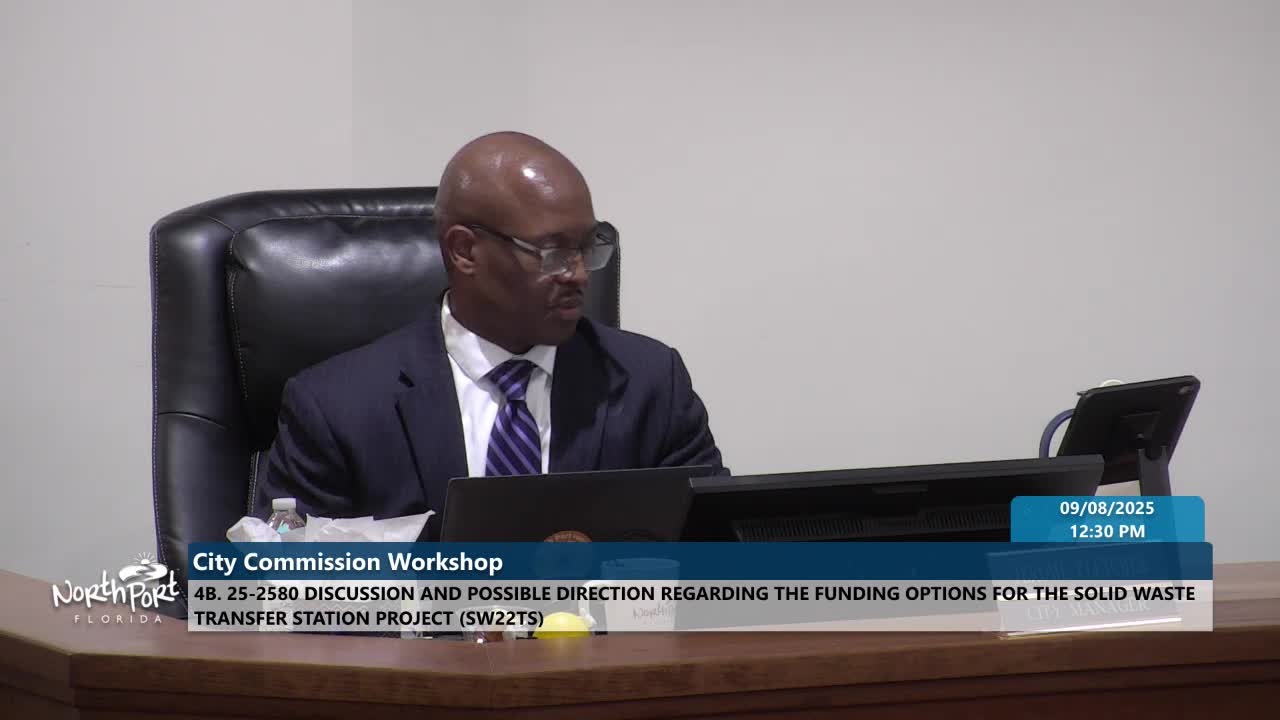
Summary
After lengthy discussion of cost, timing and options, commissioners directed staff to prioritize non-ad valorem pay-as-you-go assessments for a solid-waste transfer station and to forego public-private partnership models, per consensus.
The City Commission directed staff by consensus Sept. 8 to prioritize a pay-as-you-go financing strategy using non-ad valorem assessments to fund a planned solid-waste transfer station and to discontinue further pursuit of a public-private partnership (P3) proposal.
Public works staff and financial advisers outlined three broad funding approaches for the transfer station—self-funded pay-as-you-go assessments, certificates of participation (COPS), and a P3 arrangement—showing tradeoffs between speed, long-term cost and control. City staff recommended Option 1A: a one-year non-ad valorem assessment that would bill developed and vacant residential parcels a one-time fee of $160 and commercial parcels $300 to raise roughly $11.8 million to construct the facility.
“Pay as you go avoids interest and debt, retains local control and is most cost effective over the long term,” Public Works staff said during the presentation. The staff brief showed the city would spend more over time if it delayed the project: cumulative operating and replacement costs without a transfer station were estimated at roughly $16 million through 2030 versus about $3.5 million with the transfer station over the same period.
Commissioners debated timing and fairness. Commissioner Duval said he favored a one-year assessment and suggested the city consider rebates or lower future rates when revenue from other jurisdictions (for example Charlotte County) begins to flow into the new facility. Commissioner Fletcher, who also voiced support for Option 1A, asked whether the city could start construction sooner; staff said designs will be 100% and shovel-ready if assessments proceed on the proposed schedule, but the construction contract could not be partially awarded before funds are collected. Several commissioners expressed concern about placing the entire upfront cost on current property owners; staff noted the referendum to borrow for the project had previously failed, leaving pay-as-you-go as the feasible path.
Following discussion the commission reached consensus: prioritize non-ad valorem assessments (pay-as-you-go), consider two variants (one-year or split two-year assessment), and reject P3 and the certificate-of-participation route as primary paths. The direction gives staff a funding pathway to pursue methodology, public-noticing and implementation steps the city will need to enact assessments and return with final budgets and methodology for voter review or public hearings.
Ending: Staff will proceed with assessment methodology work and return with the assessment structure, notice and schedule for implementation as part of FY2027 planning. No binding rate adoption took place at the Sept. 8 workshop; the commission’s direction was a consensus policy input to staff.