
Zephyrhills approves stormwater utility study, directs staff to pursue property-tax billing
Get AI-powered insights, summaries, and transcripts
Subscribe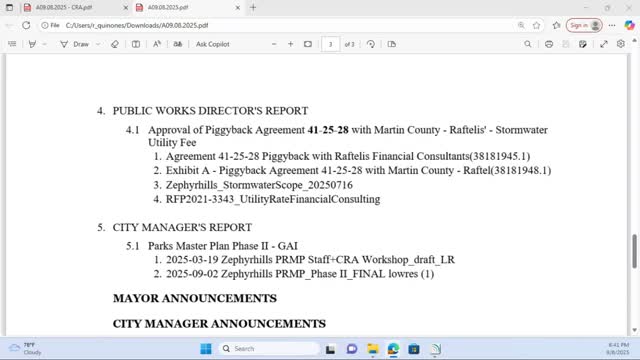
Summary
Council approved a scope and piggyback hire of Raftelis to design a stormwater utility and asked staff to pursue collection via the county property tax roll rather than monthly utility bills.
The Zephyrhills City Council on Sept. 8 authorized a consultant engagement to create a stormwater utility and directed staff to pursue billing the fee on the property-tax roll rather than monthly utility bills. Council approved using a piggyback procurement to hire Raftelis (spelled RAFTELIS in the record) to analyze existing stormwater operations, build a rate model and perform community engagement.
Why it matters A stormwater utility creates a dedicated revenue stream for stormwater management, capital improvements and ongoing maintenance. Public Works staff told council the city's stormwater program currently competes for general-fund dollars; a utility would provide a dedicated funding source for long-deferred capital needs identified after the heavy storms last year.
What council approved - The scope: staff and the consultant will document the scale of current stormwater work, identify capital and operational gaps, develop rate and billing options, and prepare an ordinance and implementation materials. The schedule provided to council aimed to complete the analysis by April, with bills issued later depending on the chosen billing mechanism. Jennifer Tavantes, vice president at Raftelis, presented the scope and timeline and said the project will run two parallel tracks: (1) documenting program needs and costs and (2) determining billing and customer-notification mechanics. - Billing approach: staff outlined two collection options — adding a line item to monthly utility bills or placing the charge on the county property-tax roll. Multiple council members favored the tax-roll option, citing fairness (property owners without a water account would still be charged appropriately) and anticipated public reaction if the fee appeared on the monthly utility bill. Council instructed staff to pursue the tax-roll option and to work with county officials on the mechanics.
Key clarifications and caveats - Timing and schedule: Raftelis said the analytical portion would conclude by April and that billing could follow later; staff said tax-collector billing would require additional coordination and a trim/notice schedule tied to county tax cycles. - Collection cost: staff noted the county tax collection agent will charge a percentage fee to collect the charge on the tax bill. The exact fee was discussed in the meeting but not finalized in the record; staff said they would firm up the percentage and provide it in follow-up. - Equity considerations: Council members argued a property-tax mechanism is more equitable because some properties may not receive water service but still create stormwater impacts.
Quotes "I'm here to talk to you about the project to implement a new stormwater utility," Jennifer Tavantes said in opening the consultant's presentation.
Next steps Staff will finalize the engagement documents and work with the consultant to develop a rate model, draft the necessary ordinance language and prepare public outreach materials. Council asked staff to return with a final report and a recommended ordinance for formal adoption once the analysis and stakeholder engagement are complete.