Get Full Government Meeting Transcripts, Videos, & Alerts Forever!
Get email alerts on the Court Finance topic
No spam. Unsubscribe anytime.
Lake County Board creates Circuit Court Clerk ‘Operations and Administration’ fund after amendment
Summary
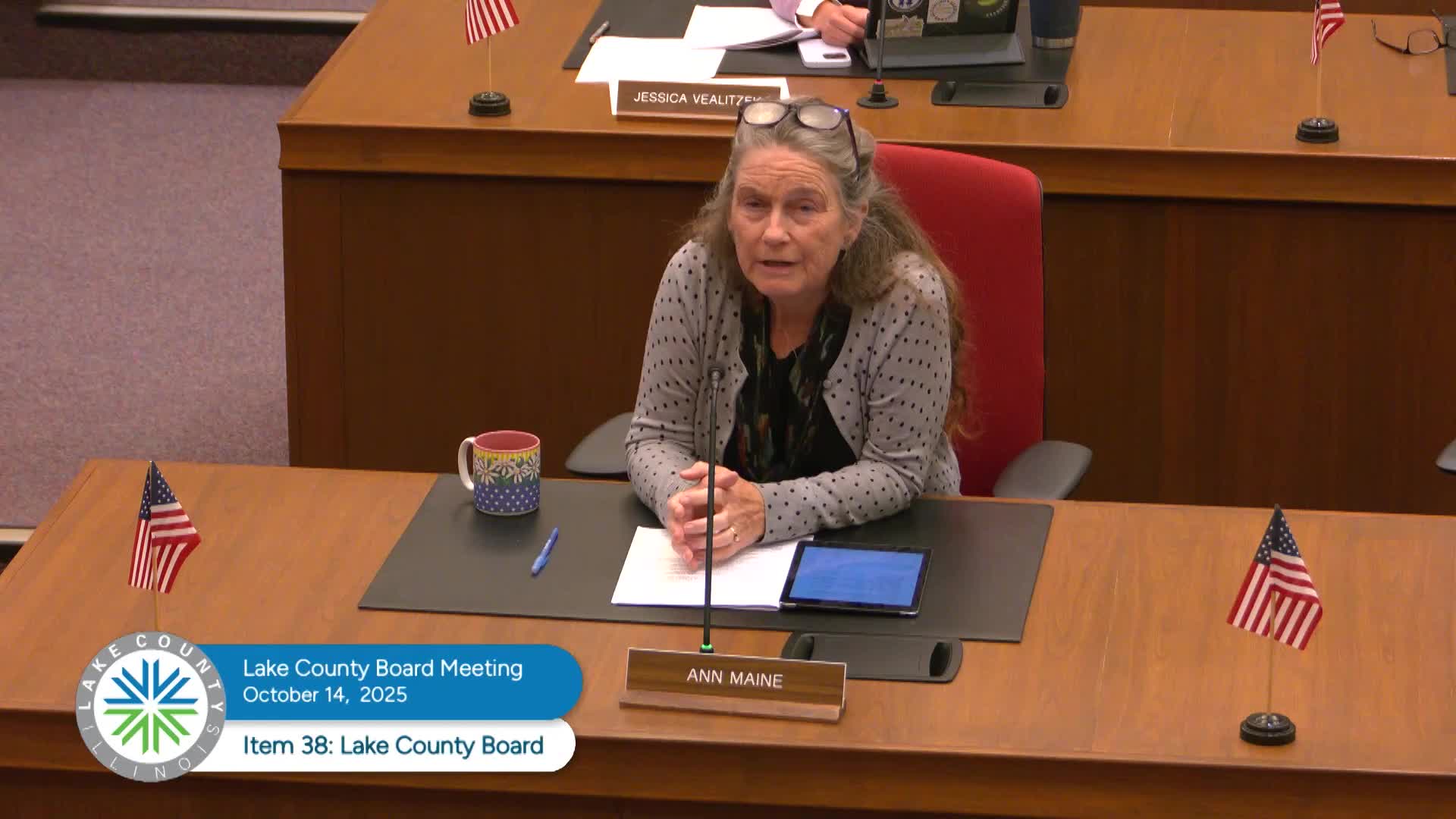
The County Board voted Oct. 14 to create a Circuit Court Clerk Operations and Administration Fund and added language requiring that specified criminal fees be remitted monthly to the county treasurer before deposit into the fund; the change followed discussion with the state’s attorney and the circuit clerk.
The Lake County Board on Oct. 14 voted to create a new Circuit Court Clerk Operations and Administration Fund and approved amended language clarifying that certain fees collected under state statute be remitted monthly to the county treasurer, who will deposit the money into the new fund.
The board approved an amendment requiring that the Circuit Court Clerk remit funds collected under 705 ILCS 130/5‑15 (felony fees) monthly to the county treasurer, who shall deposit the money identified for the fund. That amendment — offered to clarify the flow of criminal-fee revenue and to align the county's practice with state statute — passed on a roll-call vote. The entire resolution as amended then passed on a recorded vote (15 ayes, 3 abstentions).
Why it matters: The question before the board centered on transparency and the mechanics for handling fines and fees collected by the Circuit Court Clerk's office. Board members and the clerk discussed whether money should be tracked in a county fund, whether that fund must have a separate bank account, and how civil and criminal fee streams differ under state law. The clerk said the office had opened a bank account in 2024 and that roughly $500,000 was currently in it; she said the office had sought an opinion from the Illinois Attorney General to resolve statutory ambiguities.
What the board decided: The board adopted language clarifying that, consistent with state statute, funds collected under 705 ILCS 130/5‑15 are remitted monthly to the county treasurer, who will deposit the money identified for the Circuit Court Clerk Operations and Administration Fund. The board rejected a motion to refer the item back to the Finance & Administrative Committee; that motion failed and the board proceeded to consider and adopt an amendment agreed with the state's attorney's office.
Key points from the meeting - Circuit Court Clerk (on the record): said the clerk's office opened a bank account in 2024 and that "there's about half a million dollars in there right now." She said the clerk has sought an Attorney General opinion because the statutes are not fully consistent on treatment of civil vs. criminal fees. - State's Attorney Eric Reinhardt: told the board the office had reviewed the draft language and that the statutes require criminal fees to be remitted to the treasurer before deposit into the clerk's fund; he said the state's attorney's office considered the language legally acceptable. - Concern among some board members: whether the fund is only an accounting mechanism or also implies a separate bank account, and whether county administration and the treasurer had been adequately involved in drafting implementation steps.
Implementation and follow-up: The amended resolution requires the treasurer to receive remitted criminal-fee dollars and deposit them into the newly created fund. County administration and the state's attorney's office will coordinate details on accounting and reporting; the clerk indicated she had provided bank statements and would cooperate with audits. The clerk also noted that civil-fee streams are treated differently under current law and that a formal AG opinion is being sought to confirm statutory interpretation.
Ending: The board adopted the fund and the amendment to specify the post‑collection flow of criminal fees, seeking to increase transparency ahead of upcoming budget deliberations.