
Kane County executive committee approves most riverboat fund requests after heated debate; chair breaks tie
Get AI-powered insights, summaries, and transcripts
Subscribe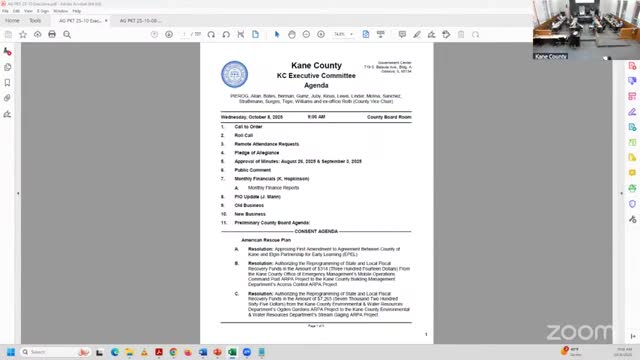
Summary
After public pleas and hours of debate, the executive committee approved the majority of the county's Grand Victoria riverboat allocations for 2026, including $4.06 million for internal projects and roughly $832,000 for external grants, following a narrowly divided vote that required the committee chair’s tie-breaking vote.
The Kane County Executive Committee approved most of the county’s proposed 2026 allocations from the Grand Victoria riverboat fund on Oct. 8 after a contentious public-comment period and lengthy committee debate. The committee approved $4,063,602 for internal county projects and $832,006.87 for external grants, a combined total of about $4.896 million. The final tally was tightly divided and required the committee chair to cast a deciding vote.
The committee’s deliberations followed public comments from the county’s elected prosecutor and several residents. State’s Attorney Jamie Mosser told the committee that recent recommended cuts from riverboat funding would force reductions in her office and remove roughly $2.2 million in requested support, on top of earlier required reductions. Mosser said the recommended riverboat allocations would “result in firing close to 40 employees” if the funding she requested is not restored. She urged the committee to reconsider allocations to prioritize public safety programs supported historically by riverboat funds.
Adam Pauley, a resident who spoke during public comment, urged the committee to hold elected officials to high standards and pressed for a censure of a named board member for unrelated remarks. Brian Anderson of Sugar Grove questioned the absence of a budget attachment in the meeting packet and also criticized planned expenditures such as a county strategic plan and a paid internship.
Committee members debated several options before voting. The riverboat committee had presented a budget that: (a) limited use to funds actually expected in 2026 rather than dipping into the riverboat reserve; (b) kept a roughly 80/20 split between internal county projects and external grants; and (c) held certain offices’ allocations to their 2025 levels rather than approving requested year‑over‑year increases. Committee member Chris Caius (mover) explained the recommendation was intended to preserve a $4.5 million “soft landing” reserve and to restrict riverboat spending primarily to one‑time projects (education, economic development and environment) rather than ongoing payroll costs.
A motion to send the proposed allocations back to the Riverboat Committee for further revision failed on a roll call vote. The committee then considered the riverboat panel’s recommended allocations as presented. After a closely divided vote, the chair cast the tie-breaking vote to approve the committee recommendation. The approved internal allocations include a mix of infrastructure and one-time county projects; approved external grants will fund eligible community requests at the levels shown in the committee’s packet.
Committee members and staff repeatedly noted the broader budget implications. Several members urged that programs currently funded through riverboat revenue that are ongoing and mission‑critical (for example, parts of the State’s Attorney’s victim services and domestic‑violence work) should be moved into the general fund in future budget cycles so they are not reliant on uncertain gaming revenue.
The debate exposed the tension between preserving a reserve to protect against long‑term revenue declines and responding to near‑term program requests from county departments and community partners. Several members said they favored honoring the riverboat committee’s discipline of not using reserves and of prioritizing one‑time projects, while others pushed to fund all requests using a portion of the reserve.
What comes next: The allocations approved by the committee will be forwarded to the full county board as part of the 2026 budget process. Several board members said they expect additional discussion at the full board before final county budget adoption.