Get Full Government Meeting Transcripts, Videos, & Alerts Forever!
Get email alerts on the Historic Preservation Public Art topic
No spam. Unsubscribe anytime.
San Luis commission recommends historic preservation and public art plan to city council
Summary
The San Luis Economic Development Commission on Oct. 1 voted to recommend a draft historic preservation and public art plan to the City Council, after a presentation by consultants Designing Local and discussion about next steps.
The San Luis Economic Development Commission on Oct. 1 voted to recommend a draft historic preservation and public art plan to the City Council, after a presentation by consultants Designing Local and discussion about next steps.
The plan, prepared by Designing Local with local staff and community input, lays out a two-part approach: a cultural-historical survey to identify historic resources and potential district boundaries, and a public-art and placemaking strategy that proposes quick-start, low-cost projects as well as larger, integrated infrastructure pieces. The commission approved a motion recommending the plan be forwarded to council after city staff changes are incorporated; the motion passed by voice vote.
Designing Local said its work combined in-person engagement at the community event Arte y La Calle, a virtual survey and an initial, high-level historic survey focused on building age. The consultants identified clusters of properties—largely along Main Street and Cesar Chavez Street near the international port of entry—that include concentrations of buildings older than 50 years, the typical threshold used to screen for National Register eligibility. Designing Local recommended two immediate preservation tools: a façade-improvement program (matching grants or small awards to improve storefronts or residential exteriors) and targeted nominations for the National Register of Historic Places to enable tax-credit eligibility.
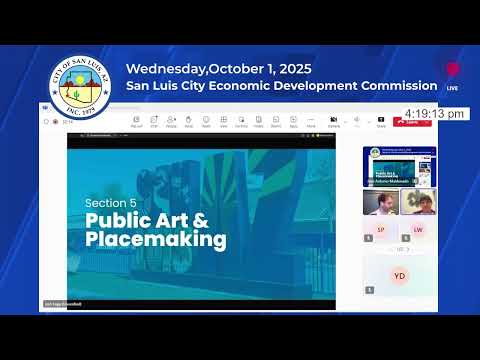
"San Luis's vision is for public art to be a vibrant reflection of our local cultures, celebrating our rich Hispanic and agricultural heritage while embodying the shared spirit between the U.S. and Mexico," consultant Josh (Designing Local) told the commission. The public-art portion of the plan groups project ideas by typology and implementation complexity, and highlights lower-cost, quick-start projects such as murals, painted fire hydrants and utility-box artwork; medium-term projects like artist-designed benches and integrated streetscape treatments; and temporary digital interventions such as projection mapping to animate historic façades during festivals.
City staff and consultants said the plan also includes a draft public-art policy intended to guide procurement, site selection, artist agreements and maintenance responsibilities. Armando Esparza, San Luis director of economic development, told commissioners the city intends to formalize governance within the Economic Development Commission and create a subcommittee to review proposals, maintain an on-call artist roster and run an annual call for projects tied to available funding.
Esparza described three initial funding streams the department expects to pursue: a council budget allocation, public-private donations or sponsorships, and outside grants. He said staff expect to submit a second draft of the plan to city staff in early November, with the goal of taking the revised plan to council in early 2026; public-art programming would begin the following fiscal year (June–July). "The public art program formalizing what we already do is going to be probably the easiest policy action that we can take," Esparza said.
Commission discussion touched on incentives to spur private-property renovation in downtown, the limits of National Register listing (consultants noted listing does not in itself prevent demolition but does enable access to historic tax credits), and practical considerations for art integrated with infrastructure (coordination with public works and maintenance obligations). Consultant Megan (Designing Local) said some community responses showed interest in functional art and light installations in addition to murals, and recommended that the city consider matching-grant approaches to encourage private property owners to participate.
After discussion, a commissioner made a motion "to recommend the historic preservation and public art plan for the City Council recommendation and approval after commission staff updates are incorporated." Another commissioner seconded the motion and the commission approved it by voice vote.
Next steps outlined in the meeting record include incorporating city staff feedback into a second draft to be circulated to staff in early November, preparing materials for council consideration in early 2026, and forming the proposed commission subcommittee to administer initial public-art calls and artist rosters. The plan document and the policy appendix will provide guidance on procurement, maintenance expectations, funding options and technical steps for larger infrastructure-integrated artworks.